MicroStrategy and Bitcoin at Risk: Is Saylor Facing Another Bankruptcy?
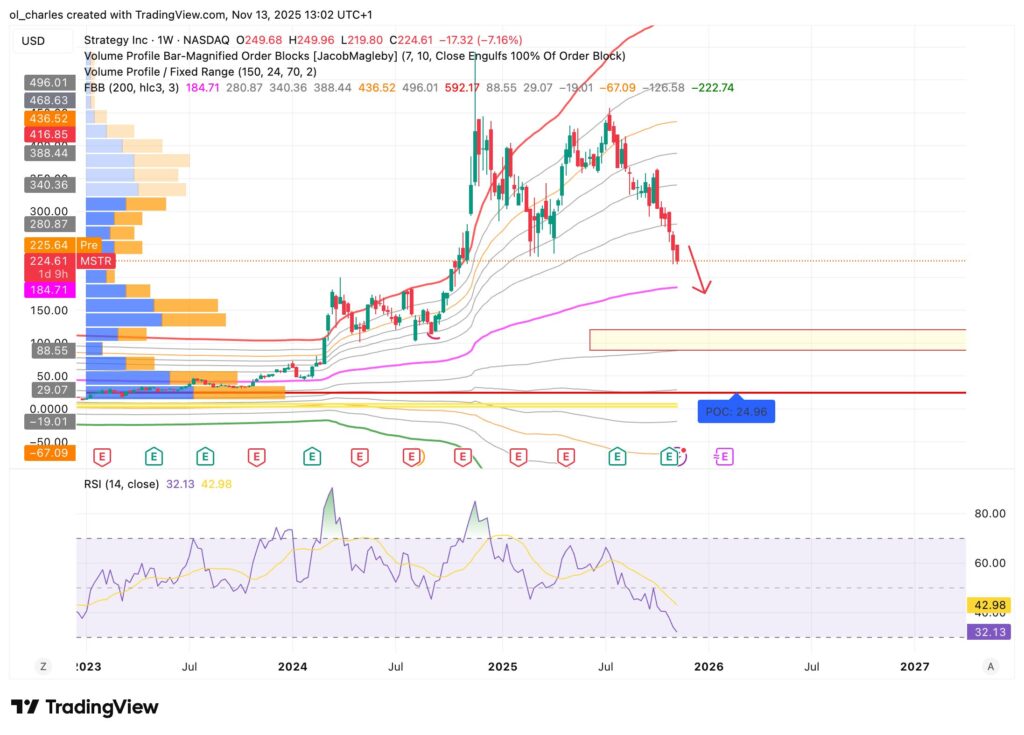
This week, MicroStrategy hit a significant milestone: its market capitalisation briefly fell below the value of its bitcoin reserves. An unprecedented occurrence shedding light on institutional investors' risk perception shift. Is this a market warning or just a technical correction?
Saylor’s business giant traded this week at an intraday market capitalization of approximately $65.34 billion, falling below the $66.59 billion valuation of its 641,692 Bitcoin reserve. This temporary negative premium marks a notable break from the stock’s usual behavior, which typically trades at a substantial premium above the net value of its digital assets.
This phenomenon reflects a brutal corporate risk reassessment by the market. Investors are now explicitly pricing into the stock the risks associated with continuous dilution, increasing leverage, and the company’s operational costs. Meanwhile, Bitcoin itself maintained a relatively stable range between $100,000 and $105,000, with only a 2% decline during the period.
Bitcoin Becomes the Safe Haven Asset Against MicroStrategy
The irony of the situation deserves highlighting. While bitcoin typically experiences higher volatility than traditional stocks, this week reversed the dynamic. BTC demonstrated relative stability while MicroStrategy stock faced intensified selling pressure. Institutional traders clearly chose direct bitcoin exposure rather than the leveraged proxy that MSTR represents.
The fear and greed index remains stuck in the extreme fear zone, confirming a fragile market sentiment. Yet this fragility affects MicroStrategy’s equity more than bitcoin itself. Trading desks clearly consider BTC as cleaner exposure, without the inherent risks of the corporate structure.
This differentiation intensifies as MicroStrategy continues its capital raising program through common and preferred stock issuances. The company just acquired an additional 487 BTC for $49.9 million, maintaining its unchanged strategy despite market turbulence. But each new issuance mechanically dilutes existing shareholders, a factor the market now incorporates into its valuation.
Paradigm Shift for Institutional Investors
The observed discount, while temporary, reveals a structural evolution in investor behavior. The market no longer automatically rewards the leverage on bitcoin that MicroStrategy offers. Flows show a marked preference for spot bitcoin ETFs, which offer direct exposure without the layers of corporate complexity.
This dynamic poses a strategic question for MicroStrategy. The company built its model on the idea of a “bitcoin treasury company” that should trade at a premium reflecting its ability to aggressively accumulate BTC. Yet this premium evaporates precisely when investors can access bitcoin through simpler regulated vehicles.
MicroStrategy shareholders must now accept volatility potentially higher than bitcoin itself. The correlation between MSTR and BTC remains strong on the upside, but the stock amplifies downward movements with high beta. This modified risk-return profile explains the correction observed this week.
For Michael Saylor, this episode doesn’t seem to question the fundamental strategy. The company continues to accumulate, convinced that its dominant position as the largest corporate bitcoin holder will create long-term value. But the market now imposes a discount that reflects the operational, financing, and governance risks inherent in this approach.
To accumulate Bitcoin without downside risk and maximize returns instead of investing in overly risky MSTR shares, choose the AI bots from Pionex. Especially the Hedging Bot. Here’s what it does:
Hedging Bot: Automatic bot that shorts BTC futures (short position) while holding spot BTC; neutralizes price declines.
How it works: When BTC drops, the short gain compensates the spot loss → capital preserved in USDT.
Bear market advantage: Generated USDT is reinvested to buy more BTC at low prices (intelligent DCA).
Result: Progressive BTC accumulation without selling your holdings, even if the market drops 50%.
Returns: 10-30% APY in USDT + free sat stacking; perfect for HODLing through crypto winter.
Charles Ledoux is a Bitcoin and blockchain technology specialist. A graduate of the Crypto Academy, he has been a Bitcoin miner for over a year. He has written numerous masterclasses to educate newcomers to the industry and has authored over 2,000 articles on cryptocurrency. Now, he aims to share his passion for crypto through his articles for InvestX.
DISCLAIMER
This article is for informational purposes only and should not be considered as investment advice. Some of the partners featured on this site may not be regulated in your country. It is your responsibility to verify the compliance of these services with local regulations before using them.
DISCLAIMER
This article is for informational purposes only and should not be considered as investment advice. Trading cryptocurrencies involves risks, and it is important not to invest more than you can afford to lose.
InvestX is not responsible for the quality of the products or services presented on this page and cannot be held liable, directly or indirectly, for any damage or loss caused by the use of any product or service featured in this article. Investments in crypto assets are inherently risky; readers should conduct their own research before taking any action and invest only within their financial means. This article does not constitute investment advice.
Risk Warning : Trading financial instruments and/or cryptocurrencies carries a high level of risk, including the possibility of losing all or part of your investment. It may not be suitable for all investors. Cryptocurrency prices are highly volatile and can be influenced by external factors such as financial, regulatory, or political events. Margin trading increases financial risks.
CFDs (Contracts for Difference) are complex instruments with a high risk of rapid capital loss due to leverage. Between 74% and 89% of retail investor accounts lose money when trading CFDs. You should assess whether you understand how CFDs work and whether you can afford to take the high risk of losing your money.
Before engaging in financial or cryptocurrency trading, you must be fully informed about the associated risks and fees, carefully evaluate your investment objectives, level of experience, and risk tolerance, and seek professional advice if needed. InvestX.fr and the InvestX application may provide general market commentary, which does not constitute investment advice and should not be interpreted as such. Please consult an independent financial advisor for any investment-related questions. InvestX.fr disclaims any liability for errors, misinvestments, inaccuracies, or omissions and does not guarantee the accuracy or completeness of the information, texts, graphics, links, or other materials provided.
Some of the partners featured on this site may not be regulated in your country. It is your responsibility to verify the compliance of these services with local regulations before using them.
Get 6200 USDT with Bitget ! 🔥
Don't miss out on this offer !
Create your account now to unlock this exclusive reward