

What is Proof of Work (POW)?
Proof of Work represents the first consensus mechanism developed for blockchains, popularized by Bitcoin in 2009. This system is based on a simple yet powerful principle: to validate transactions and create new blocks, network participants, called miners, must solve complex mathematical problems.
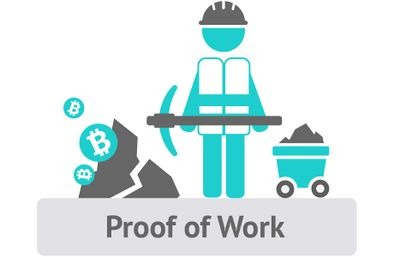
How does POW work?
In a Proof of Work system, miners compete and provide computational power from their machines. Each miner attempts to solve a cryptographic puzzle that requires billions of attempts before finding the solution. This solution, called a nonce, enables the validation of a block of transactions.
The first miner to solve the mathematical problem earns the right to add the new block to the blockchain and receives cryptocurrencies as a reward along with transaction fees. This economic incentive drives participants to secure the network.
Security through difficulty
The strength of Proof of Work lies in its adjustable difficulty. The more miners join the network, the more complex the mathematical problems become, thus maintaining a constant block creation time. For Bitcoin, this time is set at approximately 10 minutes per block.
This increasing difficulty makes the network increasingly secure. To compromise a POW blockchain, an attacker would need to control more than 51% of the total computational power of the network, which represents an unimaginable cost for major networks like Bitcoin.
Which cryptocurrencies use Proof of Work?
Besides Bitcoin, many important cryptocurrencies still use the Proof of Work mechanism. Among them are Litecoin, Bitcoin Cash, Monero, and Dogecoin. Each of these blockchains has adapted the original concept to meet its specific needs, particularly in terms of block time.
What is Proof of Stake (POS)?
Proof of Stake constitutes an alternative to Proof of Work, designed to solve several issues related to energy consumption and scalability. Unlike POW, which relies on computational power, POS operates on the principle of staking cryptocurrencies.
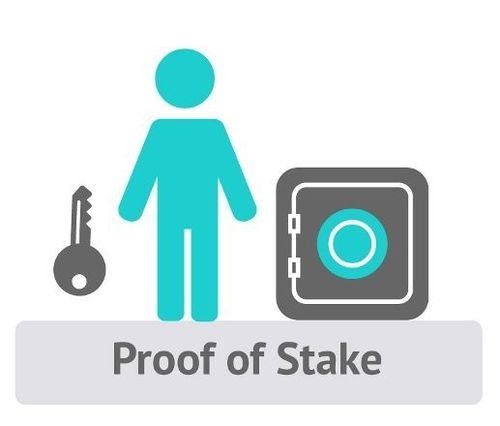
How does POS work?
In a Proof of Stake system, participants, called validators or forgers, must lock a certain amount of the blockchain’s tokens to participate in the validation process. This staking determines the chances of being selected to validate the next block.
Validator selection occurs according to several criteria, combined or not: the amount of tokens staked, the holding duration of these tokens, and sometimes a random element. Often, the more tokens a validator has at stake, the higher their chances of being chosen to validate a block, and thus receive the associated rewards.
Rewards and penalties
Validators in a POS system receive rewards in the form of new tokens and transaction fees. However, unlike POW, POS incorporates a penalty mechanism called slashing. If a validator acts maliciously or fails to follow the protocol rules, a portion of their staked tokens can be permanently destroyed.
These penalties create a relatively strong incentive to maintain network integrity. A dishonest validator risks losing their investments, making attacks economically irrational in most cases.
The evolution toward Proof of Stake
The adoption of Proof of Stake is accelerating in the crypto ecosystem. Ethereum, the world’s second-largest blockchain, completed its transition from POW to POS in September 2022 with Ethereum 2.0. This migration, called “The Merge,” reduced Ethereum’s energy consumption by more than 99%.
Other major blockchains were designed from the outset with POS, notably Cardano, Polkadot, Solana, and Avalanche. Each of these platforms has developed its own variant of Proof of Stake to optimize performance and security.
Variants of Proof of Stake
POS has evolved into several sophisticated variants. For example, Delegated Proof of Stake (DPoS) allows token holders to vote for delegates who validate transactions on their behalf. The Nominated Proof of Stake (NPoS) used by Polkadot introduces a nomination system to optimize security. These innovations demonstrate the flexibility and adaptability of the original concept.
Major differences between Proof of Work and Proof of Stake
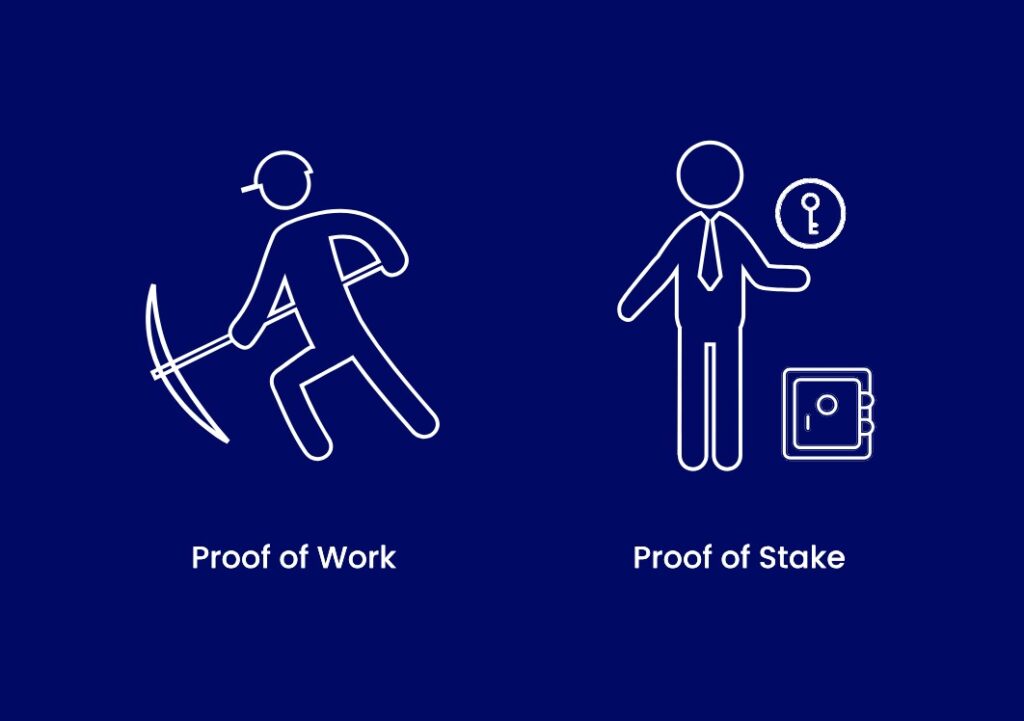
The comparison between POW and POS reveals fundamental differences. These distinctions affect all technical, economic, and environmental aspects of these protocols.
Energy consumption
The most striking difference between these two mechanisms concerns their environmental impact. Proof of Work requires massive energy consumption to power mining farms.
Bitcoin, for example, consumes as much electricity annually as entire countries, with a carbon footprint estimated at several tens of millions of tons of CO2 per year. This remains much less than traditional financial networks, but it’s important to note.
In contrast, Proof of Stake virtually eliminates this energy issue. Validators only need standard computers to participate in the network, reducing energy consumption by 99% or more compared to POW. This energy efficiency is one of the major arguments in favor of POS adoption.
Security and attack resistance
In terms of security, the two systems present different profiles. POW offers security proven by more than a decade of use. To attack a POW network, a malicious actor must acquire and maintain more than 51% of the computing power, which represents a colossal investment in hardware and electricity.
POS offers a different approach to security. An attacker would need to control more than 51% of the circulating tokens to compromise the network. However, the slashing mechanism makes this attack self-destructive: the attacker would lose their own investments if malicious behavior is detected.
Accessibility and barriers to entry
Accessibility constitutes another major point of divergence. POW mining requires considerable investments in specialized hardware (ASICs), cooling infrastructure, and electricity. These costs create high barriers to entry that favor the concentration of mining power in the hands of large companies.
POS further democratizes network participation. Although you need to own tokens to become a validator, staking pools allow small holders to participate collectively. This reduced accessibility can promote a wider decentralization of the network.
Performance and scalability
In terms of performance, Proof of Stake generally outperforms POW. POS networks can process more transactions per second with lower fees and faster confirmation times. Ethereum 2.0, for example, aims to process up to 100,000 transactions per second thanks to POS combined with sharding.
POW, particularly Bitcoin’s, remains limited to about 7 transactions per second due to the complexity of the required calculations and the fixed block time. This limitation pushes toward second-layer solutions like the Lightning Network, which can be just as fast as POS networks.
Economic model and reward distribution
The economic models also differ significantly. In POW, rewards are distributed proportionally to the computing power provided, creating a technological arms race. Miners must constantly invest in more powerful hardware to remain competitive.
POS rewards validators based on their stake, creating a system where token holders are incentivized to hold them and actively participate in securing the network. This model promotes long-term price stability and reduces selling pressure.
Summary table of differences
| Criteria | Proof of Work (POW) | Proof of Stake (POS) |
|---|---|---|
| Energy consumption | High | Low |
| Security | Relatively stronger, very costly attack | Relatively less strong, but dissuasive slashing |
| Transaction speed | Slow (7 TPS for Bitcoin) | Fast (thousands of TPS) |
| Transaction fees | High during congestion | Generally lower |
| Barrier to entry | High (specialized hardware) | Moderate (token ownership) |
| Decentralization | Risk of centralization due to mining | Risk of centralization due to staking pools |
| Environmental impact | Significant | Almost neutral |
| Transaction finality | Probabilistic | Deterministic |
| Scalability | Possible with L2 solutions | Possible with L2 solutions |
| Technological maturity | Very mature (+14 years) | Relatively younger |

