

What is Aster?
Aster is a next-generation decentralized exchange (DEX) specializing in perpetual contract trading and spot trading. Launched in 2025, the platform is the result of a strategic merger between two entities with complementary expertise: Astherus Finance, recognized for its yield products, and APX Finance, appreciated for its robust derivatives trading infrastructure.
This union has created a unified platform that aims to combine the best of both worlds: a simplified and accessible user experience, while offering advanced trading tools and deep liquidity.
The fundamental principle of Aster is based on non-custodial trading, which means users maintain complete control of their assets at all times, without ever having to deposit them with intermediaries like Binance, Coinbase, etc. The platform operates on multiple blockchains, providing greater flexibility by avoiding the complexities of fund transfers between different networks (bridging) for traders.
With over 6 million users, a TVL of $1.18 billion and cumulative volumes exceeding $3 trillion, Aster is rapidly establishing itself as a major player in the sector.
How does a DEX work?
Before exploring Aster’s specifics in more detail, it’s essential to understand how a decentralized exchange (DEX) operates. Unlike centralized platforms (CEX) like Bitget, which act as trusted third parties to manage user orders and funds, a DEX operates directly on the blockchain. Transactions are executed peer-to-peer via smart contracts, autonomous programs that apply exchange rules transparently and immutably.
DEXs primarily use two models to ensure liquidity: the order book, similar to traditional exchanges, and the Automated Market Maker (AMM). Aster combines these approaches to offer both a professional trading interface with order books and a simplified experience based on on-chain liquidity. You only need a personal wallet to trade on this type of exchange.
The team behind Aster
The identity of the main team behind Aster remains discreet, a common practice in the decentralized finance ecosystem that often favors anonymity or pseudonyms.
However, the project’s genesis is well known: Aster was born from the merger between Astherus Finance and APX Finance in late 2024. This alliance allowed capitalizing on the respective strengths of both projects. Astherus Finance was primarily recognized for its innovative yield-generating products, particularly in the liquid staking domain. APX Finance had built a solid reputation through its high-performance infrastructure dedicated to perpetual contract trading.
What is the connection between CZ and Aster?
The name Aster truly exploded on the international scene in early November 2025, following an announcement by Changpeng Zhao (CZ), the charismatic founder and former CEO of Binance. In a post on social network X, CZ revealed he had personally invested in the project by purchasing more than 2 million ASTER tokens for approximately $2.5 million. He specified this was a long-term investment rather than a speculative trading operation.

This declaration, coming from one of the industry’s most influential figures, had an immediate and spectacular effect. The ASTER token price surged in the hours that followed, and daily trading volume jumped from a few hundred million to over $2 billion. This event not only thrust Aster into the spotlight but was also interpreted by many as a major confidence signal in the project’s potential.
Following the high volatility generated by his announcement, CZ later declared he would refrain from publicly communicating about his personal investments in the future.
Aster’s features
To stand out in such a competitive sector, Aster focuses on a range of features designed to attract both novice and seasoned professional traders. The platform structures its offering around several major pillars.
First, Aster offers three distinct trading modes to adapt to different user profiles.
- The Perpetual (Pro) mode targets experienced traders with a complete interface featuring order books, advanced technical analysis tools, and deep liquidity.
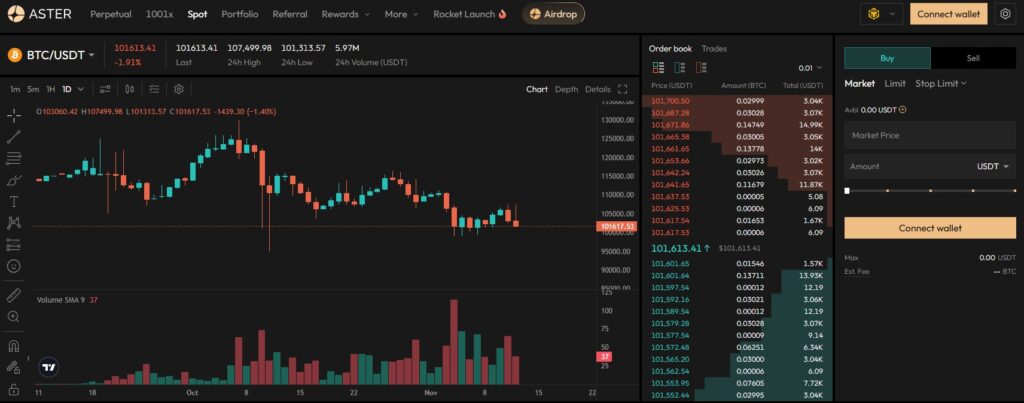
- The 1001x (Simple) mode, designed for simplicity and speed, allows taking leveraged positions (up to 1001x) with one click, with MEV (Maximal Extractable Value) protection.
- Finally, the Spot mode enables buying and selling assets at current market prices.
Beyond these trading modes, Aster integrates advanced features such as hidden orders, which allow traders to place large orders without displaying them publicly in the order book.
The platform also highlights its cross-chain trading, which greatly simplifies the user experience by eliminating the need for bridges to transfer assets between different blockchains.
Finally, the Aster Earn section offers various yield products, such as BNB liquid staking (asBNB) and an interest-generating stablecoin, USDF.
ASTER: Asterdex’s native token
At the heart of the ecosystem lies the ASTER token, the platform’s native cryptocurrency. This isn’t just a speculative asset, but a cornerstone designed to provide concrete utility to its holders. The maximum supply of the ASTER token is set at 8 billion units, with a majority portion allocated to community incentives, such as airdrops and reward programs.

One of the main functionalities of the ASTER token is its use as trading collateral. Users can deposit their ASTER tokens to open and maintain leveraged positions, benefiting from an 80% margin ratio.
Additionally, holding and using ASTER as collateral provides a 5% reduction on transaction fees, which represents a significant advantage for active traders. You can follow its live price below:
How to buy ASTER
Acquiring the ASTER token is a relatively simple process, particularly via centralized exchange platforms that have quickly listed it. Here’s a step-by-step guide to buying ASTER on the Bitget platform:
- Create a Bitget account: Visit Bitget’s official website and create an account by providing an email address and secure password.
- Verify your identity (KYC): Complete the identity verification process by providing a valid ID document to unlock all features.
- Deposit funds: Deposit funds via bank transfer, credit/debit card, or cryptocurrency transfer (like USDT) from another wallet.
- Access the market: In the trading interface, select the “Spot” or “Perpetuals” section and search for the ASTER/USDT or ASTER/USDT.P pair
- Place a buy order: Choose a “Market” order to buy at current price, or a “Limit” order to set your purchase price, then confirm and you’re done!
Aster’s advantages and disadvantages
Like any project in the crypto ecosystem, Aster presents a set of advantages that attract users, but also disadvantages and risks that are crucial to consider before engaging with the platform.
Advantages
- Extreme leverage: With leverage reaching up to 1001x on Simple mode, Aster offers considerable profit opportunities for experienced traders.
- Non-custodial and multi-chain trading: Users maintain complete control of their assets and can trade on multiple blockchains without resorting to complex bridges.
- Diversity of trading modes: Three distinct interfaces (Pro, Simple, Spot) allow adaptation to all profiles, from beginner to professional.
- Complete ecosystem: Beyond trading, Aster Earn offers yield products (liquid staking, USDF stablecoin) to diversify investment strategies.
- CZ’s backing: Changpeng Zhao’s personal investment brings exceptional credibility and visibility to the project.
Disadvantages
- Very recent project: Launched in 2025, Aster has not yet proven itself long-term and its sustainability remains to be demonstrated.
- Transparency controversies: Doubts have been raised regarding the reliability of displayed trading volumes, prompting DefiLlama to temporarily remove its data.
- Narrative dependence: Aster’s meteoric success largely relies on speculative enthusiasm and CZ’s backing, making it vulnerable to sentiment shifts.
- Anonymous team: The identity of main developers remains unclear, which may raise questions about project governance and accountability.
- Fierce competition: The perpetual DEX sector is saturated with established players like Hyperliquid and dYdX, making the battle for market share particularly difficult.
Aster vs other perpetual DEXs: Comparison
The decentralized perpetual contract exchange market is booming. To better position Aster, here’s a comparison with its main competitors: Hyperliquid, dYdX, Paradex and Lighter.
| Criteria | Aster | Hyperliquid | dYdX (v4) | Paradex | Lighter |
|---|---|---|---|---|---|
| Technology | Multi-chain (BNB Chain) | Proprietary Layer 1 | Cosmos blockchain | Starknet Appchain | Arbitrum Layer 2 |
| Max leverage | Up to 1001x | Up to 50x | Up to 20x | Up to 50x | Up to 1000x |
| Fees | Low, -5% with ASTER | Zero gas fees | Validator model | Zero fees announced | Low |
| Particulars | Simple mode, CZ backing | Vaults, strong TVL | Complete decentralization | 250+ markets | Aggregated liquidity |
| Maturity | Recent, September 2025 | Established since 2023, leader | 2023, Historical player | Recent, February 2024 | Recent, October 2025 |
This comparison highlights the diversity of approaches. Aster and Lighter position themselves on very high leverage, while dYdX capitalizes on complete decentralization. Hyperliquid stands out with its mature ecosystem, and Paradex focuses on Layer 2 technology and a large number of markets.
How to use Aster? Step-by-step guide
Using a DEX like Aster may seem intimidating at first, but the platform has been designed to simplify the process:
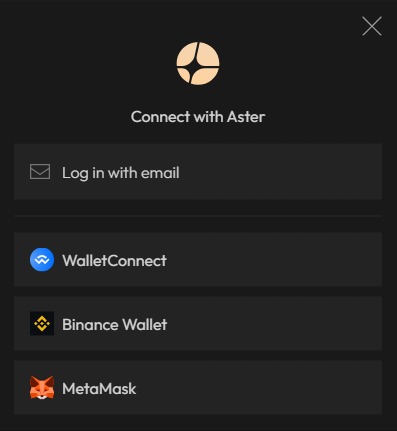
- Connect your wallet: Visit the Aster website and connect a compatible wallet (MetaMask, Trust Wallet, Bitget Wallet) or use an email address.
- Deposit funds: Deposit assets (USDT, USDC or ASTER) that will serve as collateral. The multi-chain functionality avoids using external bridges.
- Choose your trading mode: Select the mode suited to your profile: “Perpetual (Pro)” for experienced traders or “1001x” for simplicity, for example.
- Open a position: Choose the asset to trade, define the amount, leverage and direction (long or short), then confirm the transaction.
- Manage and close your position: Monitor your positions in real-time and watch your margin ratio to avoid liquidation.
Aster’s future: Perspectives and expected developments
Aster’s ambition doesn’t stop at its current offering. The development team has unveiled an ambitious roadmap that hints at major evolutions. Among the most anticipated developments is the integration of zero-knowledge proofs, cutting-edge technology that could significantly improve transaction privacy and scalability.
Even more audacious, the project plans to launch its own Layer 1 blockchain, dubbed “Aster Chain”. This dedicated infrastructure would allow Aster to free itself from current network constraints and fully optimize its environment for high-performance trading.
Finally, the roadmap mentions developing an “intents”-based system, aimed at radically simplifying the trading experience by automating strategy execution across different liquidity sources and blockchains.
Our take on Aster: The DEX that will overtake Hyperliquid?
So, is Aster the new perpetual DEX giant, destined to dethrone the current leader, Hyperliquid? It’s still too early to say with certainty. Aster has undeniable assets: a comprehensive and versatile trading offering, attractive leverage, and above all, exceptional spotlight thanks to CZ’s investment.
However, caution remains warranted. The platform’s success is intrinsically linked to a powerful narrative and enthusiasm that could prove ephemeral. Doubts raised about the transparency of its volumes and fierce competition in this sector are major challenges.
Hyperliquid benefits from a considerable head start in terms of maturity, community trust and proven liquidity. To surpass its rival, Aster will need to not only maintain its current momentum, but also prove the robustness of its technology, the reliability of its figures and its ability to innovate long-term. The battle for the perpetual DEX throne is just beginning, and Aster has clearly positioned itself as a very serious contender.

