

Geopolitics, macro and crypto: What is really happening?
The crypto market is experiencing a highly volatile week. The VIX surged by 13.16% in a single session, the S&P 500 and Nasdaq suffered a severe correction, and Brent crude is climbing due to tensions in the Middle East. The Binance Research report confirms that the VIX index dropped from 35 to 23 over seven days, while Goldman Sachs estimated that CTA strategies could trigger between $35 billion and $87 billion in selloffs across equity markets over the coming days.
For Bitcoin, this backdrop creates a paradoxical situation. On one hand, its correlation with traditional markets forces BTC to react to the same macro triggers. On the other, Binance Research highlights a crucial point: geopolitical shocks driven by oil do not break BTC, but systemic events native to crypto do. Between March 2 and March 17, 2026, spot Bitcoin ETFs recorded net inflows of $1.7 billion despite the geopolitical turmoil. This figure indicates that institutional investors are buying while retail investors panic.
The SEC faces 91 ETFs and a worrying silence
The US regulatory landscape has entered a decisive phase. 91 crypto ETF applications were awaiting a final decision as of March 27, 2026, covering 24 tokens including ETFs linked to Solana and XRP. The SEC decision on March 17 to classify 16 digital assets as commodities has unblocked this regulatory pipeline.
However, the CLARITY Act caused the most damage in the short term. Circle shares plummeted by 20% in a single session, closing at $101.17 compared to $126.64 the previous day. This wiped out $5.6 billion in market capitalization following the leak of a draft proposing a ban on passive yields for stablecoins. Coinbase lost 11% in the same downward move.
What few analysts are pointing out: according to Markus Thielen of 10x Research, this yield ban could structurally redirect flows back to traditional finance, creating a direct headwind for DeFi. Protocols like Uniswap, Aave or dYdX could see their volumes and liquidity contract if the bill is passed as is. The final markup is expected at the end of April.
Ethereum holds strong: A powerful signal or false hope?
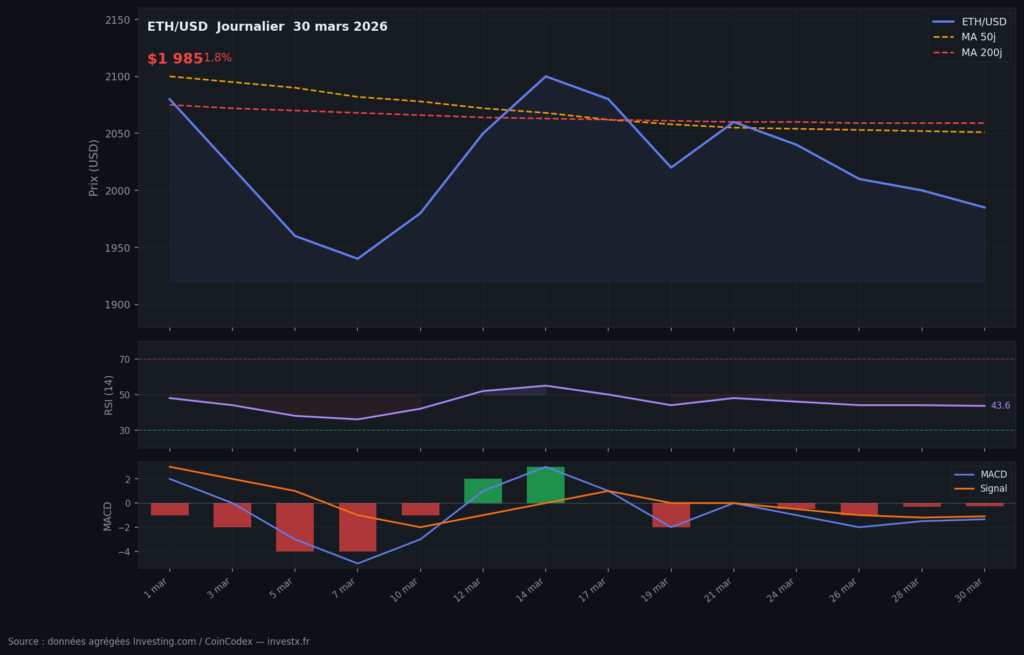
Amidst this turmoil, Ethereum is standing out. Closing up 0.96% on a day when the Nasdaq severely corrects is no small feat. When ETH displays positive relative strength against tech indices during times of stress, it is often a sign that capital is repositioning into decentralized protocols as an alternative safe haven.
The real question is whether this resilience can be sustained. If the CLARITY Act weakens DeFi and the SEC remains silent on altcoin ETFs, ETH could find itself caught in the crossfire: regulatory pressure on one side and institutional hesitation on the other. The RSI and MACD on the daily timeframe will be the first indicators to watch to validate or invalidate this bounce.
Is now the right time to take a position?
Binance Research’s historical analysis is unambiguous: in the 12 months following the US midterm elections, the S&P 500 has grown by an average of 19% and Bitcoin by roughly 54% across the three post election cycles recorded since 2014. The midterms are scheduled for November 3, 2026, which is seven months away. This timeline coincides with an unblocking regulatory pipeline and persistent institutional accumulation.
What emerges from all these signals is that the market is going through a repricing phase, not a capitulation. The current macro and regulatory pressure is compressing prices, but institutional fundamentals remain intact. The coming weeks, particularly the CLARITY Act markup and the initial decisions on the 91 ETFs, will be decisive in confirming or invalidating this scenario.
Sources:
- [EXT_LINK_1:]@BinanceResearch on X
- @paulbarron on X
- Investing.com
- CoinCodex
Related Articles:

