

The Red Candle Curse: A Historic Warning Signal?
The crypto market is holding its breath as January draws to a close. If Bitcoin closes this month in the red, it will mark its fourth consecutive monthly loss. According to historical data, such a losing streak hasn’t occurred since 2018, the year when BTC ultimately capitulated to hit a bottom around $3,000.
Currently, Bitcoin is trading in a critical zone between $87,700 and $88,000, showing a decline of approximately 1.5% over the last 24 hours. The inability of buyers (bulls) to reverse the trend reinforces the cautious sentiment. This repetition of the 2018 pattern doesn’t necessarily mean a return to $3,000, but it suggests that the market structure is extremely fragile and could precede a phase of capitulation or prolonged correction.
Can the $85,000 Support Save Bitcoin from Falling?
From a technical perspective, BTC is caught in a vice. The $84,300 – $86,000 level acts as a crucial immediate support (daily order block). This is the line of defense that traders are nervously watching: a clean break below this threshold could trigger a cascade of liquidations and open the door to increased volatility.
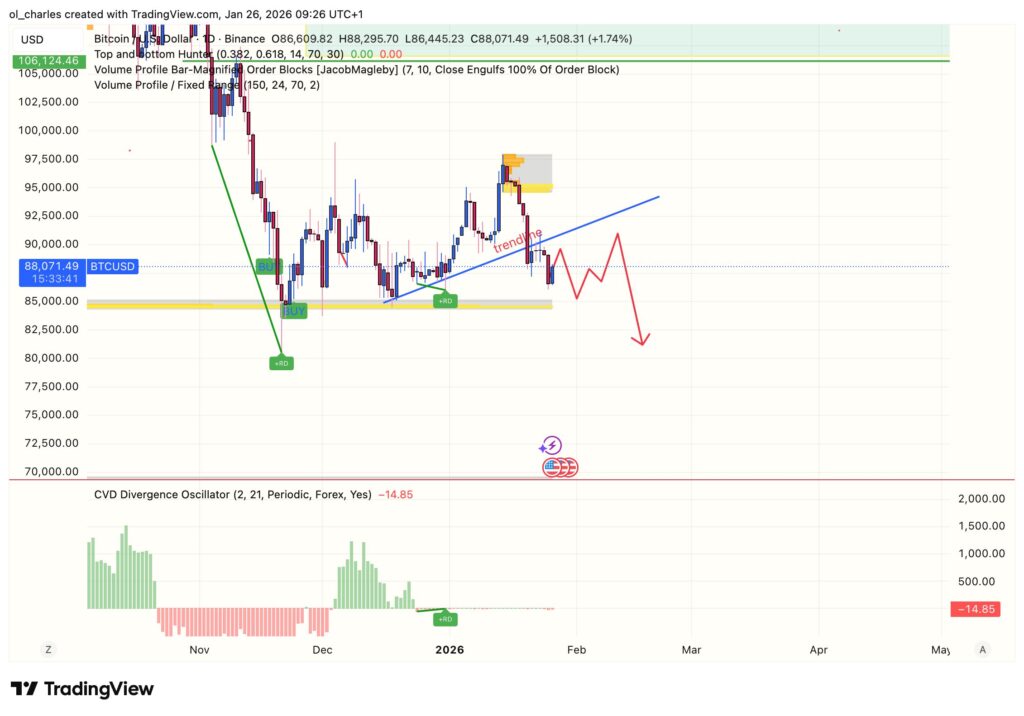
On the upside, the trendline sits around $91,000. To invalidate the bearish thesis and avoid this infamous fourth red candle, Bitcoin must imperatively reclaim this psychological level before the monthly close. Momentum indicators currently show buyer fatigue, leaving sellers free to test the market’s nerves.
Should We Fear Another Massive Correction or Buy the Dip?
Two scenarios are emerging for the coming days. In a bearish scenario, the validation of the monthly losing streak could push BTC to test lower liquidity zones, potentially toward $84,500, confirming bear dominance.
Conversely, a last-minute bullish surge, driven by institutional buying volumes, could allow BTC to close above its monthly opening price. This would break the 2018 curse and could restart the engine toward new highs. For now, caution is warranted: the market is at a crossroads.
Related Articles:

