

An Institutional “Bull Trap”? The Numbers Behind the Chaos
February 2026 had started off with a bang. After a brutal end to January, institutional investors finally seemed ready to buy the dip. On Monday, February 2nd, US Spot Bitcoin ETFs recorded a spectacular net inflow of $561.9 million, ending a four-day streak of outflows. Fidelity (FBTC) led the charge with over $153 million, closely followed by giant BlackRock (IBIT).
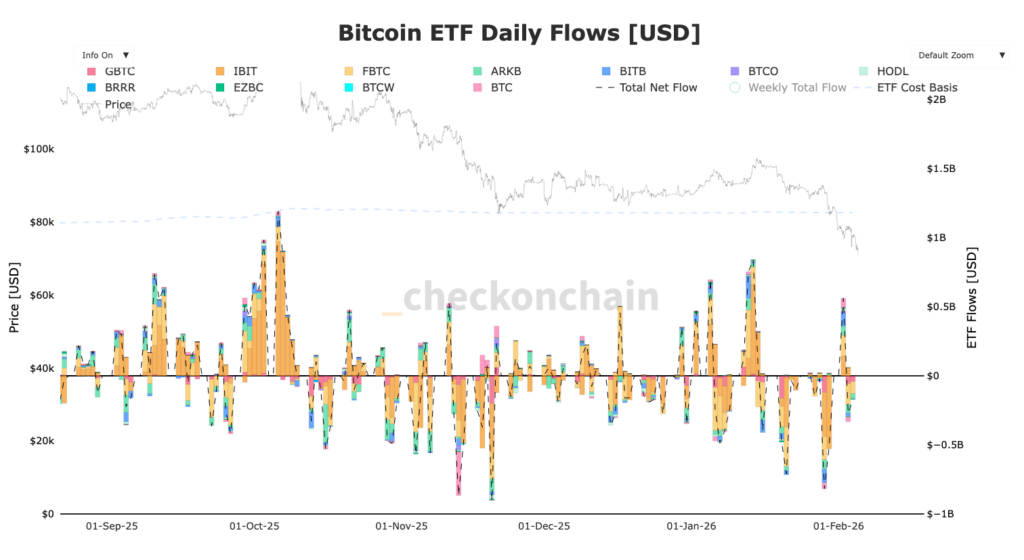
But the euphoria was short-lived. The very next day, the trend violently reversed. On Tuesday, February 3rd, these same financial products suffered a hemorrhage of $272 million. Notably, Fidelity, which had massively accumulated the day before, saw nearly $148 million flow out, almost entirely erasing its previous day’s gains. This “revolving door” movement suggests that even whales and asset managers are navigating blindly, favoring short-term tactical trading strategies over strategic accumulation.
Bitcoin Below $71,000: Bearish Structure Confirmed
The impact on price was immediate. This institutional indecision acted as a bearish catalyst, pushing Bitcoin’s price below the psychological barrier of $71,000 on February 4th, a level not seen since November 2024. We are now far from the October 2025 ATH of $126,000, with the market showing a correction of over 40%.
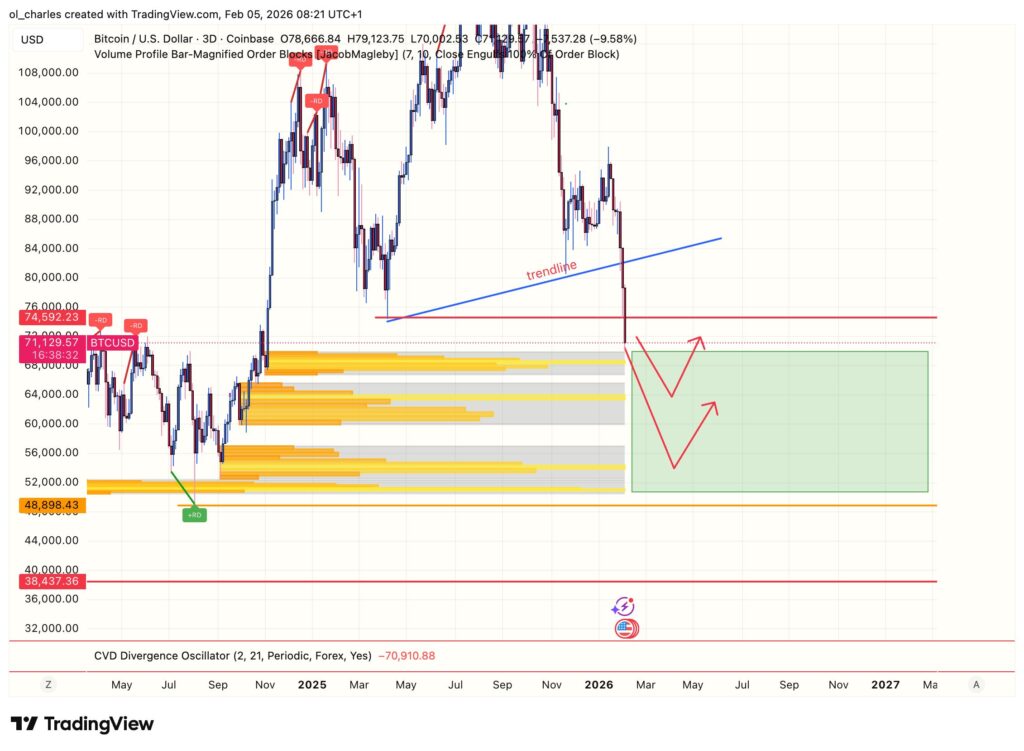
From a technical perspective, the situation is concerning. BTC is now trading below its key moving averages, confirming an intermediate bearish trend. It has also decisively broken the $74,000 low, confirming that the decline should continue lower.
Should You Buy the Dip or Wait for Final Capitulation?
However, the numerous order blocks formed over 3 days between $50,000 and $70,000 provide a perfect foundation for Bitcoin to prepare its bottom and rebound. Several support levels are worth watching, notably $67,000, $63,000, and $53,000 for BTC.
This brutal reversal in ETF flows sends a contradictory signal. On one hand, the massive inflow on February 2nd proves there’s latent demand ready to step in at these price levels. On the other hand, the speed of the outflows shows extreme nervousness in the face of macroeconomic uncertainties (Fed policy, delayed US employment data). The crypto market currently seems correlated with traditional risk assets, struggling to play its role as a safe haven.
For traders, caution is warranted. According to NoLimit, insiders are selling massively in the stock market and a bear market is brewing there.
Related Articles:

