

Selling Pressure Suffocating the Market
The crypto market is currently caught in a vice. On one side, investors hope for an immediate rebound, on the other, on-chain data tells a much more cautious story. Ki Young Ju, a respected figure in crypto analysis, recently shared a stark assessment: we are in a well-defined bearish cycle, not just a temporary correction.
The fundamental problem lies in the imbalance of capital flows. Currently, selling pressure is completely overwhelming new capital inflows. Simply put, there are more whales and institutions looking to reduce their exposure or take profits than new entrants ready to buy at high prices. This phenomenon of “institutional unwinding” prevents any attempt at an upward breakout.
For Ki Young Ju, the absence of significant buying interest at these price levels is a warning signal. As long as this imbalance persists, imagining an immediate return to the ATH is more wishful thinking than rational analysis. The market needs to “breathe,” and paradoxically, this could mean an additional drop to clean up positions.
Why is the $54,000 Level Crucial?
The CryptoQuant analyst points to a precise technical and psychological level: $54,000. This figure isn’t pulled out of thin air. It often corresponds to major support zones based on the “Realized Price” of investor cohorts. Historically, true market bottoms form when Bitcoin’s price comes to test, or even break below, the average purchase price of holders.
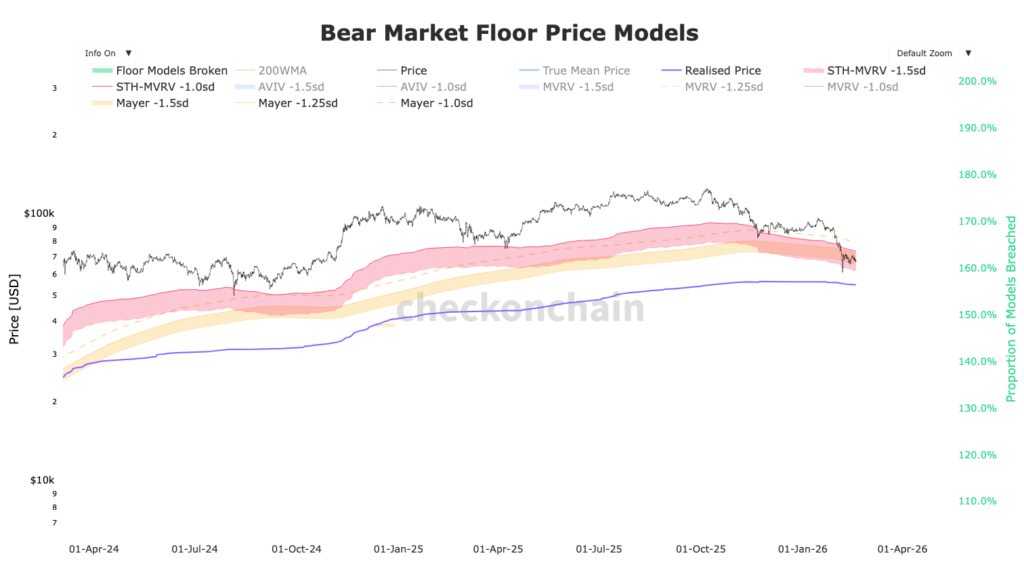
Currently, Bitcoin has not yet shown signs of total capitulation. Capitulation is that moment of panic when the last uncertain holders sell at a loss, transferring their assets to stronger hands (the “Diamond Hands”). Without this purging event, the market remains in limbo, unable to build a solid foundation for the next rally.
If BTC were to fall toward $54,000, it would represent a painful but potentially healing correction. This level could act as a liquidity magnet, triggering the massive buy orders needed to reverse the trend. Ki Young Ju warns that this healing process could take months. Patience is therefore essential for traders monitoring charts in search of an optimal entry point.
Institutions and ETFs: Engine Stalled?
Another key factor in this analysis rests on institutional behavior, particularly through Bitcoin Spot ETFs. After driving the market during previous phases, these flows seem to have dried up or are no longer sufficient to offset selling. CryptoQuant’s analysis suggests that without a massive resurgence of institutional liquidity, momentum will remain bearish.
The crypto market can no longer rely solely on retail investor “hype.” The current market structure requires massive volumes to move the needle. The absence of “buying interest” currently confirms that large portfolios are waiting for more attractive price levels to reposition themselves. They won’t FOMO at current levels.
This “cleanup” phase is typical of market cycles. It separates solid projects and convinced investors from short-term speculators. If Ki Young Ju’s prediction materializes, the coming months will be a resilience test for the entire ecosystem, but they could also offer one of the best accumulation opportunities of the year.
Faced with this analysis, the question for any investor is how to react. Should one sell now to buy back lower, or engage in DCA (Dollar Cost Averaging) hoping the support holds? If $54,000 is touched, will it constitute the starting point of the next Bull run or simply a step toward even deeper lows? The answer will depend on the reaction of buying volumes once this critical threshold is reached.
For many traders, like Killa, a descent between $47,000 and $54,000 is a generational opportunity to DCA for the long term. According to him, the bottom should arrive by August of this year with a first low point between March.
Related Articles:

