
Bitcoin vs. Ethereum: Which will surge first?
Bitcoin and Ethereum diverge! Why is BTC soaring while ETH lags? Discover the key factors behind the price decoupling and future predictions.



Bitcoin and Ethereum diverge! Why is BTC soaring while ETH lags? Discover the key factors behind the price decoupling and future predictions.
The US-Iran ceasefire on April 7 triggered a sharp rebound across the entire crypto market. But beneath the surface numbers, two very different dynamics are at play. Bitcoin climbed by 4.6% to reach $71,723 with over $55 billion in trading volume, catalyzing a widespread rally. Ethereum advanced by 7.1% and Solana by 6.0%. However, these synchronized gains mask a structural decoupling that has been widening for several months between the market’s top two assets.
The real breakthrough of 2026 is not in the price, it is in the nature of the movement. The correlation of Bitcoin with the global monetary easing index from Binance Research shifted from +0.21 before the spot ETF approvals to -0.778 in 2026. This is not just a weakening of the old relationship, it is a complete structural inversion. It is nearly three times stronger in the opposite direction. Bitcoin has transitioned from a lagging macro receiver to a forward-looking pricer, anticipating Fed decisions rather than reacting to them.
On-chain data reinforces this argument. The supply held by long-term holders (LTH) remained at historically high levels throughout Q1 2026 despite price volatility. Bitcoin reserves on centralized exchanges continue to drop. This signals that coins are migrating to cold storage rather than sell-side liquidity. The MVRV ratio, which compares market capitalization to realized capitalization, has stayed below 2.0 since the start of 2026. This indicates that the market is far from the euphoria zone that historically precedes major cycle tops.
The key support to watch is the $68,000 zone. A breakdown below this level would target the $65,000 to $66,000 range, aligning with the lower Bollinger Band. The upper band at $74,482 represents the next significant technical resistance before a potential test of new all-time highs.
Ethereum presents a radically different profile. The ETH/BTC ratio sits around 0.028, a level unseen since early 2020, right before DeFi summer. Ethereum’s dominance over the total crypto market cap has dropped to roughly 10.4%, down from 18% a year ago. Yet, the total TVL across Ethereum and its L2s still exceeds $50 billion. Daily active addresses remain stable, and the network generates more fee revenue than any other blockchain.
On March 30, 2026, the Ethereum Foundation made its largest single staking deposit. 22,517 ETH (roughly $46.2 million) were injected into the Beacon Chain. This move directly reduces the circulating supply. However, it coincides with eight consecutive days of net outflows from Ethereum ETFs and weak new address creation.
More recently, the Ethereum Foundation executed a major strategic pivot: shifting from periodic ETH sales to massive staking, locking up approximately 69,500 ETH ($143 million) to generate yield, thereby reducing structural sell pressure. Net taker volume has turned positive for the first sustained period since 2023.
Immediate resistance for ETH sits between $2,300 and $2,400. A clean breakout with volume could trigger a short squeeze on accumulated bearish positions. If it fails, the pivotal $2,050 support remains the absolute must-defend level.
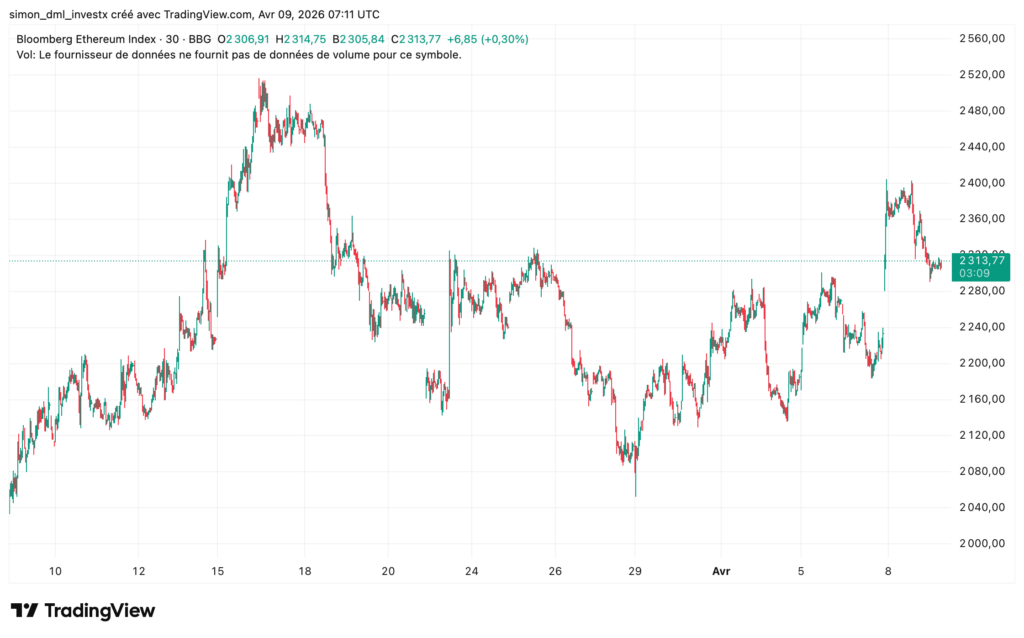
Bitcoin dominance stands at 56.8% as of April 8, 2026, a level historically associated with altcoin suppression. When BTC dominance breaks above 55%, capital concentrates on Bitcoin while the majority of altcoins struggle to attract new buyers.
This metric is the most important signal to watch for traders positioning in altcoins right now. The last two times this pattern of ETH rallying while BTC consolidates appeared, in Q2 2019 and Q4 2023, Ethereum outperformed Bitcoin by 40 to 80% over the following three months. But buying ETH against a rising BTC dominance means fighting the trend, and fighting trends in crypto is costly.
The most honest market read to date: Bitcoin has the fundamentals and on-chain structure to target $73,000 to $75,000 if the geopolitical context remains favorable and ETFs maintain their inflows above $1 billion per month. Ethereum has the foundation for a violent rotation, but the timing depends on a reversal in BTC dominance, not an isolated post-ceasefire bounce. For crypto investors, monitoring the price forecast of both assets separately is now a necessity. 2026 has definitively broken the “BTC pumps, ETH follows” model.
Sources:
Related Articles:

Crypto analyst with over 7 years of trading experience and a strong background in the iGaming and cryptocurrency industries, I cover crypto news with a rigorous yet accessible approach. Passionate about blockchain since 2019, I have published more than 1,200 articles and guides on cryptocurrencies, DeFi, and blockchain, recognized for their reliability and clarity.
Specializing in on-chain trading and whale activity analysis, I decode blockchain flows to anticipate market trends before they become obvious.
One of my articles was cited by Éric Larchevêque, co-founder of Ledger, highlighting the quality and credibility of my analysis.
My goal remains unchanged: to make crypto accessible and understandable for everyone, from beginners to experienced investors.
Follow me on LinkedIn and X to stay updated with my latest insights.
DISCLAIMER
This article is for informational purposes only and should not be considered as investment advice. Trading cryptocurrencies involves risks, and it is important not to invest more than you can afford to lose.
InvestX is not responsible for the quality of the products or services presented on this page and cannot be held liable, directly or indirectly, for any damage or loss caused by the use of any product or service featured in this article. Investments in crypto assets are inherently risky; readers should conduct their own research before taking any action and invest only within their financial means. This article does not constitute investment advice.




Risk Warning : Trading financial instruments and/or cryptocurrencies carries a high level of risk, including the possibility of losing all or part of your investment. It may not be suitable for all investors. Cryptocurrency prices are highly volatile and can be influenced by external factors such as financial, regulatory, or political events. Margin trading increases financial risks.
CFDs (Contracts for Difference) are complex instruments with a high risk of rapid capital loss due to leverage. Between 74% and 89% of retail investor accounts lose money when trading CFDs. You should assess whether you understand how CFDs work and whether you can afford to take the high risk of losing your money.
Before engaging in financial or cryptocurrency trading, you must be fully informed about the associated risks and fees, carefully evaluate your investment objectives, level of experience, and risk tolerance, and seek professional advice if needed. InvestX.fr and the InvestX application may provide general market commentary, which does not constitute investment advice and should not be interpreted as such. Please consult an independent financial advisor for any investment-related questions. InvestX.fr disclaims any liability for errors, misinvestments, inaccuracies, or omissions and does not guarantee the accuracy or completeness of the information, texts, graphics, links, or other materials provided.
Some of the partners featured on this site may not be regulated in your country. It is your responsibility to verify the compliance of these services with local regulations before using them.

