

FOMC Minutes, Ceasefire, and Bitcoin at $72,000
The FOMC minutes from March 17 and 18, 2026, published on April 9, confirm what the markets have feared for several weeks: the Fed is flying blind. Policymakers weighed opposing scenarios regarding how the war could impact inflation and employment. Most participants stated that a prolonged war could weaken the labor market and increase the need for rate cuts. Meanwhile, others estimated that rate hikes might be necessary if surging energy prices intensify inflationary pressure. For a crypto market looking for a clear signal, this is maximum ambiguity.
The internal picture at the FOMC is more fragmented than it appears. Seven policymakers favor zero rate cuts in 2026, while seven support a single cut. Only one governor dissented: Stephen Miran, who favored a 25 basis point cut. Jerome Powell acknowledged that the possibility of a rate hike was discussed at the meeting, but the vast majority of participants did not view it as their baseline scenario.
The economy is caught in a vice. The CPI rose by 2.4% year over year in February, and the core CPI is holding at 2.5%, still above the 2% target. Oil prices crossed the $100 per barrel mark in March, and the Fed’s internal inflation model estimates that a $10 per barrel increase pushes inflation up by approximately 0.35%. A three to six month period above $100 could therefore add more than one percentage point to inflation. For traders positioning rate futures, this context is particularly challenging to integrate into a coherent model.
The Fed maintained its projection of a single rate cut in 2026. Nevertheless, markets remain skeptical about the chances of monetary easing this year. The next FOMC meeting is scheduled for April 28 and 29, 2026.
Bitcoin at $72,700: A Breakout or a Short Squeeze?
In this blurry macroeconomic context, Bitcoin produced its most violent move in weeks. Bitcoin surged to around $72,700 after Trump announced a two week ceasefire with Iran, abruptly reversing days of bearish positioning. The spike triggered approximately $595 million in crypto liquidations. Short positions accounted for roughly $427 million, marking the most aggressive short squeeze since early March.
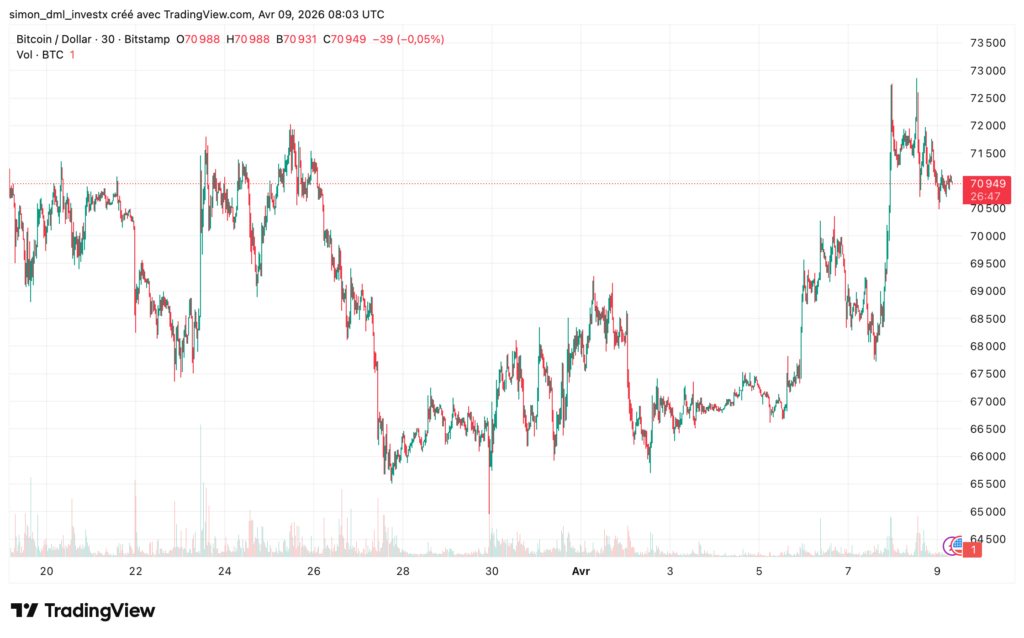
The mechanics of these liquidations are well known to active operators in the derivatives markets. The rally was partly fueled by short covering after traders betting on an escalation between the US and Iran were caught off guard. In this type of setup, the market often stalls while waiting for fresh demand. Without it, gains can quickly reverse.
The following day proved this caution right. Bitcoin held above $70,000 but markets retraced the ceasefire euphoria. Cracks appeared in the truce between the US and Iran less than 48 hours after its announcement. The Iranian Parliament signaled that three clauses of the ceasefire had been violated, while Brent crude climbed back toward $97.
The Real Catalyst for Crypto: The April Meeting
For cryptocurrency investors, the right question is not whether the Fed will cut rates in April, but rather what geopolitical scenario will unfold by April 29. James Butterfill, Head of Research at CoinShares, explains it clearly:
“If the conflict were to deescalate, the immediate effect would be felt through lower oil prices and reduced inflationary pressure, increasing the probability of a looser monetary policy, which tends to support Bitcoin.”
Bitcoin’s correlation with the Nasdaq at 0.74 means that any hawkish signal from the Fed suggesting that rates will remain higher for longer could prolong the current weakness well beyond May. The key levels remain clear. The support sits between $62,000 and $65,000, while resistance is concentrated between $72,000 and $75,000. For those closely following technical analysis, the $68,000 level remains the crucial pivot that must hold on a daily close.
For traders looking to position themselves, the equation is straightforward. A lasting ceasefire reduces oil driven inflation and frees the Fed’s hands to cut rates. This gives Bitcoin the room to test $75,000 and then explore uncharted territory since its all time high of $125,904 in October 2025. If the truce collapses and oil surges again, the opposite scenario applies with the exact same mechanics. Monitoring Bitcoin ETFs also remains a useful barometer. Sustained inflows exceeding one billion per month would validate institutional resilience. The crypto market is waiting for the same event as the rest of the financial markets: a resolution to the crisis in the Middle East. Until this is resolved, following Bitcoin price predictions without factoring in the geopolitical variable is like flying blind.
Sources:
- TradingView
- ruswar on X
- NickTimiraos on X
Related Articles:

