
Bitcoin plummets amidst Ormuz tensions: Where will the price go?
Bitcoin & crypto markets react to escalating tensions in the Strait of Hormuz. Learn about the impact & potential future price movements. Read now!


Bitcoin & crypto markets react to escalating tensions in the Strait of Hormuz. Learn about the impact & potential future price movements. Read now!
The geopolitical escalation in the Middle East has triggered an immediate shockwave across risk assets. Donald Trump’s 48-hour ultimatum concerning the Strait of Hormuz has reignited fears of a global energy crisis. With oil barrels threatening to settle durably above $100, the specter of stagflation is spooking investors. In this anxiety-ridden climate, the crypto market has suffered a brutal correction, with Bitcoin acting as the first pressure valve in the face of macroeconomic stress.
Within a matter of hours, volatility exploded. Bitcoin’s price violently oscillated within a channel between $67,265 and $71,051, even marking an incursion below $68,000 before stabilizing around $68,395. This bearish dynamic caught many overleveraged traders off guard. Data reveals an 80% surge in liquidations across the market, crossing the dizzying threshold of $300 million in a single day.
Bitcoin alone concentrated over $123 million in forced closures. This phenomenon illustrates a massive capital flight and liquidity tightening, rather than simple profit-taking. Far from the euphoria of a bull run, market operators are adopting a defensive posture, seeking to limit damage in the face of an increasingly uncertain economic environment.
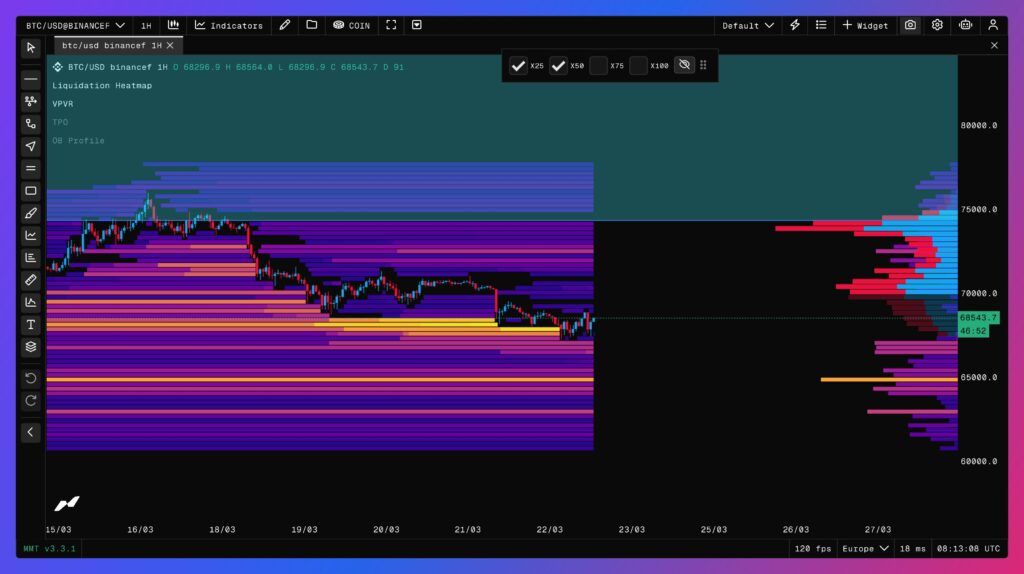
The liquidation map shows clusters at $66,000 and $64,700 to the south and around $69,700 to the north. These two zones have a high probability of being liquidated in the coming days.
If Bitcoin trembled, altcoins literally nosedived, amplifying the downward movement as is their habit during stress phases. Ethereum (ETH) saw its price drop by more than 3% to land around $2,021. Meanwhile, highly sought-after assets like Solana (SOL) and Ripple (XRP) suffered similar losses, confirming coordinated selling pressure across the entire sector. The global market capitalization thus slipped toward $2.37 trillion.
A striking feature of this retracement: Bitcoin’s dominance climbed to reach 58.2%. This 0.27% increase proves that investors are rotating their portfolios. They’re abandoning higher-risk tokens to seek refuge in the liquidity and relative safety of BTC. This behavior is typical of risk aversion periods and distances, for now, the prospect of a new rally in alternative cryptocurrencies.
Market sentiment collapsed in record time. The Fear and Greed index plunged to an alarming score of 9, signaling extreme fear among participants. Meanwhile, short positions climbed to 51.7%, indicating that traders are massively betting on a continuation of the decline. Liquidity has become fragile, and the market now seems driven by panic rather than fundamental convictions.
The current situation raises numerous questions about the crypto market’s short-term resilience. Institutional flows, which had supported prices in recent weeks, are showing signs of weakness. After recording $199 million in net inflows on March 17th, Spot Bitcoin ETFs suffered a violent reversal with $163 million in outflows the very next day. This institutional instability reinforces the climate of doubt.
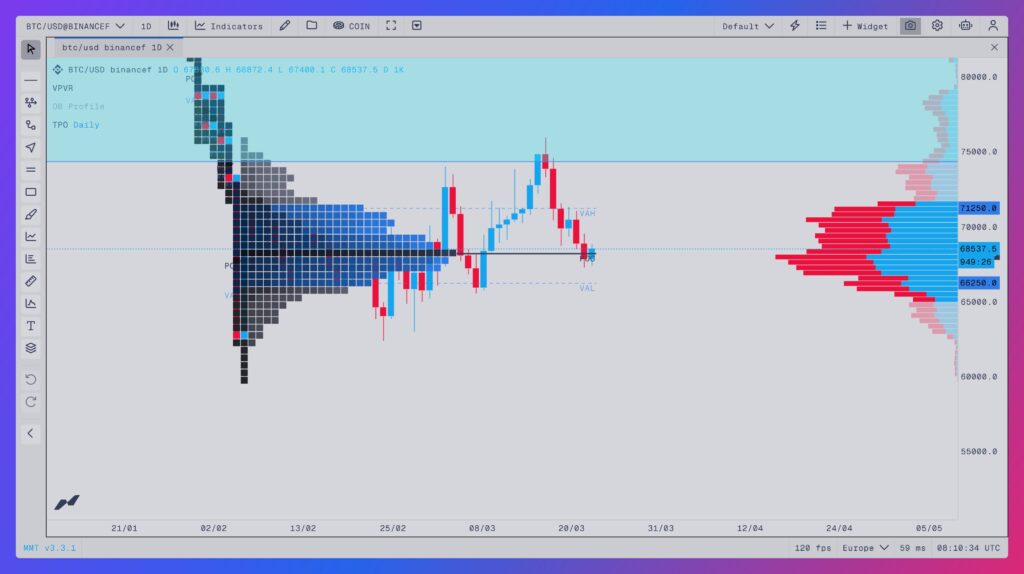
Bitcoin is back in its POC zone with a crucial daily POC at $68,230. This level must be maintained on a daily basis. The VAL at $66,200 is the last important liquidity zone in this range. A drop below this level and Bitcoin has $57,000 as its next target.
Facing these headwinds, investors must navigate with extreme caution. Will whales take advantage of this dip to accumulate, or are we witnessing the beginnings of a deeper purge? How far can Bitcoin’s price fall if the Strait of Hormuz crisis intensifies in the coming days?
Related Articles:

Charles Ledoux is a Bitcoin and blockchain technology specialist. A graduate of the Crypto Academy, he has been a Bitcoin miner for over a year. He has written numerous masterclasses to educate newcomers to the industry and has authored over 2,000 articles on cryptocurrency. Now, he aims to share his passion for crypto through his articles for InvestX.
DISCLAIMER
This article is for informational purposes only and should not be considered as investment advice. Trading cryptocurrencies involves risks, and it is important not to invest more than you can afford to lose.
InvestX is not responsible for the quality of the products or services presented on this page and cannot be held liable, directly or indirectly, for any damage or loss caused by the use of any product or service featured in this article. Investments in crypto assets are inherently risky; readers should conduct their own research before taking any action and invest only within their financial means. This article does not constitute investment advice.

Risk Warning : Trading financial instruments and/or cryptocurrencies carries a high level of risk, including the possibility of losing all or part of your investment. It may not be suitable for all investors. Cryptocurrency prices are highly volatile and can be influenced by external factors such as financial, regulatory, or political events. Margin trading increases financial risks.
CFDs (Contracts for Difference) are complex instruments with a high risk of rapid capital loss due to leverage. Between 74% and 89% of retail investor accounts lose money when trading CFDs. You should assess whether you understand how CFDs work and whether you can afford to take the high risk of losing your money.
Before engaging in financial or cryptocurrency trading, you must be fully informed about the associated risks and fees, carefully evaluate your investment objectives, level of experience, and risk tolerance, and seek professional advice if needed. InvestX.fr and the InvestX application may provide general market commentary, which does not constitute investment advice and should not be interpreted as such. Please consult an independent financial advisor for any investment-related questions. InvestX.fr disclaims any liability for errors, misinvestments, inaccuracies, or omissions and does not guarantee the accuracy or completeness of the information, texts, graphics, links, or other materials provided.
Some of the partners featured on this site may not be regulated in your country. It is your responsibility to verify the compliance of these services with local regulations before using them.

