

Deep Dive into Institutional Blockchain and the CC Token
Canton Network is not just another speculative project; it’s an institutional-grade infrastructure, a Layer 1 specifically designed to bridge the traditional finance (TradFi) world with blockchain innovations.
Developed by Digital Asset, the network offers a unique interoperability solution that preserves privacy, a non-negotiable prerequisite for major financial institutions.
Using the Daml smart contract language, Canton enables distinct applications and assets to synchronize and interact without compromising privacy or participant control.
This architecture has attracted an unprecedented ecosystem of partners. The list includes names like Goldman Sachs (which uses the network for its Digital Asset Platform), Microsoft, BNP Paribas, Citi, HSBC, and Deutsche Bank. These players are not mere marketing partners; they are active participants, using Canton for critical operations like tokenizing US Treasury bonds and other financial assets.
The on-chain metrics are equally impressive. Canton already dominates the RWA space with an overwhelming lead, displaying $407 billion in tokenized assets on its network, 35 times more than Ethereum’s RWA TVL. It processes over $400 billion in daily transactions and generates more than one million dollars in fees.
The native token, Canton Coin ($CC), was launched just days ago with an approach that radically breaks from industry norms: no pre-sale, no pre-mining for private investors. The 100 billion tokens planned will be issued over 10 years as rewards for actual network usage, a strategy aimed at ensuring fair distribution and aligning token growth with ecosystem growth.
Recently, the project has officially called on developers to start building on the network, signaling a willingness to open this ecosystem beyond its initial institutional circle.
Investment Thesis: The Most Obvious Market Anomaly in Crypto?
The investment thesis for Canton Network is based on a glaring and rarely observed market anomaly. Despite its crushing dominance in the RWA sector, its market capitalization (~$4 billion) is more than 100 times lower than Ethereum’s (~$417 billion).
This spectacular undervaluation, while its usage and revenue metrics are very real, forms the core of the bullish argument. The lack of traditional marketing and social media presence, which would be a red flag for any other project, is here perceived by many as a unique opportunity to invest before the general public discovers the project.
The massive institutional backing and discreet accumulation observed in pre-launch markets (with valuation exceeding $6 billion) suggests that informed investors and “smart money” are already positioning for a potential massive revaluation. The recent call to developers reinforces this thesis, countering fears of a purely institutional and closed network and signaling a new phase of active growth.
Technical Analysis of CC Token: Towards a Po3?
Since its launch at $0.11, the $CC token has already shown solid performance, currently trading around $0.12.
Technical analysis, though the token is young, reveals promising signs, with a Po3 in preparation. On-chain analysts have identified what appears to be an institutional accumulation phase, visible through consolidation zones and silent absorption of available supply.
The current price structure suggests the formation of a solid base, with volume that, while not explosive, remains consistent and indicates sustained buyer interest. The general forecast shared by several observers is that the token will be actively bought in the coming weeks, as information spreads.
The short-term target valuation, according to some technical and fundamental analyses, sits between $4.6 and $7 billion. Breaking through the first post-launch resistances, located around $0.20, could serve as a trigger and initiate significant bullish momentum, especially if market recognition finally begins to catch up with the project’s overwhelming fundamentals.
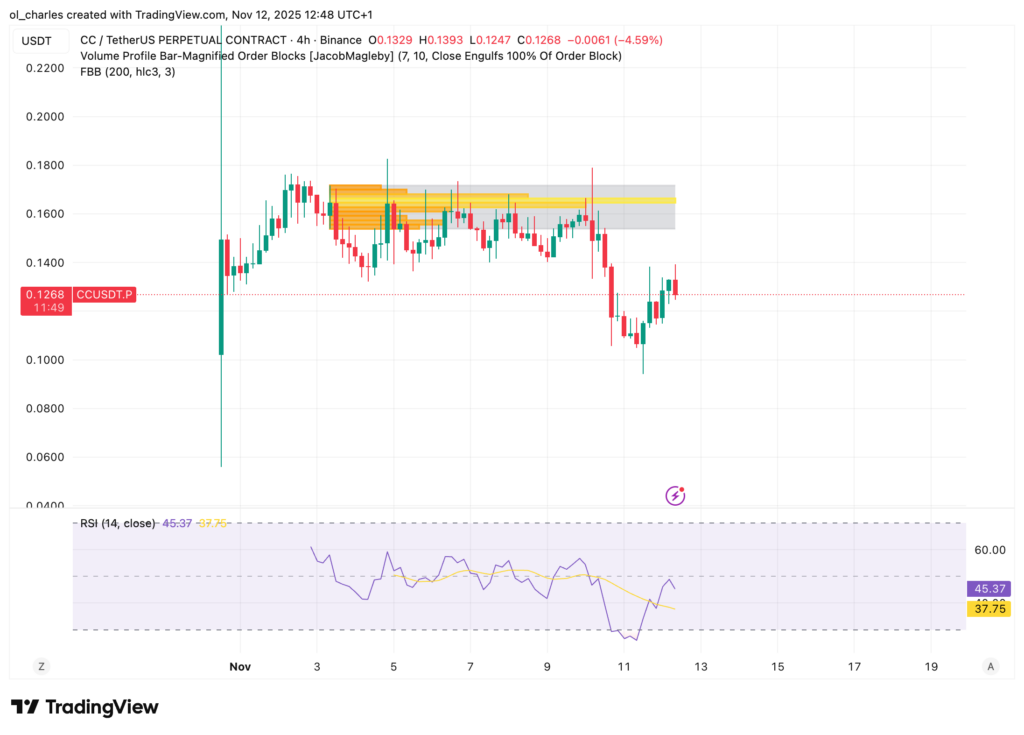
The 4-hour Order Block shows distribution and selling pressure between $0.15 and $0.17. This zone will therefore be crucial and must be broken to relaunch the bullish trend.
What Strategy to Adopt?
For the CC token, it’s better to opt for DCA and set stop losses below its current price. Newly launched tokens are often very volatile.
To minimize risks in case of CC falling, generate up to 180% profits with Pionex bots.
For example, Pionex’s Hedging Bot is an automated solution that combines long and short positions on altcoins like HYPE and SOL, using futures and spot contracts to neutralize risks while profiting from volatility. Its reliability relies on advanced risk management via AI 2.0, dynamically adjusting hedges (e.g., long SOL spot + short SOL futures) to limit risks. Even during bear markets.
Designed for the long term, it generates stable returns of 50-180% annualized on wide ranges. Test them now: Launch Pionex → Bot → Futures Grid or Hedging → AI Strategy → Create,
Related articles:

