

CleanSpark Liquidates 97% of Its Production: The Shocking Numbers
The data is in, and it’s unequivocal. CleanSpark, one of the American mining giants often praised for its treasury management, made a complete 180-degree turn in February 2026. While the company mined 568 BTC during the month, it sold 553, representing an impressive liquidation rate of 97%. This operation generated approximately $36.6 million in liquidity, at an average selling price of $66,279.
This move sharply contrasts with the accumulation strategy (the famous HODL) that had prevailed among major publicly traded players until now. In January, CleanSpark was still holding onto a large portion of its coins. This sudden change is not insignificant: it indicates that even the most robust players feel an urgent need for immediate cash flow. The market, which watches miners’ wallets like a hawk, often interprets these movements as a short-term bearish signal. If the producers themselves aren’t keeping their tokens, who will?
This is not an isolated case. On-chain data shows that miners’ global reserves have been in free fall since the October 2025 peak (when Bitcoin flirted with $126,000). Today, with BTC consolidating around $66,000 – $70,000, the selling pressure from these institutional players adds a major resistance layer, preventing any significant breakout to the upside for now.
Declining Profitability and AI Pivot: Why Are Miners Selling?
Why such a hemorrhage now? The answer is twofold: margin compression (profitability squeeze) and an irresistible technological opportunity. The hashprice — revenue generated per unit of computing power — has fallen below the critical threshold of $30 per PH/s. In this context, mining Bitcoin becomes a tight-margin activity for many, especially with energy costs that aren’t weakening.
Faced with this reality, the sector’s narrative is changing. It’s no longer just “mine and hold,” but “mine to finance AI.” CleanSpark, like its competitors Riot Platforms and Core Scientific, is using this liquidity to invest massively in high-performance computing (HPC) infrastructure. The calculation is straightforward: why expose yourself to the extreme volatility of the crypto market when tech giants are ready to pay fortunes for computing power dedicated to artificial intelligence?
This structural transition transforms miners into structural net sellers. They’re no longer selling out of panic, but as an industrial strategy. However, for the crypto trader, the result is the same: an increase in available supply on exchanges (sell-side liquidity). This is a classic capitulation mechanism from miners, often observed during retracement phases post-ATH, where only the most efficient survive or reinvent themselves.
Take advantage of the capitulation to accumulate maximum BTC on OKX. Indeed, up to $10,000 in rewards to win to boost your investments right now with our exclusive offer here:
Price Impact: Will the $57,000 Support Hold?
Bitcoin’s history teaches us that miner capitulation phases often mark major inflection points. When miners sell massively, it first creates downward pressure, absorbing demand from retail and institutional investors. The market then finds itself in a turbulence zone, oscillating between fear and uncertainty.
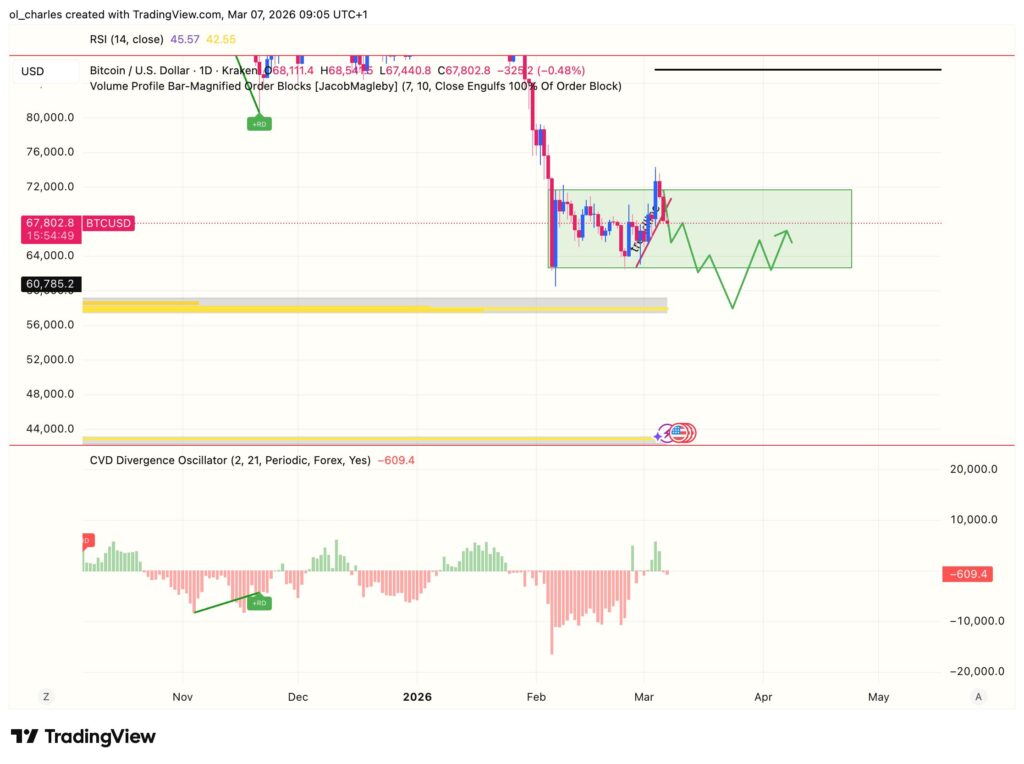
Currently, Bitcoin seems set to seek liquidity below $60,000. The daily order block between $57,000 and $59,000 could serve as a bottom to reintegrate the range above $60,000 and attempt to find healthy consolidation there. A loss of this demand zone and BTC will seek $52,000 or even $47,000.
Related Articles:

