

Governance Changes and Uncertainties Surrounding WLFI
Following Alt5 Sigma’s announcement of its plan to acquire $1.5 billion worth of WLFI tokens, changes have been made to the board of directors’ composition. Eric Trump, initially appointed to the board, has now been relegated to observer status, while Zak Folkman, World Liberty’s COO, has been designated as a director, subject to shareholder approval.
This restructuring raises questions about the specific Nasdaq requirements that motivated these modifications. Although regulations have not provided clear explanations, legal analysts struggle to identify the precise reasons for accepting one candidate and rejecting the other, both appearing equally non-independent.
Eric Trump expressed his views on X, stating that he remains fully committed to the project and truly believes it is the “future of finance.”
Technical Analysis: Mixed Signals and Persistent Uncertainties
Analysis of the hourly chart for WLFI reveals the formation of an inverse head and shoulders pattern around recent lows, suggesting potential for a reversal. However, confirmation of this pattern would require a sustained bounce above the resistance at $0.22-0.23.
The WLFI token is currently facing significant selling pressure, reaching new 52-hour lows at $0.1963. This large-scale distribution, without transparent explanation from the World Liberty team, raises concerns about the soundness of its fundamentals.
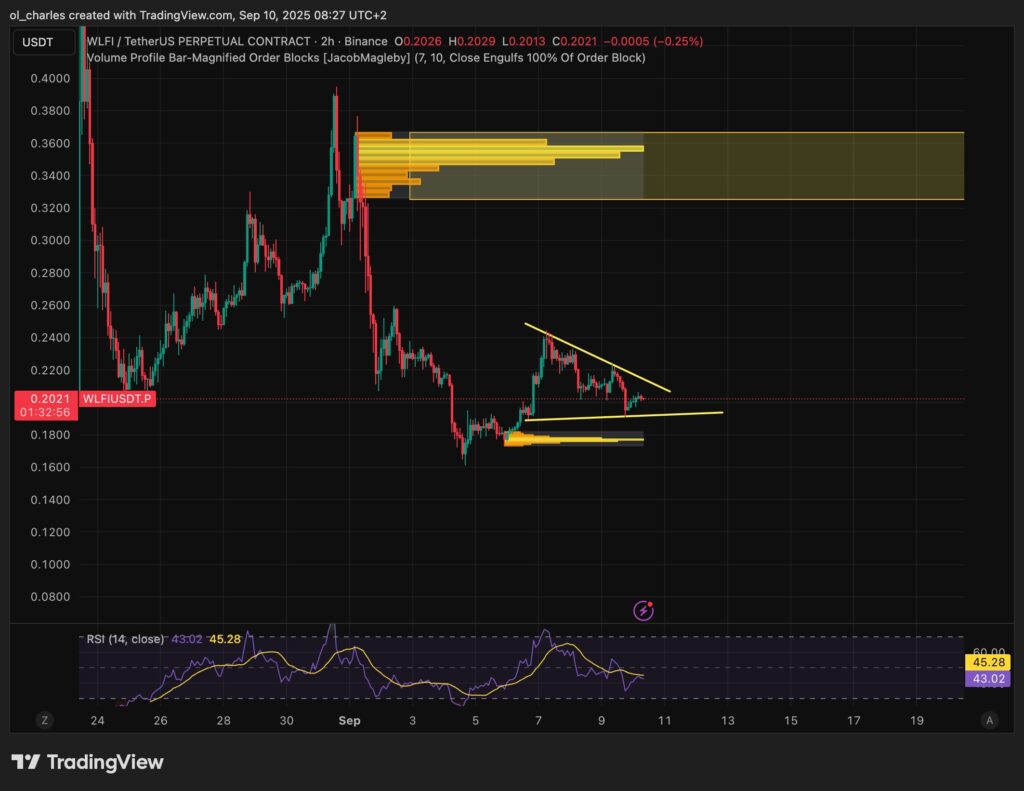
Currently, WLFI is managing to maintain above $0.19. However, a return of the 2-hour RSI to oversold territory is highly likely, which should push it toward the demand zone between $0.17 and $0.18.
Conversely, if WLFI breaks the resistance at $0.26, it will have a clear path to the Fair Value Gap at approximately $0.30.
Despite potential for a rebound around support levels, investors should carefully monitor WLFI price movements, governance changes, and regulatory developments. The token’s recovery will depend on World Liberty’s ability to overcome these obstacles and reassure investors about the strength of its project.
Eric Trump’s withdrawal from World Liberty Financial’s board of directors has created a perfect storm of regulatory and technical uncertainties around the WLFI token. Investors must carefully weigh the risks and opportunities before committing to this volatile market.
How to Generate Profits on WLFI with Pionex Bots?
WLFI is emerging as a promising DeFi token linked to an innovative ecosystem, offering growth potential despite current turbulence – a unique opportunity for visionary investors to bet on the future of decentralized finance.
Pionex allows you to purchase World Liberty Financial in a simple and secure manner. Here’s a step-by-step guide:
- Registration and verification: Create an account on Pionex via the website or mobile app. Provide an email address and activate two-factor authentication (2FA) for maximum security. Complete KYC verification by providing identification, which raises your trading limits.
- Fund deposit: Add funds via bank card, SEPA transfer (free in Europe) or crypto transfer from another wallet. Pionex handles over 100 fiat currencies, making WLFI accessible to traders worldwide.
- Purchasing WLFI: Go to the “Spot Trading” section and select the WLFI/USDT or WLFI/EUR pair. Enter the amount to invest, choose a market order for immediate execution or a limit order for a target price. Fees are minimal, around 0.05%.
- Secure storage: After purchase, keep your WLFI in the Pionex wallet or transfer them to an external hardware wallet. The platform stores 95% of funds in cold storage for optimal protection.
Optimizing WLFI Purchases with Trading Bots on Pionex
The Grid Trading Bot is ideal: it deploys a grid of automated buy/sell orders around the current price, profiting from swings – set it between $0.14 and $5 to accumulate during dips toward $0.20 and $0.18.
The DCA Bot (Dollar-Cost Averaging) is suitable for WLFI, investing in tranches to smooth entries in the face of regulatory news, aiming for an optimized average around $0.22. These bots automate strategies, maximizing returns on potential WLFI rebounds without constant effort.
On the same topic:

