

Strong Fundamentals, Price Under Pressure
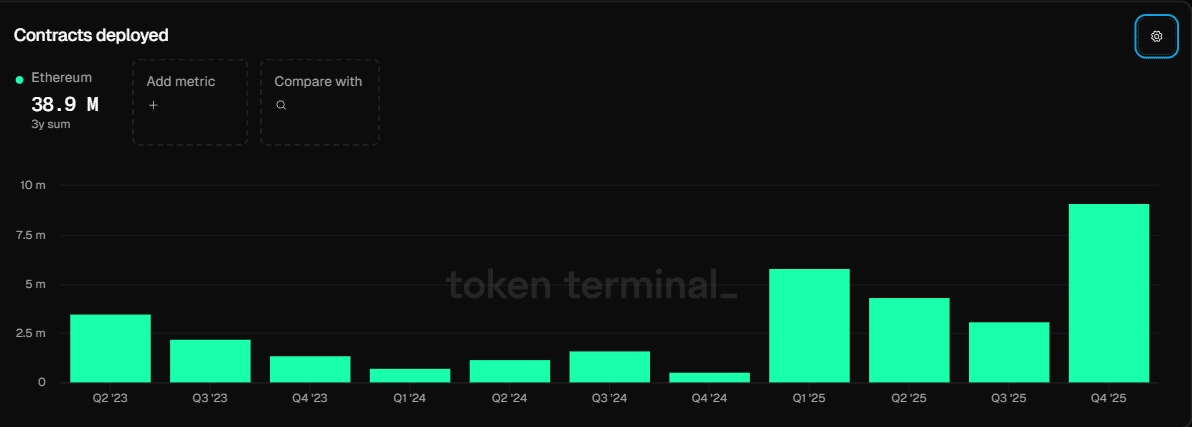
The paradox is striking: fundamentally, Ethereum has never been more robust. On-chain data shows a record 9.1 million smart contracts deployed and an explosion in DApps volumes, now reaching $180 billion weekly. Network activity confirms massive adoption and sustained use of the ecosystem.
Yet the price tells a completely different story. Ether (ETH) shows a severe correction of -45%, its worst quarterly performance since the bear market of 2018. This disconnect between fundamentals and price is surprising: network utility is progressing, but buying pressure remains absent, leaving the token in what appears to be an undervalued zone.
Investors seem to favor short-term speculation over structural conviction. The derivatives market dominates, while spot accumulation remains insufficient to build sustainable support. The result: rock-solid fundamentals, but an asset still vulnerable to volatility.
Stalled Rotation and $2,000 Support in Danger
Hopes for a Bitcoin to Ethereum rotation are fading. The ETH/BTC ratio continues to erode, signaling the absence of rotational flows toward major altcoins. Instead of migrating to ETH, capital remains positioned on Bitcoin or exits the market, hampering any attempt at outperformance.
Two major obstacles explain this inertia: outflows from Ethereum ETFs, notably more than $45 million withdrawn from BlackRock’s ETHA fund, and the lack of spot conviction. Leverage dominates trading, while certain sales attributed to wallets linked to Vitalik Buterin weigh on retail investor sentiment.
Now, all eyes are on the critical support at $2,000, with price moving around $1,900 – $2,000. Without clear defense accompanied by massive spot volume, the risk of deeper capitulation increases. The question is no longer just about a new ATH, but about a possible sustained migration of liquidity to competitors like Solana (SOL) in 2026.
Related Articles:

