Ethereum plunges to $2,100: Can ETH reach $1,300 in 2026?
Ethereum's price drops to $2,100. Expert analysis reveals potential support levels, price targets, and scenarios for the next bull run. Click to learn more!



Ethereum's price drops to $2,100. Expert analysis reveals potential support levels, price targets, and scenarios for the next bull run. Click to learn more!
The situation has deteriorated sharply for the second-largest cryptocurrency by market cap. Within 24 hours, Ethereum (ETH) has suffered a severe correction, dragging the price below the psychological and technical threshold of $2,400. At the time of writing, the asset is trading around $2,240, marking a drop of nearly 10% on the day.
This decline validates a worrying bearish structure. The support level at $2,475, which had held during previous attacks, was shattered with massive selling volume. Technical indicators like the RSI (Relative Strength Index) are plunging into oversold territory, signaling intense selling pressure but also suggesting that a short-term technical bounce could occur due to seller exhaustion.
On-chain analysis reveals that many short-term holders are now “underwater,” increasing the risk of panic selling if the current level doesn’t hold. The loss of $2,400 has transformed this former support into a major resistance that bulls will absolutely need to reclaim to hope for a trend reversal.
The market stands at a crossroads. If bearish pressure persists, the bears’ next target is clearly identified. According to market data and liquidation levels, a confirmed break below $2,200 would open the path toward the critical support at $1,740. This level corresponds to a historical accumulation zone and could act as the last line of defense before a much deeper correction.
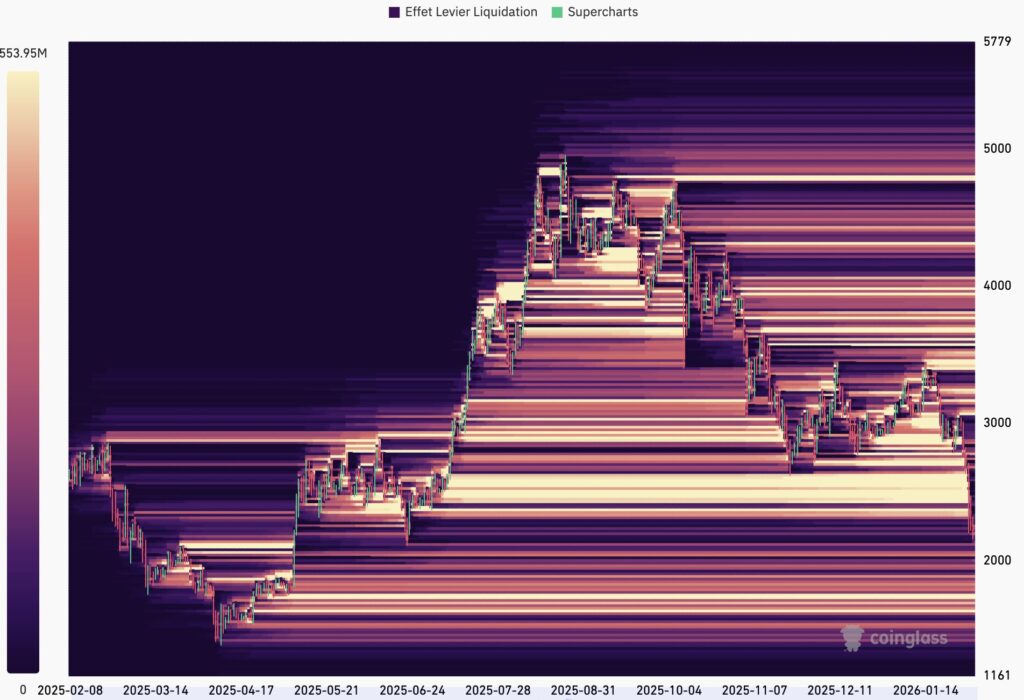
Conversely, to invalidate this catastrophic scenario, Ethereum must absolutely reclaim the $2,400 – $2,475 zone. Such a move, accompanied by rising volumes, could signal a fakeout (false breakdown) and trap short sellers (short squeeze), thus relaunching momentum toward $2,600.
Market sentiment is currently dominated by extreme fear, often synonymous with opportunities for long-term contrarian investors. However, for traders, caution is warranted: catching a falling knife that’s losing its supports so easily is very risky.
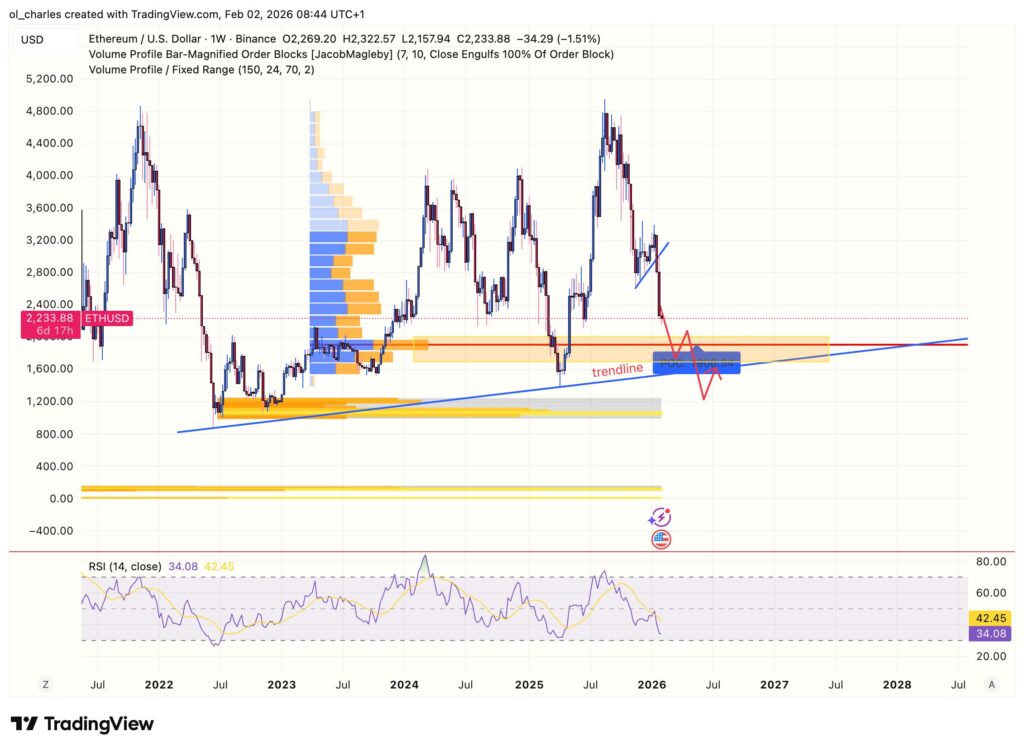
Moreover, the historical trendline increases the probabilities of a deeper drop toward $1,300 if ETH breaks downward and closes below the weekly POC at $1,900.
Related Articles:

Charles Ledoux is a Bitcoin and blockchain technology specialist. A graduate of the Crypto Academy, he has been a Bitcoin miner for over a year. He has written numerous masterclasses to educate newcomers to the industry and has authored over 2,000 articles on cryptocurrency. Now, he aims to share his passion for crypto through his articles for InvestX.
DISCLAIMER
This article is for informational purposes only and should not be considered as investment advice. Trading cryptocurrencies involves risks, and it is important not to invest more than you can afford to lose.
InvestX is not responsible for the quality of the products or services presented on this page and cannot be held liable, directly or indirectly, for any damage or loss caused by the use of any product or service featured in this article. Investments in crypto assets are inherently risky; readers should conduct their own research before taking any action and invest only within their financial means. This article does not constitute investment advice.




Risk Warning : Trading financial instruments and/or cryptocurrencies carries a high level of risk, including the possibility of losing all or part of your investment. It may not be suitable for all investors. Cryptocurrency prices are highly volatile and can be influenced by external factors such as financial, regulatory, or political events. Margin trading increases financial risks.
CFDs (Contracts for Difference) are complex instruments with a high risk of rapid capital loss due to leverage. Between 74% and 89% of retail investor accounts lose money when trading CFDs. You should assess whether you understand how CFDs work and whether you can afford to take the high risk of losing your money.
Before engaging in financial or cryptocurrency trading, you must be fully informed about the associated risks and fees, carefully evaluate your investment objectives, level of experience, and risk tolerance, and seek professional advice if needed. InvestX.fr and the InvestX application may provide general market commentary, which does not constitute investment advice and should not be interpreted as such. Please consult an independent financial advisor for any investment-related questions. InvestX.fr disclaims any liability for errors, misinvestments, inaccuracies, or omissions and does not guarantee the accuracy or completeness of the information, texts, graphics, links, or other materials provided.
Some of the partners featured on this site may not be regulated in your country. It is your responsibility to verify the compliance of these services with local regulations before using them.