

Ethereum and Solana: Giants with Feet of Clay?
Evgeny Gaevoy didn’t mince words. According to Wintermute’s CEO, neither Ethereum (ETH) nor Solana (SOL) possess a true “moat” — that famous defensive barrier supposed to protect their market share. Despite a bull run that saw both ecosystems attract billions in capital, their leadership position appears far more fragile than it seems when facing new entrants.
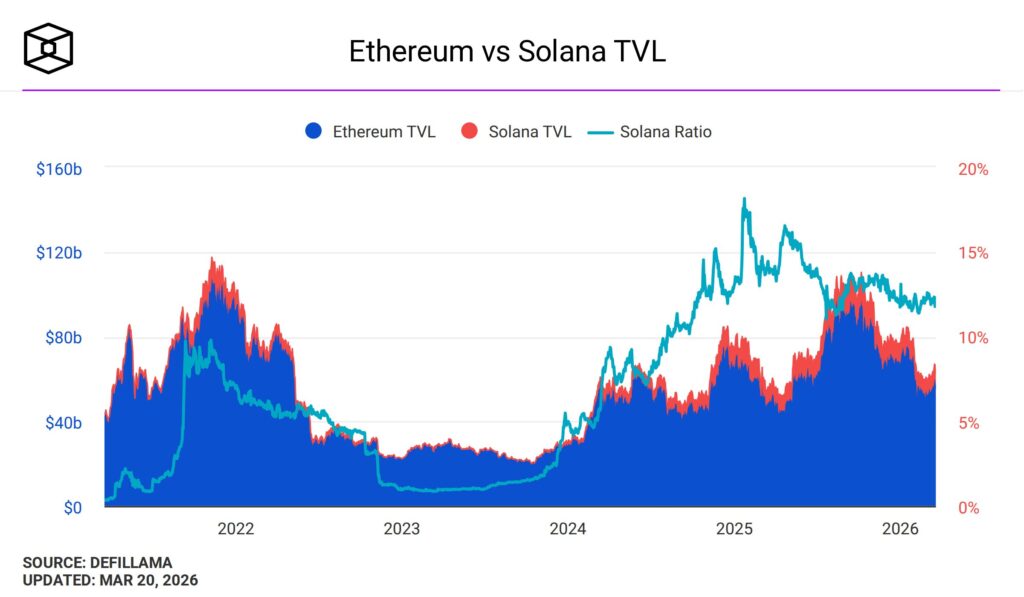
For Ethereum, the assessment is harsh. While the blockchain displays a massive TVL (Total Value Locked) of over $56 billion, Gaevoy believes much of these funds are merely “trapped money” from institutional experimentation. The network struggles to innovate beyond its pioneer status, risking a decline in influence if genuine catalysts don’t emerge quickly.
On Solana’s side, the analysis is hardly more flattering. While the network experienced a spectacular rally driven by memecoin frenzy, it suffers from a critical lack of new fundamental decentralized applications (dApps). Without diversifying its use cases, Solana could face a brutal correction of its ecosystem once the hype dissipates.
Hyperliquid’s Surprising Rise: The New Revenue King?
The real surprise in this analysis lies in the rise of next-generation players, capable of crushing established models and seeing their adoption explode. The most striking example cited by Gaevoy is Hyperliquid. In just three years of existence, this blockchain specialized in derivatives trading has achieved a remarkable feat by establishing itself against industry leaders.
Today, Hyperliquid captures nearly 45% of the revenue generated by fees across the entire blockchain market. An enormous performance that proves a new entrant, equipped with optimized technology and smooth user experience, can siphon liquidity from historical giants. Moreover, trading volumes on commodities and stocks have exploded on Hyperliquid. Now, traders are trading more oil, gold and silver than crypto with an OI of over $1.5 billion.
Furthermore, the threat doesn’t stop at decentralized platforms. The imminent arrival of private enterprise blockchains, like Circle’s Arc project or Google’s mysterious Universal Ledger, could offer more stable transaction environments. A dynamic that risks making investors bearish on traditional Layer 1 blockchains if they don’t adapt quickly.
How Far Can Ethereum and Solana’s Price Go Against This New Competition?
Faced with these revelations, the question of these assets’ long-term valuation arises. If Ethereum and Solana want to hope for a new ATH in the coming years, they must imperatively consolidate their ecosystem and prove their technology is irreplaceable. The crypto market is ruthless, and the absence of a “moat” could cost late investors dearly.
However, institutional liquidity continues to support these two behemoths. Recent inflows into Ethereum ETFs and Solana network’s resilience against outages show that confidence isn’t completely broken. Traders will need to closely monitor upcoming support levels to avoid being trapped by an unexpected retracement in the markets.
As the blockchain war intensifies and new challengers threaten to soar, the cards are being reshuffled. Will investors be able to identify tomorrow’s true gems before the market dictates its law? The battle for Web3 dominance is just beginning.
Related Articles:

