Ethereum: Whales buy the dip, But is a crash inevitable?
Ethereum whales are buying the dip below $3,000. Is a price crash inevitable? Get the latest ETH analysis and market insights.



Ethereum whales are buying the dip below $3,000. Is a price crash inevitable? Get the latest ETH analysis and market insights.
The recent drop of Ethereum below the $3,000 mark has acted as a buy signal for some of the market’s largest wallets. According to on-chain data, whales and institutional investors have injected over $130 million to buy this dip. Among them, Trend Research borrowed 70 million USDT to acquire approximately 24,555 ETH, while an OTC whale secured 20,000 ETH via FalconX.
However, this bullish picture is clouded by worrying contrary movements. The giant BlackRock has transferred over 30,000 ETH (approximately $91 million) to Coinbase Prime, a move typically associated with an intention to sell or hedge. This divergence between accumulation by some players and distribution by others creates palpable uncertainty in the market, as the price currently hovers around $3,030.
From a chart perspective, the loss of the support at $3,000 has validated a bearish break of structure. Analysts are now monitoring critical liquidity zones located lower. If buyers fail to quickly reclaim the current level, the price could be drawn toward $2,718, or even $2,620, where significant stop orders are concentrated.
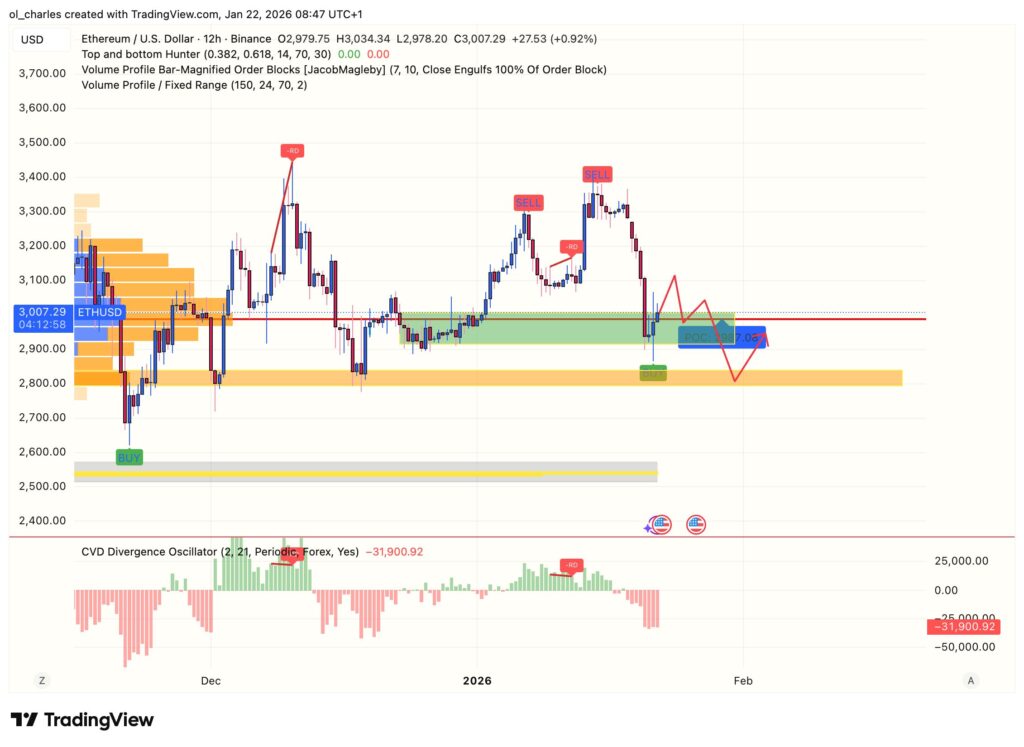
Moreover, the delta between whales and retail investors has moved into negative territory. This means that despite the sporadic buying mentioned above, the overall trend among large wallets is toward reducing long exposure or adding short positions. With over $280 million in liquidations recorded recently, volatility remains extreme.
The situation is critical for the market’s second-largest cryptocurrency. On one hand, the voracious appetite of certain institutions like BitMine, which continues to accumulate for staking, offers a safety net. On the other, the technical structure and BlackRock’s outflows weigh heavily on sentiment.
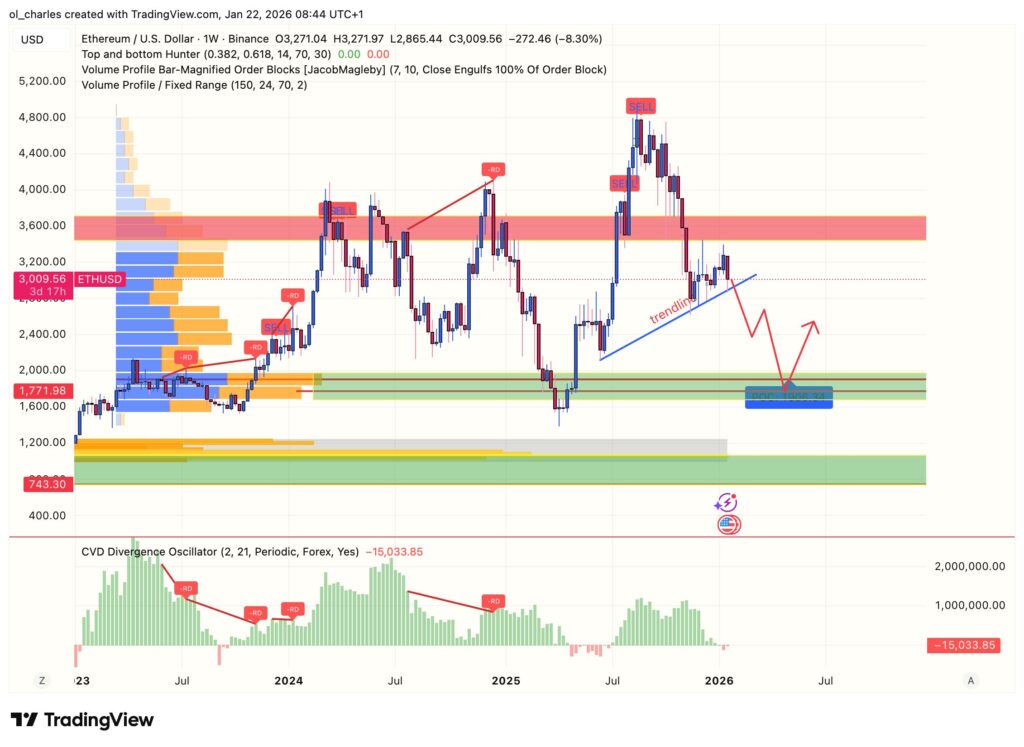
Furthermore, the bullish trendline offers an ideal opportunity for market makers to liquidate all the longs accumulated for months below this level in order to buy ETH even lower. In this context, ETH could return to its demand zone around $1,780 in the coming months.
Traders must now monitor the price reaction in the current zone. Will a weekly close below $2,900 confirm the bearish scenario of a drop toward $2,700, or will the accumulators have enough strength to trigger a short squeeze and restart the engine?
Related Articles:

Charles Ledoux is a Bitcoin and blockchain technology specialist. A graduate of the Crypto Academy, he has been a Bitcoin miner for over a year. He has written numerous masterclasses to educate newcomers to the industry and has authored over 2,000 articles on cryptocurrency. Now, he aims to share his passion for crypto through his articles for InvestX.
DISCLAIMER
This article is for informational purposes only and should not be considered as investment advice. Trading cryptocurrencies involves risks, and it is important not to invest more than you can afford to lose.
InvestX is not responsible for the quality of the products or services presented on this page and cannot be held liable, directly or indirectly, for any damage or loss caused by the use of any product or service featured in this article. Investments in crypto assets are inherently risky; readers should conduct their own research before taking any action and invest only within their financial means. This article does not constitute investment advice.





Risk Warning : Trading financial instruments and/or cryptocurrencies carries a high level of risk, including the possibility of losing all or part of your investment. It may not be suitable for all investors. Cryptocurrency prices are highly volatile and can be influenced by external factors such as financial, regulatory, or political events. Margin trading increases financial risks.
CFDs (Contracts for Difference) are complex instruments with a high risk of rapid capital loss due to leverage. Between 74% and 89% of retail investor accounts lose money when trading CFDs. You should assess whether you understand how CFDs work and whether you can afford to take the high risk of losing your money.
Before engaging in financial or cryptocurrency trading, you must be fully informed about the associated risks and fees, carefully evaluate your investment objectives, level of experience, and risk tolerance, and seek professional advice if needed. InvestX.fr and the InvestX application may provide general market commentary, which does not constitute investment advice and should not be interpreted as such. Please consult an independent financial advisor for any investment-related questions. InvestX.fr disclaims any liability for errors, misinvestments, inaccuracies, or omissions and does not guarantee the accuracy or completeness of the information, texts, graphics, links, or other materials provided.
Some of the partners featured on this site may not be regulated in your country. It is your responsibility to verify the compliance of these services with local regulations before using them.