

XRP ETFs Crush the Competition with an Unprecedented Fee War
The rapid accumulation in XRP ETFs is driven by an aggressive cost compression strategy. Franklin Templeton struck hard with its XRPZ fund, displaying management fees of 0.19% fully waived on the first five billion dollars of assets until May 2026. For portfolio managers and institutional advisors, this structure amounts to a free carry trade for six months, eliminating all cost-related friction.
Grayscale follows the same logic with its GXRP, waiving its standard fees for three months. This massive subsidy from issuers has unleashed institutional capital flows that were waiting for precisely these conditions to deploy. The day of November 24th perfectly illustrates this: the entry of these two giants triggered an injection of 164 million dollars in a single session, representing nearly 30% of the total accumulated since launch.
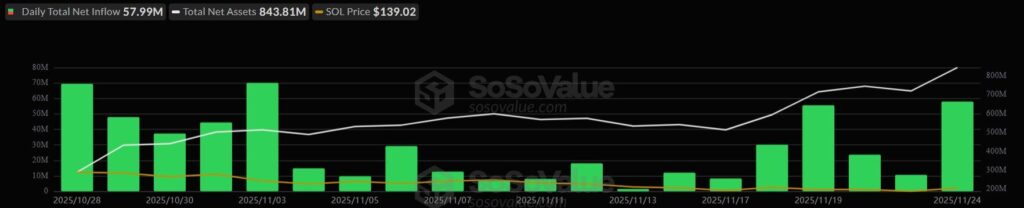
The Solana ETFs also offer exemptions, notably Bitwise’s BSOL, but the scale of Franklin’s cap creates an unparalleled magnitude effect. This fee structure differential transforms XRP into the preferred vehicle for tactical allocations, while Solana remains a more speculative position in model portfolios.
XRP Breaks Key Resistance While Solana Absorbs Selling Pressure
The fundamental divergence between the two assets lies in their flow-price relationship. The 568 million dollars in Solana ETF inflows occurred during a 30% correction from recent highs. These flows cushioned selling pressure without reversing the bearish trend, transforming the SOL ETF into a defensive accumulation tool for institutional investors seeking an entry point on the dip.
XRP takes the opposite trajectory. After a 17% decline over 30 days, the token surged 10% following the record day of November 24th, breaking through the psychological threshold of 2 dollars before reaching 2.27 dollars. This zone historically represents a massive supply ceiling, where long-term holders liquidate positions to offset losses accumulated since early 2025.
Glassnode on-chain data confirms that this resistance acted as a sell wall during previous cycles. Today, the daily inflow of 40 to 100 million dollars via ETFs creates price-insensitive demand capable of absorbing this legacy supply. Unlike Solana where flows fight against market gravity, XRP ETFs function as a battering ram, transforming a distribution zone into an institutional accumulation floor.
Heading Toward 2 Billion Dollars in Assets Under Management Before the End of 2025?
The current pace places XRP on a trajectory never observed for an altcoin outside Bitcoin and Ethereum. If the trend normalizes around 40 to 60 million dollars in daily inflows after the initial euphoria, the ETF complex could reach 1.5 billion dollars in assets under management by year-end.
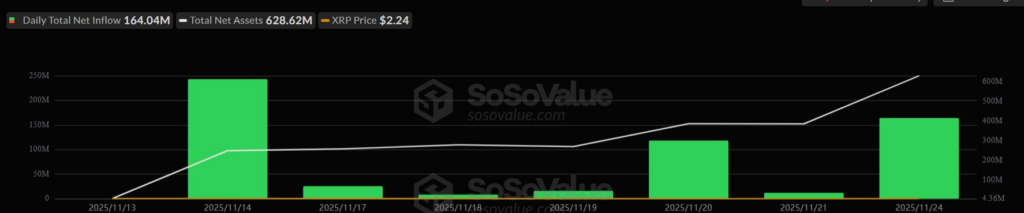
The bullish scenario becomes even more credible if Franklin Templeton succeeds in massively convincing registered investment advisors. These players manage trillions of dollars and favor zero-fee wrappers for tax optimization and tactical rotation. If this segment fully activates, the 2 billion dollars in assets under management threshold becomes achievable before the close of 2025.
This performance transforms XRP into a benchmark for institutional altcoin allocations. The adoption speed even surpasses that observed during the launch of the first spot Ethereum ETFs, suggesting structural appetite for crypto exposures beyond the BTC-ETH duopoly. The coming weeks will tell whether this momentum proves sustainable or if saturation approaches.
Take advantage of our exclusive offer to purchase your Ledger wallet during Black Friday:

Related content:

