

Is Ethereum About to Crash ?
Ethereum is currently down nearly 3% and trading below $4,000. Meanwhile, Bitcoin looks poised to move toward long-term clusters around $105,000 in the coming weeks after being rejected at $113,000 and losing the $112,000 support level.
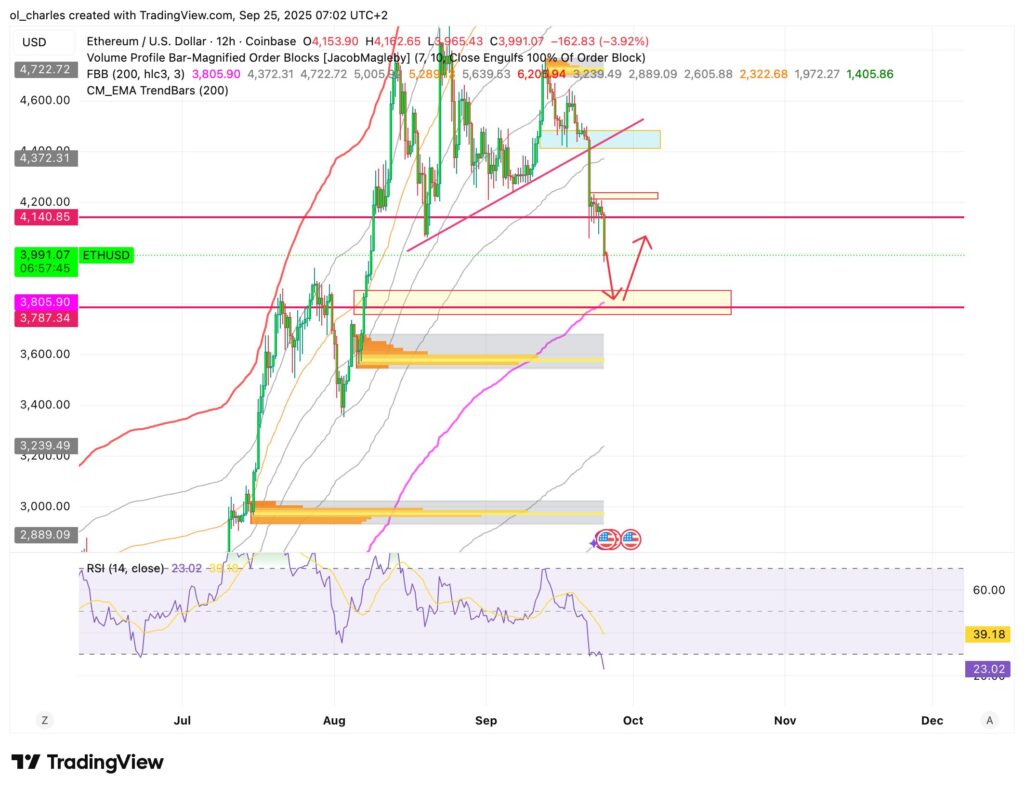
As a result, Ethereum is expected to return to the $3,700 zone very soon. Depending on how it reacts in this zone, ETH could even fall as low as $2,900 or even $2,300.
If ETH drops into this zone, it’s advisable to wait and observe the reaction before entering a position if you’re late to the trade.
According to trader Ansem, ETH could experience a 50% crash in the coming weeks. Additionally, numerous long positions are situated in the region between $3,600 and $3,400, increasing the probability of a deeper drop below $3,700.
The next support levels are at $2,980 and $2,250. While the support at $2,980 is more likely to hold than the one at $2,300, which represents an extreme scenario. A scenario that Ansem is also anticipating.
A Short Opportunity Not to Miss on ETH
At $4,192, ETH is testing a fragile support at $3,900, with a risk of long liquidations at $3,400 that could accelerate the drop to $2,900. A short position here offers an attractive risk/reward ratio (1:3). For beginners, start small (1-2% of your portfolio) and observe the reaction at $3,700 before adjusting.
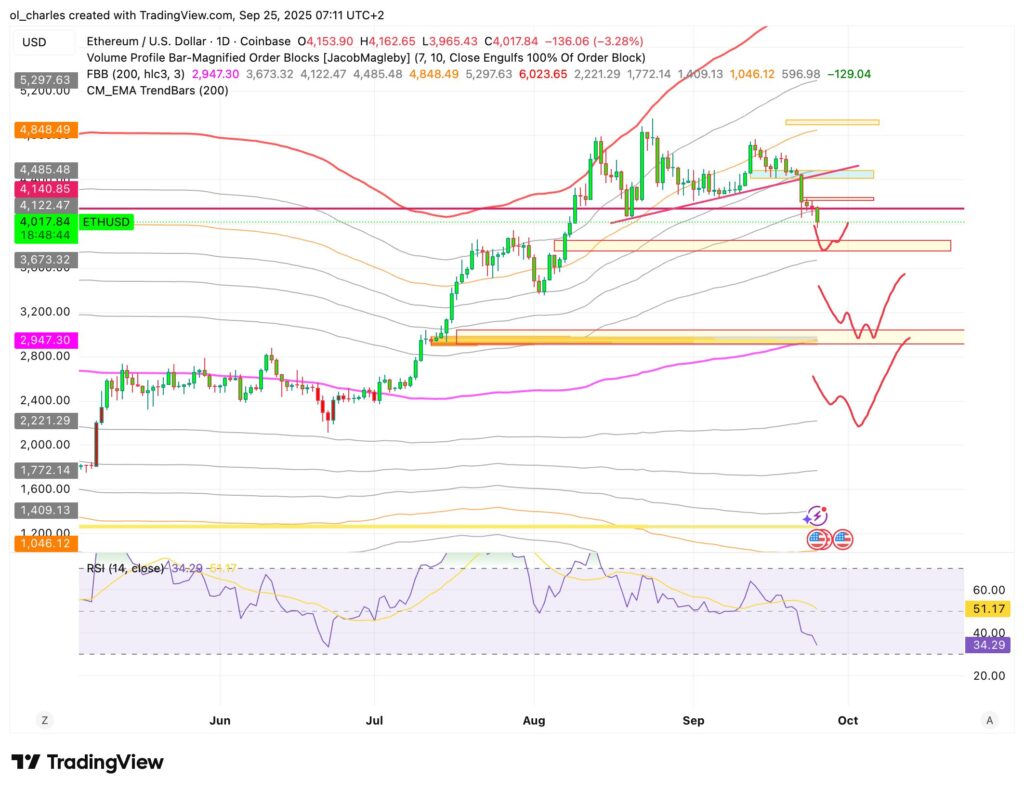
Here’s a short trade to execute on ETH using Bitget right now :
- Entry point : between $3,900 and $4,200
- Stop Loss : $4,300
- TP : $3,700, $2,900, $2,300
- Leverage : x3 to x5
Here’s how to execute your short on Bitget easily, without needing extensive trading knowledge :
How to Short Ethereum on Bitget ?
Shorting ETH means betting on a price decrease : you borrow ETH to sell now, then buy it back cheaper to pocket the difference. On Bitget, this is accessible through futures contracts (perpetuals), with no advanced experience required. Here are the simple steps, following the proposed strategy :
- Create a Bitget account : Download the app or visit Bitget. Register with your email or phone number, and complete KYC verification (ID) in 5-10 minutes. This is mandatory for deposits over €1,000 and ensures security under MiCA regulations in Europe.
- Deposit funds : Transfer money via credit card (Visa/Mastercard, ~1-2% fee), SEPA transfer (free, 1-2 days), or crypto (USDT from another wallet). Start with €100-500 to test. Funds land in your “spot wallet”; transfer them to “futures” via the “Assets” tab for trading.
- Access futures contracts : Go to “Futures” > “USDT-M” (USDT-denominated perpetuals, ideal for beginners). Search for “ETH/USDT”. Choose a perpetual contract (unlimited expiration) and low leverage (click on “x1-x5” to avoid unexpected liquidations).
- Place your short order :
- Select “Sell/Short” (sell to short).
- Entry point : Set a limit order between $3,900 and $4,200 to enter gradually (e.g., 50% at $4,000, 50% at $3,900). This prevents entering too high if ETH climbs.
- Quantity : Calculate based on your capital (e.g., 0.01 ETH for €100 with 1x leverage).
- Stop Loss (SL) : Place at $4,300 (“Stop Market” or “Trailing Stop” order). This is your safety net: if ETH rises to $4,300, the order automatically closes your position to limit losses to ~2-5% of your investment. For beginners, SL is essential – it protects against whipsaws (false moves) and enforces discipline. Without SL, an unexpected rise could wipe out your capital!
- Take Profit (TP) : Set partial exits – 50% at $3,700 (first TP, 7% gain), 30% at $2,900 (25% gain), and 20% at $2,300 (~40% gain). Use “Limit” orders to lock in profits without 24/7 monitoring. Manage risk: never risk more than 1-2% per trade; adjust size if leverage >1x.
- Monitor and close : Use the app for push alerts. If ETH hits $3,700 without bouncing, hold; otherwise, cut manually. And move your stop loss to your entry point.

