

Increased Volatility Expected for Crypto Market This Week
This week’s economic calendar is likely to trigger increased volatility in crypto markets. Savvy investors know that certain macroeconomic events can trigger sudden movements in Bitcoin, and this week is no exception. The upcoming U.S. inflation data is among the most anticipated releases, capable of influencing not only traditional markets but the entire crypto ecosystem.
Meanwhile, several major mining companies are preparing to reveal their quarterly results. These figures will provide valuable insights into the health of the Bitcoin network and mining profitability amid increasing difficulty. The correlation between miner performance and BTC price remains a leading indicator that experienced traders monitor closely.
U.S. Inflation in the Spotlight: What Impact on Bitcoin?
The release of U.S. inflation data represents this week’s major macroeconomic event. The Consumer Price Index (CPI) could trigger a chain reaction across all risk assets, including Bitcoin. Historically, inflation figures directly influence the Fed’s monetary policy and, by extension, institutional investors’ risk appetite.
If inflation proves higher than expected, pressure could intensify on the Fed to maintain higher interest rates for longer. This scenario would generally favor the U.S. dollar at the expense of alternative assets like Bitcoin. Conversely, controlled inflation could revive hopes for monetary easing and stimulate purchases of cryptocurrencies.
Furthermore, CPI releases consistently create local tops or bottoms in Bitcoin’s price. In this context, Bitcoin’s direction over the next 2 days will determine its trajectory in the coming weeks. A rise leading into the CPI data would likely create a local top between November 14 and 16. Conversely, if the price drops until Thursday’s CPI release, a bottom would form during those same dates.
Miners’ Quarterly Results: A Barometer of Network Health
Financial announcements from Bitcoin mining companies represent another important catalyst this week. These quarterly results will reveal the sector’s profitability in an environment where mining difficulty has reached historic highs. Miners’ margins have compressed in recent months, particularly due to rising energy costs and increased competition.
Several major players in the sector will publish their figures, offering a global view of the industry. Investors will closely examine several metrics: operational hashrate, production cost per Bitcoin, BTC reserves on balance sheets, and hedging strategies implemented. This data helps evaluate the potential selling pressure that miners could exert on the market.
The distribution of hashrate among different players constantly evolves. Inefficient or undercapitalized miners struggle to maintain their operations, leading to market consolidation. This dynamic has direct implications for network security and mining decentralization, two fundamental aspects that the crypto community watches closely.
Technical Levels to Watch and Crypto Market Sentiment
As BTC broke through $105,000, it has a strong chance of continuing its rise to the zone between $109,000 and $115,000 by the CPI release. Resistance levels are located at $106,900, $110,000, and $112,100.
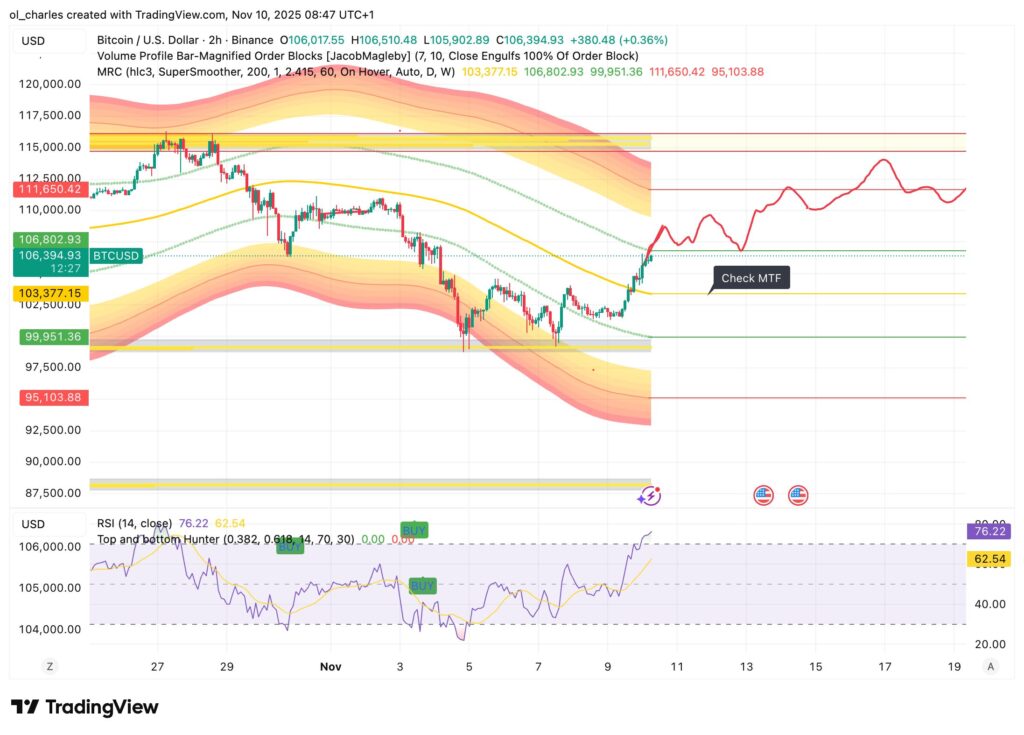
On-chain indicators show a market relatively balanced between buyers and sellers. The MVRV ratio remains in a neutral zone, while wallets holding between 100 and 1000 BTC are gradually accumulating. These medium-sized “whales” often adopt counter-cyclical behavior that precedes major movements.
Market sentiment oscillates between fear and greed according to the traditional index. Trading volumes remain moderate compared to periods of high volatility, suggesting a waiting phase before a more pronounced directional movement. Major altcoins generally follow Bitcoin with a slight time lag and amplified volatility.
Should You Buy Now?
In this context of uncertainty about Bitcoin’s clear direction, Pionex’s Grid Trading Bot, used by 5.2 million investors, continues to execute orders according to its predefined grid and generates profits on every intra-range oscillation.
Concrete example: a grid set yesterday between $98,000 and $115,000 (100 grids, $15,000 invested) has triggered 42 partial sales since midnight, for a realized gain of $1,847 net of fees (0.05%).
The AI Strategy option automatically proposed an adjustment to $102,000 – $112,000 at 06:12 CET to follow the range movement. No leverage is applied, so capital remains entirely in spot positions and there’s no liquidation risk.
The volume of Pionex bots has increased by 312% since last night, reflecting increased adoption during this phase of high volatility. If you want to benefit from this dynamic without active management, launching a Grid Bot takes less than 90 seconds:
- Open the Pionex website
- Deposit USDT or BTC (zero fees)
- Bot → Grid Trading → BTC/USDT → AI Strategy → Create.
On the same topic:

