

Protocol 23 and the Rise of the Stellar Network
The Protocol 23 upgrade represents the major technical catalyst for 2025. This evolution introduces parallel execution of Soroban smart contracts, with an ambitious target of 5,000 TPS. To put this in context, Ethereum currently processes between 15 and 30 TPS on its main layer. This scalability would multiply the network’s current capabilities by more than 150 times.
The expected impact goes beyond raw performance. Transaction fees are expected to drop, making Stellar competitive against Ethereum Layer 2s. This speed-cost combination could attract DeFi developers and institutional tokenization projects. JP Morgan notably highlights the persistent lack of truly efficient cross-border payment solutions at a global scale.
Now, cross-border payments have historically been Stellar‘s specialty. With anticipated growth in this sector through 2027, the technical timing appears optimal. The question now is whether execution will live up to the whitepaper’s promises.
XLM Between €1.29 in 2025 and €6.19 in 2030
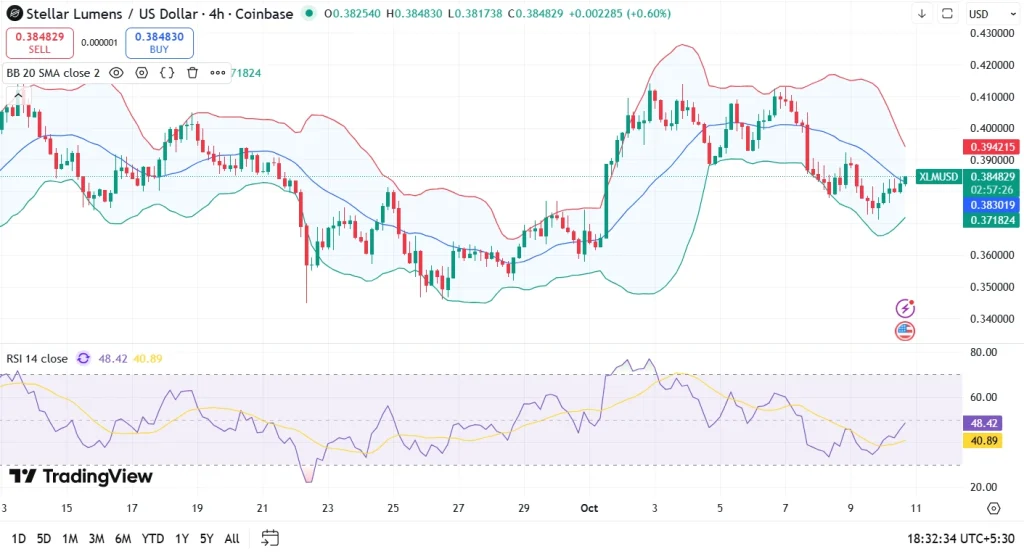
Technical forecasts position XLM’s maximum price at €1.29 by the end of 2025, with a potential floor at €0.65 and an average around €0.97. These projections are based on assumptions of a marked altseason and rising institutional adoption. In the absence of a global bullish momentum, the bearish scenario would bring the token back toward its current support levels.
For 2026-2027, models anticipate progression toward €1.76 then €2.58, crossing several psychological thresholds. This trajectory would imply average annual growth of 35% to 45%, consistent with the expansion of the RWA market. The years 2028-2030 project more ambitious peaks, culminating at €6.19 by the end of the decade.
These figures contrast with other sources: Changelly anticipates €1.07 in 2030, Binance predicts €0.53, and CoinCodex suggests €0.68. These divergences reflect crypto market uncertainty and the difficulty of modeling institutional adoption. It’s worth noting that Stellar reached its ATH at €0.94 in January 2018. Reaching €1 in 2025 would therefore represent a new record, requiring a market cap multiplied by 4, given the circulating supply of 32.3 billion tokens and a current market cap of approximately €8.1 billion.
Stellar vs Ripple: Two Visions of Blockchain Payments
The comparison with Ripple (XRP) is inevitable. Both projects share a common origin through Jed McCaleb, co-founder of Ripple before launching Stellar in 2014. However, their philosophies have diverged: Ripple focuses on adoption by financial institutions and central banks, with a more centralized structure, while Stellar prioritizes financial inclusion, decentralized access, and emerging markets.
This difference is also reflected in their performance. Ripple benefits from superior liquidity and a strong institutional presence despite its disputes with the SEC. Stellar offers reduced fees and more open governance, but struggles to generate the same level of adoption. For peer-to-peer payments, Stellar has advantages; for enterprise solutions and liquidity, Ripple remains dominant.
Investors should remember that these two assets are not interchangeable. Their use cases partially overlap, but their market dynamics are distinct. XLM will not necessarily follow XRP’s movements, even though a macro correlation exists at the overall crypto market level.
Take advantage of Black Friday to secure your crypto with a Ledger: 50% off and up to $90 free, an offer available for a limited time.
Related articles:

