

Japan on the Brink of Financial Collapse
For decades, Japan has been the engine of global liquidity thanks to a policy of near-zero interest rates. But this model is now breaking down. The country is facing a perfect storm: a colossal debt of 230% of its GDP (the highest in history), persistent inflation at 3%, and exploding bond yields.
The 30-year bond yield has reached 3.41%, a level not seen since 1999. Every 0.5% increase in rates costs the government an additional $45 billion per year, making the debt simply unsustainable.
Trapped, the Bank of Japan (BoJ) faces an impossible dilemma: either it raises rates to combat inflation, triggering a collapse of its own debt, or it continues printing money. Letting inflation destroy savings. For now, it has chosen the second option, announcing a new stimulus plan of 21.3 trillion yen, a decision that only worsens the debt problem and further weakens the yen.
The Domino Effect: How Japan Is Dragging Down Bitcoin
The link between Japan and Bitcoin lies in a financial mechanism called the “yen carry trade.” For 30 years, financial institutions worldwide have been massively borrowing yen at near-zero rates to invest in riskier, higher-yielding assets, such as U.S. stocks and, more recently, Bitcoin. The size of this “carry trade” is estimated between $350 billion and $4 trillion. A colossal amount hidden in complex derivative products.
The danger is that this trade is only profitable if the yen remains weak. If the BoJ is forced to raise rates to defend its currency, or if the market loses confidence and the yen strengthens abruptly, this entire house of cards collapses. Investors would be forced to urgently sell their assets (stocks, Bitcoin) to repay their yen-denominated loans. As one analyst puts it, “when USD/JPY breaks, Bitcoin feels it first.” Bitcoin, being one of the most liquid and riskiest assets, would be the first to be sold, triggering contagion across all financial markets.
Bitcoin: The $82,000 Zone as the Last Line of Defense
In this tense macroeconomic context, technical analysis gives us a roadmap of key levels to watch. The current drop has a clear objective: the high liquidity zone located around $82,000. This level is not insignificant. It corresponds not only to a major liquidity pool where numerous buy orders are placed, but it’s also the average purchase price of BlackRock’s IBIT ETF. It’s a major psychological and technical zone that could act as a powerful support.
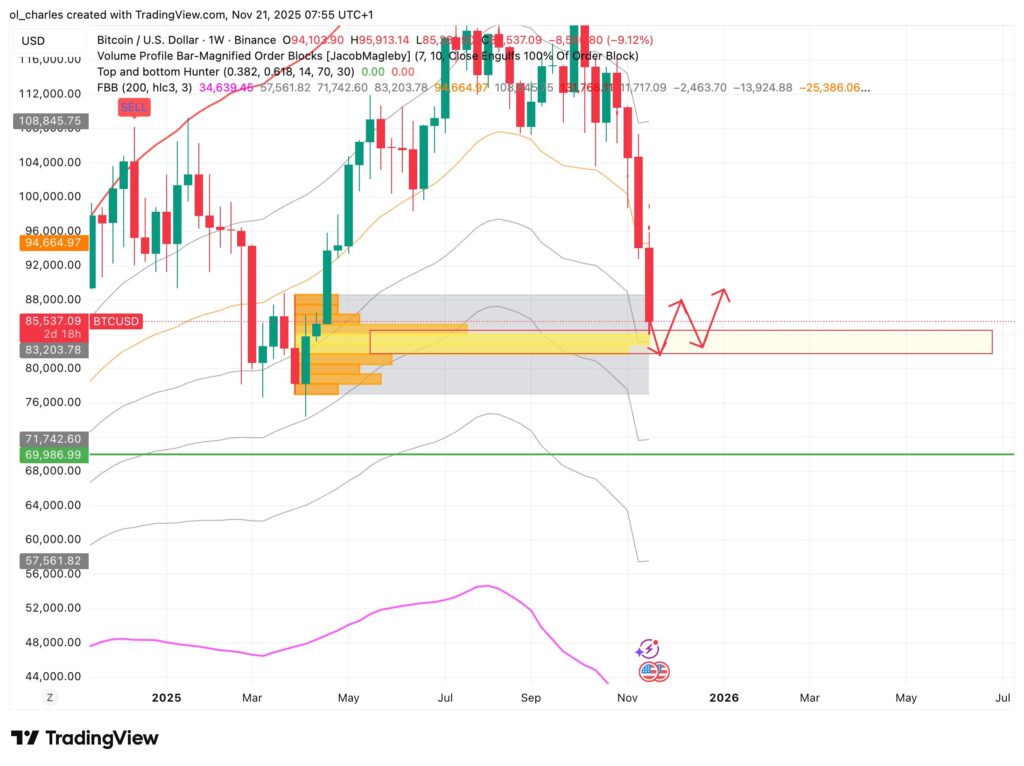
A bounce from this $82,000 zone is entirely possible, with a first short-term target around $87,000. However, this would only be a technical rebound. For hopes of a sustained bullish recovery to be rekindled, Bitcoin must imperatively reclaim the $90,000 level and transform it into solid support. As long as this level is not regained, the market remains under threat of a new wave of decline, with the specter of the Japanese crisis looming over all risk assets.
To conclude, these sales are also accompanied by new OG whale sales. The selling pressure is therefore not over, and the same could be true for the drop if sellers don’t show up explosively.
What Should You Do During Bitcoin’s Drop?
Protect yourself from crashes with Pionex’s Hedging Bot. This free and automated bot allows you to protect your BTC with x1 leveraged shorts to make profits during downturns and accumulate even more Bitcoin. Even in a bear market, generate between 30 and 80% annual returns on Bitcoin. Test them now:
Related Articles:

