

Mysterious Bitcoin Deposits to Binance
Blockchain data shows that Bitcoin miners have significantly increased their deposits to Binance during November. According to analysis, these network validators transferred approximately 71,000 BTC to the world’s largest cryptocurrency exchange platform, representing a value exceeding $7 billion at current prices.
This unusual activity occurs amid a particularly tense market environment. The transfers concentrated around the lows recorded after the recent crash, suggesting that some miners may have succumbed to panic and liquidated part of their holdings to secure their treasury.
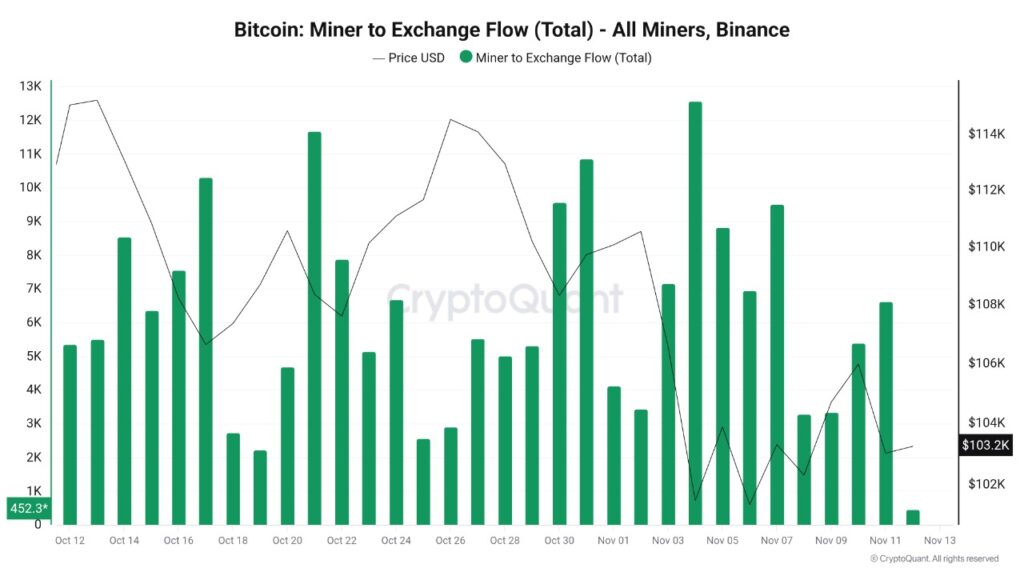
The “Miner to Exchange Flow” metric constitutes a key indicator for analyzing this cohort’s behavior. When these flows intensify, it generally signals selling intention, as miners rarely transfer their coins to a centralized platform without liquidation objectives. Conversely, low flows indicate a holding strategy, signaling confidence in future price evolution.
October-November: A Historic Distribution Sequence
The selling pressure observed in November is not an isolated phenomenon. It continues from October, when miners had already deposited 200,000 BTC across various platforms. This massive distribution over two consecutive months represents a notable anomaly in this group’s usual patterns.
It’s important to remember that Bitcoin miners operate under specific economic constraints. Their business model requires regularly selling part of their production to cover fixed operational costs, primarily electricity bills which can represent up to 60% of their expenses. Some distribution is therefore structurally normal and predictable.
However, the magnitude of recent transfers to Binance far exceeds usual treasury management volumes. The 71,000 BTC deposited in November equals approximately three weeks of the network’s total production. This concentration on a single platform over such a short period raises questions about the financial health of certain mining actors.
The timing of these inflows also deserves attention. The deposits coincided with a significant correction in Bitcoin’s price, which dropped below key psychological levels. This synchronization suggests that some miners may have been forced to sell at a loss or urgently, probably to avoid more serious liquidity problems.
Declining Hashrate: Bitcoin Miners Under Pressure
Another signal confirms the mining sector’s current difficulties: Bitcoin’s hashrate declined after reaching a historic peak in October. This metric measures the total computing power connected to the network and constitutes an excellent barometer of sentiment among miners.
The hashrate decline occurs in a particularly unfavorable context. On one side, BTC’s price has fallen nearly 15% from its recent peaks. On the other, mining difficulty, which automatically adjusts every 2,016 blocks, has continued to increase, further compressing margins for the least efficient operators.
This toxic combination of declining revenues and rising costs forces the most vulnerable miners to make difficult decisions. Some choose to sell their accumulated reserves, others partially disconnect their machines, and the most fragile risk total capitulation.
Miners still using previous-generation hardware, such as Antminer S19s or equivalents, find themselves particularly exposed. With production costs estimated between $35,000 and $50,000 per BTC depending on regions, these operators can hardly maintain profitability at current price levels, especially if their electricity exceeds $0.06 per kWh.
Related topics:

