
WLFI faces lawsuit threat: Scandal and crash in the DeFi world
WLFI, linked to the Trump family, faces a lawsuit threat against Justin Sun. Discover the details of the DeFi accusations and the token's collapse. Read now!



WLFI, linked to the Trump family, faces a lawsuit threat against Justin Sun. Discover the details of the DeFi accusations and the token's collapse. Read now!
The scandal had been brewing for several weeks. It finally erupted into broad daylight with a series of explosive posts by Justin Sun on the X network. The Tron founder, who has a $175 million exposure to the World Liberty Financial project, publicly accuses the team of hiding a blacklist function within the WLFI token’s smart contract. This is a case that goes far beyond a simple commercial dispute.
The accusation is technical, but its impact is immediate. Justin Sun claims that a blacklist function was secretly embedded into the WLFI smart contract code. This allows the team to freeze the assets of any wallet without validation from decentralized governance. In other words, without community voting, without transparency, and without recourse.
Sun claims to be a direct victim: his wallet containing over $100 million in WLFI tokens has allegedly been blocked since September 2025. If these facts are proven true, this is not a bug but a deliberate architectural choice. It stands in total contradiction to the fundamental principles of decentralized finance. A project claiming to be decentralized cannot unilaterally centralize the freezing of its investors’ funds without causing a major breach of trust with its community.
World Liberty Financial’s response was swift and aggressive. The project’s official account outright rejected the accusations, turning the tables on Justin Sun. The team claims to have detected massive coordinated selloffs via the HTX platform, suggesting that Sun was looking to liquidate his positions at the expense of retail investors before the scandal broke publicly.
The message published by WLFI leaves no ambiguity about what comes next. The team claims to have the contracts and the evidence, promising a legal showdown. This escalation occurs in an already tense context for the project, which had used its own tokens as collateral to take out a $75 million loan in stablecoins on the Dolomite protocol. This is a risky practice that raises legitimate questions about the project’s actual financial stability. The mechanics of this type of collateralized loan are detailed in our trading section for those who wish to understand the associated risks.
On the markets, the verdict is final. The WLFI token has reached a new ATL around $0.07, representing a 76% drop from its all time high. The technical structure is degraded across all timeframes. The momentum remains clearly bearish and no credible recovery signal is visible in the short term.
What makes the situation worse is the very nature of the crisis. This is not a correction linked to an unfavorable macro environment or a sector rotation. It is a fundamental crisis of confidence, the hardest kind to overcome for a token whose value relies precisely on the credibility of its team. Investors wishing to follow the case can monitor key levels via specialized exchange platforms and should prioritize keeping an eye on any potential legal ruling. This is the only catalyst capable of breaking the deadlock in either direction.
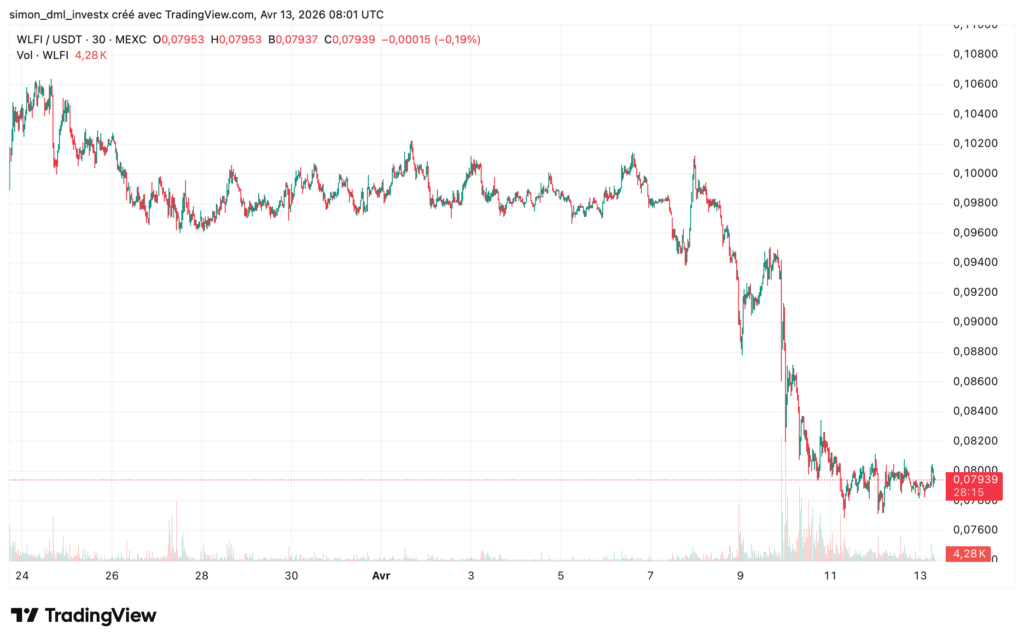
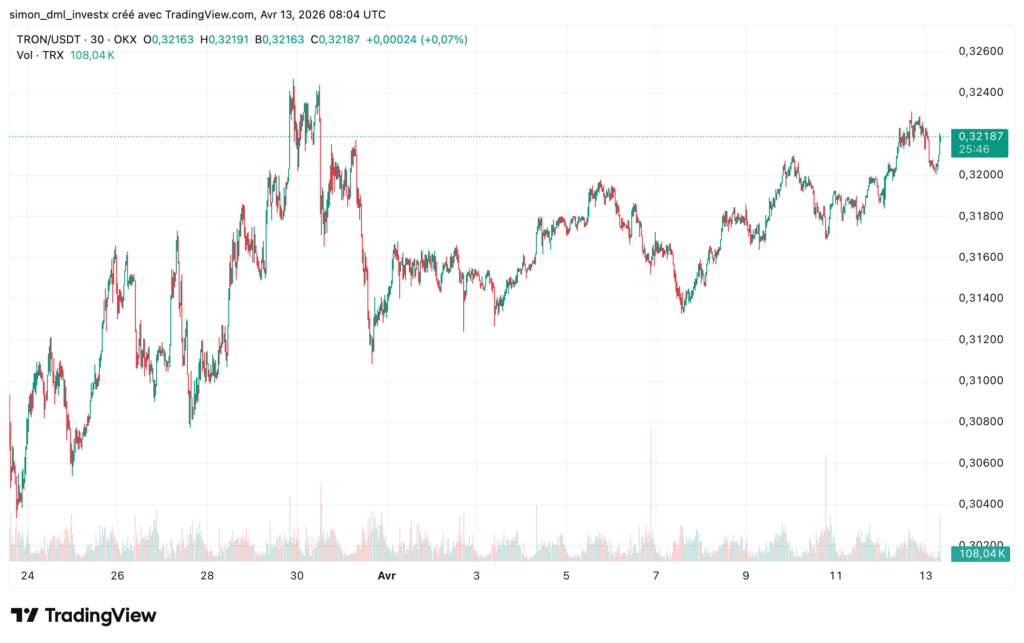
While WLFI collapses, Justin Sun’s TRX token is showing relative stability, and even a slight bounce in a market that remains under pressure. This divergence is telling. For now, the markets seem to be punishing WLFI more severely than Tron in this PR battle, although this does not prejudge the legal outcome.
This does not mean Sun is off the hook. His own practices on HTX are the subject of serious accusations, and the evidence put forward by WLFI still needs independent verification. For traders interested in this type of situation, our guide on technical analysis and risk management serves as a reminder that assets under legal pressure generate erratic and highly unpredictable price movements.
This is the central issue. WLFI is not an anonymous project: it is directly associated with Donald Trump and his family. This gives it a level of media exposure that is completely out of proportion with a standard altcoin. Today, this visibility is working against it. Every legal development will be scrutinized, amplified, and interpreted through a political lens just as much as a financial one.
Fundamentally, the alleged existence of a backdoor in a smart contract is a major issue. If confirmed, it represents a serious offense in the DeFi ecosystem, comparable to a partial rug pull. Projects that have survived similar controversies did so by providing total transparency regarding their code and governance. WLFI has not yet published an independent audit of the contract in question. Until this step is taken, investor distrust will remain absolute. The token will continue to face structural selling pressure. When tracking price predictions on this type of controversial asset, caution remains the watchword.
Sources:
Related Articles:

Crypto analyst with over 7 years of trading experience and a strong background in the iGaming and cryptocurrency industries, I cover crypto news with a rigorous yet accessible approach. Passionate about blockchain since 2019, I have published more than 1,200 articles and guides on cryptocurrencies, DeFi, and blockchain, recognized for their reliability and clarity.
Specializing in on-chain trading and whale activity analysis, I decode blockchain flows to anticipate market trends before they become obvious.
One of my articles was cited by Éric Larchevêque, co-founder of Ledger, highlighting the quality and credibility of my analysis.
My goal remains unchanged: to make crypto accessible and understandable for everyone, from beginners to experienced investors.
Follow me on LinkedIn and X to stay updated with my latest insights.
DISCLAIMER
This article is for informational purposes only and should not be considered as investment advice. Trading cryptocurrencies involves risks, and it is important not to invest more than you can afford to lose.
InvestX is not responsible for the quality of the products or services presented on this page and cannot be held liable, directly or indirectly, for any damage or loss caused by the use of any product or service featured in this article. Investments in crypto assets are inherently risky; readers should conduct their own research before taking any action and invest only within their financial means. This article does not constitute investment advice.




Risk Warning : Trading financial instruments and/or cryptocurrencies carries a high level of risk, including the possibility of losing all or part of your investment. It may not be suitable for all investors. Cryptocurrency prices are highly volatile and can be influenced by external factors such as financial, regulatory, or political events. Margin trading increases financial risks.
CFDs (Contracts for Difference) are complex instruments with a high risk of rapid capital loss due to leverage. Between 74% and 89% of retail investor accounts lose money when trading CFDs. You should assess whether you understand how CFDs work and whether you can afford to take the high risk of losing your money.
Before engaging in financial or cryptocurrency trading, you must be fully informed about the associated risks and fees, carefully evaluate your investment objectives, level of experience, and risk tolerance, and seek professional advice if needed. InvestX.fr and the InvestX application may provide general market commentary, which does not constitute investment advice and should not be interpreted as such. Please consult an independent financial advisor for any investment-related questions. InvestX.fr disclaims any liability for errors, misinvestments, inaccuracies, or omissions and does not guarantee the accuracy or completeness of the information, texts, graphics, links, or other materials provided.
Some of the partners featured on this site may not be regulated in your country. It is your responsibility to verify the compliance of these services with local regulations before using them.

