NEAR Protocol (NEAR) : How It Works , Use Cases , and Significance in 2026
Near Protocol asserts itself as one of the most innovative blockchains in the crypto ecosystem, merging AI and blockchain technology to establish the world's first truly AI-native platform. Ranked as the second most utilized Layer 1 blockchain globally, it delivers outstanding performance while upholding eco-friendly ethos with its carbon neutrality.
Near Protocol is a revolutionary layer 1 blockchain designed to democratize access to decentralized applications and facilitate the emergence of Web3. This decentralized infrastructure stands out with its unique approach combining artificial intelligence and blockchain technology, positioning NEAR as the first truly AI-native blockchain in the market.
The unique feature of Near Protocol lies in its ability to process up to 100,000 transactions per second thanks to its Nightshade sharding technology. This innovative approach allows data and calculations to be split across multiple parallel fragments, eliminating bottlenecks that limit traditional blockchains.
The Near Protocol ecosystem extends far beyond a simple blockchain. It includes educational initiatives such as NEAR University and NEAR Academy, designed to train a new generation of Web3 developers. This holistic approach aims to create a complete ecosystem where technology, education, and innovation converge.
The History of Near Protocol
The story of Near Protocol begins in 2018 with the ambitious vision of three tech entrepreneurs determined to solve the scalability and accessibility problems of existing blockchains. This initiative was born from frustration with Ethereum‘s limitations and the technical complexity that was hindering the mass adoption of decentralized applications.
The development of Near Protocol accelerated throughout 2019 and 2020, with several phases of intensive testing that validated the effectiveness of Nightshade sharding and the Doomslug consensus algorithm. Near Protocol’s mainnet was officially launched in October 2020, marking the culmination of more than two years of research and development.
2021 was marked by exponential growth of the ecosystem, with the launch of numerous decentralized applications and the establishment of strategic partnerships. Finally, in 2022, Near Protocol reached an important milestone with the integration of artificial intelligence features, foreshadowing its positioning as an AI-native blockchain.
Who Created Near Protocol ?
Near Protocol was created by a trio of visionary entrepreneurs: Alexander Skidanov, Illia Polosukhin, and Erik Trautman. This founding team brings exceptional technical expertise and a clear vision for the future of blockchain technology.
Alexander Skidanov, co-founder and former engineer at Microsoft, brings solid experience in software development and distributed systems architecture. His technical expertise was crucial in designing Near Protocol’s unique architecture.
Illia Polosukhin, co-founder and former researcher at Google, is recognized as one of the pioneers of modern artificial intelligence. He notably contributed to the development of transformers, the technology behind ChatGPT and other advanced AI models. His AI expertise was crucial in positioning Near as the first AI-native blockchain.
Erik Trautman, entrepreneur and trainer, founded the Viking Code School and brings a unique perspective on technological education. His vision of democratizing access to blockchain programming is reflected in Near Protocol’s educational initiatives.
The NEAR token forms the central element of the Near Protocol ecosystem, fulfilling several essential functions that ensure the proper functioning and security of the network. Unlike purely speculative tokens, NEAR has real and multiple utility that makes it a fundamental digital asset.
The first function of NEAR involves paying transaction fees on the network. Each interaction with the blockchain requires payment of fees in NEAR, ensuring network security by making DDOS attacks costly while compensating validators who maintain the infrastructure.
Staking represents the second major use of NEAR. Holders can lock their tokens to participate in securing the network and receive rewards proportional to their stake. This mechanism not only secures the blockchain but also offers investors a way to generate passive income with attractive yields.
Decentralized governance constitutes the third pillar of NEAR‘s utility. Holders can participate in important decisions regarding protocol evolution, technical updates, and network parameters. Voting power is proportional to the amount of NEAR held and staked.
The Near Protocol ecosystem is experiencing remarkable growth with notably 46 million monthly active users by mid-2025, positioning the blockchain as the second most used in the world. This massive adoption demonstrates the practical utility of the NEAR token in a rapidly expanding ecosystem.
How does the Near Protocol network work ?
The Near Protocol network is built on a revolutionary technical architecture that combines several innovations to achieve exceptional performance while maintaining robust decentralization. This layer one blockchain uses advanced mechanisms that fundamentally distinguish it from traditional networks.
Sharding
Nightshade sharding technology constitutes Near Protocol’s most remarkable innovation. Unlike traditional blockchains that process all transactions sequentially on a single network, Nightshade divides the network into multiple parallel fragments called shards. Each shard can process its own transactions and smart contracts independently, significantly multiplying the overall processing capacity.
The Doomslug Algorithm
The Doomslug consensus algorithm accompanies sharding by offering fast finality and robust security. Doomslug is an optimized variant of “Byzantine Fault Tolerance” (BFT) that allows consensus to be reached even in the presence of malicious or failing nodes. This approach guarantees block times of 600 milliseconds and finality of 1.2 seconds.
Near Protocol’s parallel execution architecture allows multiple types of operations to be processed simultaneously. Smart contracts can execute in parallel on different shards, optimizing resource use and reducing wait times. This approach contrasts with traditional blockchains where operations are processed sequentially.
A Highly Connected Blockchain ?
The interoperability solutions developed by the Near Protocol team include the Aurora protocol for EVM compatibility, Rainbow Bridge for cross-chain transfers, and OctopusNetwork for interoperability with other blockchains. These tools allow developers to create applications that can interact with the entire blockchain ecosystem.
Advantages and Disadvantages of Near Protocol (NEAR)
An objective evaluation of Near Protocol requires a balanced analysis of its strengths and weaknesses in the current competitive blockchain landscape.
The 5 main advantages of Near Protocol :
1. Exceptional performance and scalability : With a theoretical capacity of 100,000 transactions per second thanks to Nightshade sharding, Near Protocol far surpasses Bitcoin and Ethereum. Block times of 600 ms and finality of 1.2 seconds offer a smooth user experience comparable to Web2 applications.
2. Massive adoption and user growth : With 46 million monthly active users by mid-2025, Near Protocol has become the second most used Layer 1 blockchain in the world, just behind the Solana network. This adoption testifies to the ease of use and attractiveness of the ecosystem.
3. AI-native innovation and unique positioning : Near Protocol positions itself as the first truly AI-native blockchain, integrating artificial intelligence features directly into its architecture. This unique approach opens new possibilities for intelligent decentralized applications.
4. Carbon neutrality and environmental sustainability : Unlike energy-intensive blockchains like Bitcoin, Near Protocol displays carbon neutrality thanks to its efficient consensus mechanism. This ecological approach addresses the growing environmental concerns of investors and users.
5. Educational ecosystem and developer-friendly environment : The NEAR University and NEAR Academy initiatives create an environment conducive to talent development. Advanced developer tools and comprehensive documentation facilitate adoption by application creators.
The 5 main disadvantages of Near Protocol :
1. Intense competition in the Layer 1 ecosystem : Near Protocol faces fierce competition with established blockchains like Ethereum, Solana, Avalanche, and Polygon. Despite its technical advantages, capturing market share remains difficult against more mature ecosystems.
2. Technical complexity of sharding : While Nightshade sharding offers performance advantages, its complexity can create challenges for developers and potentially introduce undiscovered vulnerabilities. Managing inter-shard communication adds a layer of complexity.
3. Dependence on AI feature adoption : Near Protocol’s AI-native positioning represents both an opportunity and a risk. If blockchain AI adoption doesn’t materialize as expected, this competitive advantage could turn into an unprofitable investment.
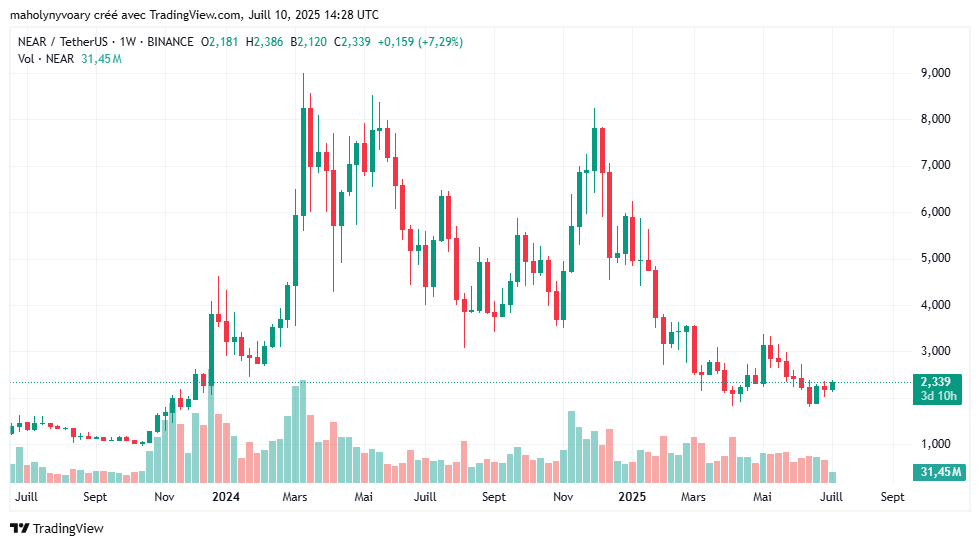
4. Price volatility and recent performance : The NEAR token has experienced significant volatility with declines of several percent in 2025 despite user growth. This disconnection between adoption and price may discourage short-term investors.
5. Relative centralization of validators : Like many recent blockchains, Near Protocol presents a relative concentration of validators that may raise questions about the real decentralization of the network, particularly in its early years of existence.
Near Protocol (NEAR) Price and Predictions
The recent price evolution of NEAR shows contrasting performance in 2025. In July 2025, the token broke through the $2.19 resistance with a volume spike of 1.97 million compared to the average of 1.22 million. However, the price also experienced corrections, notably a 5% drop in early July when the $2.30 resistance could not be maintained.
NEAR Price Predictions for 2026 ?
Price predictions vary among analysts but generally show moderate optimism. Changelly anticipates a minimum price of $2.34 and a maximum of $2.46 by the end of 2025. Cryptopolitan is more optimistic with a high forecast of $4.66 for the second half of 2025.
Longer-term predictions from Our Crypto Talk suggest a range of $3.50 to $6.50 for 2025, with an average price of $5.00. These projections are based on growing AI adoption and expansion of the Near Protocol ecosystem.
Factors influencing the price of NEAR include adoption, unique positioning as an AI-native blockchain, and institutional developments such as the launch of the Bitwise NEAR Staking ETP which offers institutional access to NEAR staking.
Near Protocol’s on-chain activity shows encouraging signals with continued growth in decentralized applications and increased transaction volume. The blockchain maintains block times of 600 ms and finality of 1.2 seconds, demonstrating the technical robustness that underpins the token’s value.
Key Moments in Near Protocol’s History
The history of Near Protocol is made up of key events that have shaped its development and positioning in the blockchain ecosystem.
2018 : Foundation and initial vision marks the beginning of the Near Protocol adventure. Alexander Skidanov, Illia Polosukhin, and Erik Trautman combine their expertise to create a blockchain capable of solving Ethereum’s scalability problems.
2019 : Development of Nightshade sharding constitutes a major technical milestone. The team finalizes the unique sharding architecture that will allow Near Protocol to process thousands of transactions per second.
October 2020 : Mainnet launch represents the culmination of two years of intensive development. The Near Protocol network becomes operational with its basic features and begins to attract the first developers.
2021 : Ecosystem expansion with the launch of numerous DeFi and NFT applications. Aurora, the EVM compatibility solution, is deployed, allowing Ethereum developers to easily migrate their applications.
2022 : Integration of AI features marks the beginning of Near’s positioning as an AI-native blockchain. The team begins developing tools specifically designed for artificial intelligence applications.
January 2022 : All-time high (ATH) NEAR price of $20.42 after a 56% increase in just 7 days.
May 2025 : Record user adoption with 46 million monthly active users.
July 2025 : Launch of Bitwise NEAR Staking ETP opens institutional access to NEAR staking, marking an important milestone in protocol adoption.
Acquiring NEAR tokens is an essential step for those who want to invest in the project, participate in its governance, or use the applications in its ecosystem. Due to its growing market capitalization and popularity, the NEAR token is available on the majority of centralized exchange platforms (CEX).
These platforms allow you to buy NEAR directly with euros or dollars via different payment methods (bank card, wire transfer). Here is our ranking of the best platforms in 2026 :
It’s important to distinguish between specialized exchange platforms (like those mentioned above) where you actually buy and hold cryptocurrencies, and brokers that sometimes offer derivative products like CFDs (Contracts For Difference) on cryptocurrencies. For direct ownership and total control of your assets, it’s better to use a specialized exchange platform.
How to Buy NEAR on Bitget ? Mini Tutorial
Here’s how to buy NEAR in 5 steps on the best platform in our ranking.
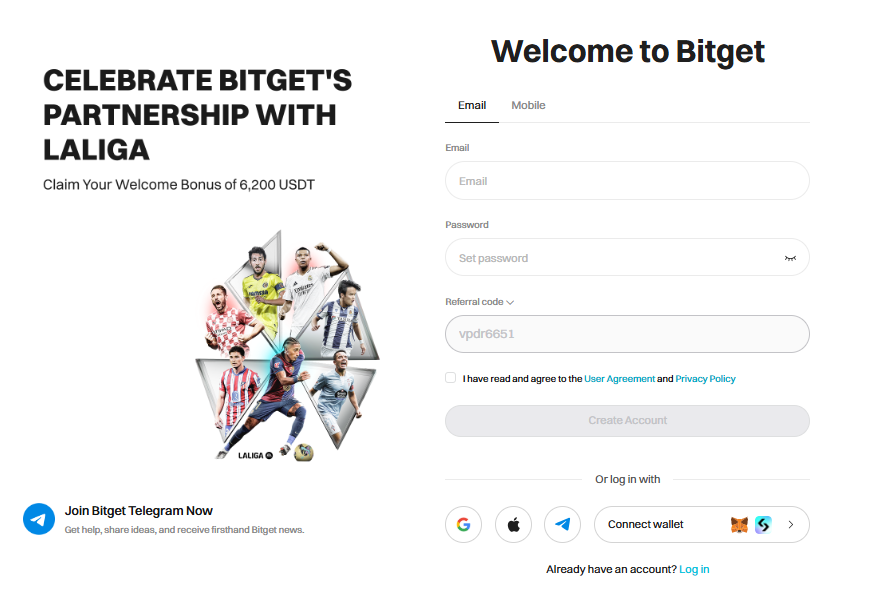
Create an account on Bitget :
Go to the official website
Click on “Sign Up”
Fill out the form with your email and password
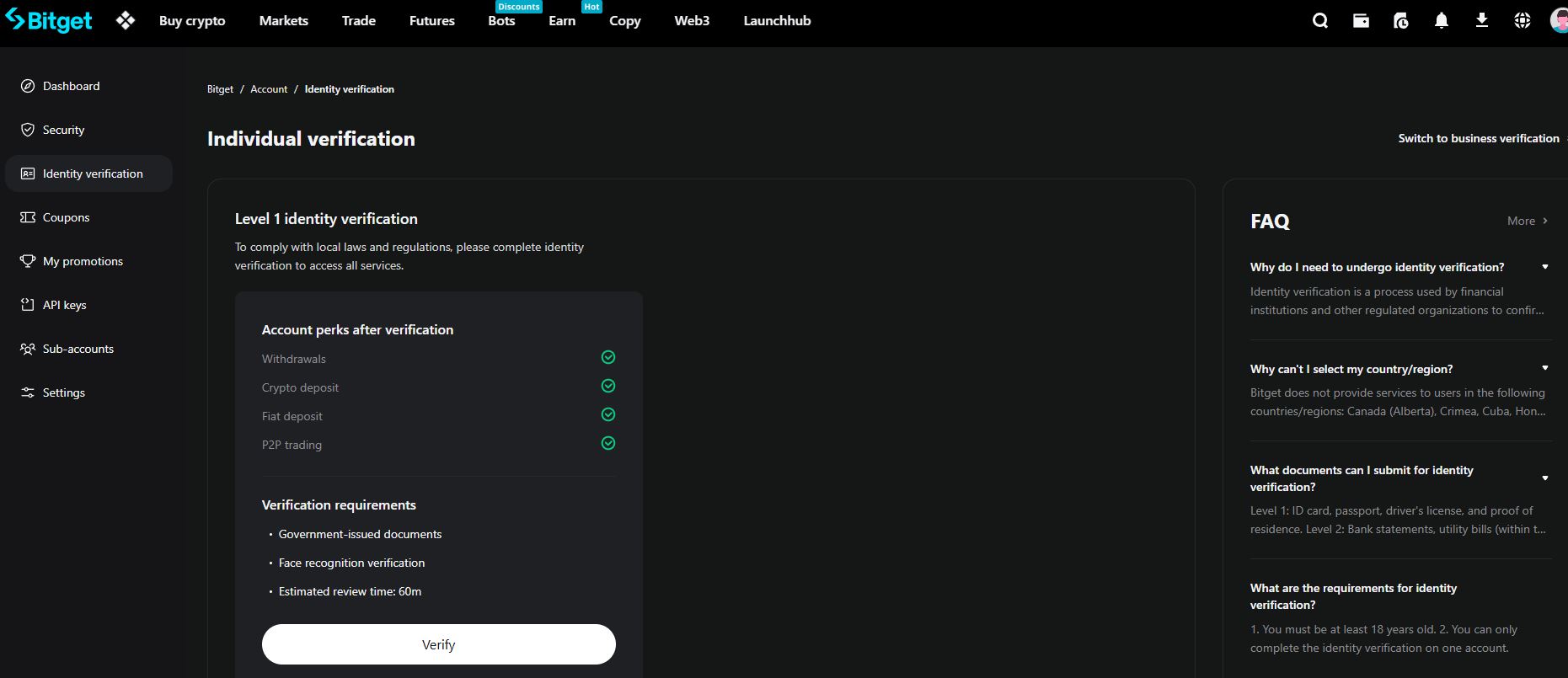
Complete KYC verification :
Prepare a valid ID document
Follow the verification instructions
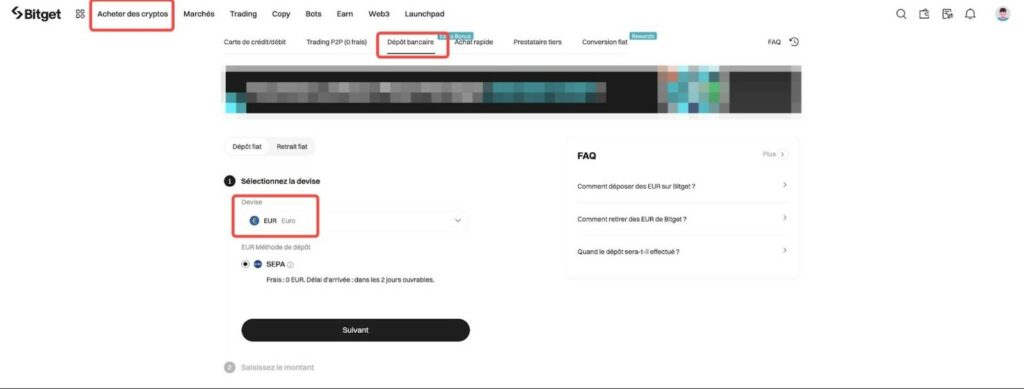
Deposit funds :
Fund your account on the platform. Via bank transfer, credit card or other cryptocurrencies for example.
Buy NEAR :
Navigate to “Spot Trading”
Search for the NEAR/USDT or NEAR/EUR pair
Place a buy order specifying the amount of NEAR you want to acquire or the amount you want to spend.
You can generally choose between a market order (buying at the current price) or a limit order (buying at a specific price you define).
Secure your NEAR :
After purchase, it is strongly recommended to transfer your NEAR tokens from the exchange platform to a secure personal wallet (see next section) to have full control over them.
Choose a platform that matches your needs in terms of fees, security, ease of use, and regulatory compliance in your jurisdiction.
Once you’ve acquired NEAR tokens, the question of their secure storage becomes paramount. Leaving your cryptocurrencies on an exchange platform (CEX) involves significant risks: you don’t directly control your private keys, and your funds could be lost in case of platform hacking, regulatory issues, or company bankruptcy.
That’s why it’s strongly recommended to transfer your NEAR to a personal wallet where you alone hold the private keys. “Not your keys, not your coins” is a fundamental adage in the ecosystem.
There are mainly two types of wallets for storing your NEAR :
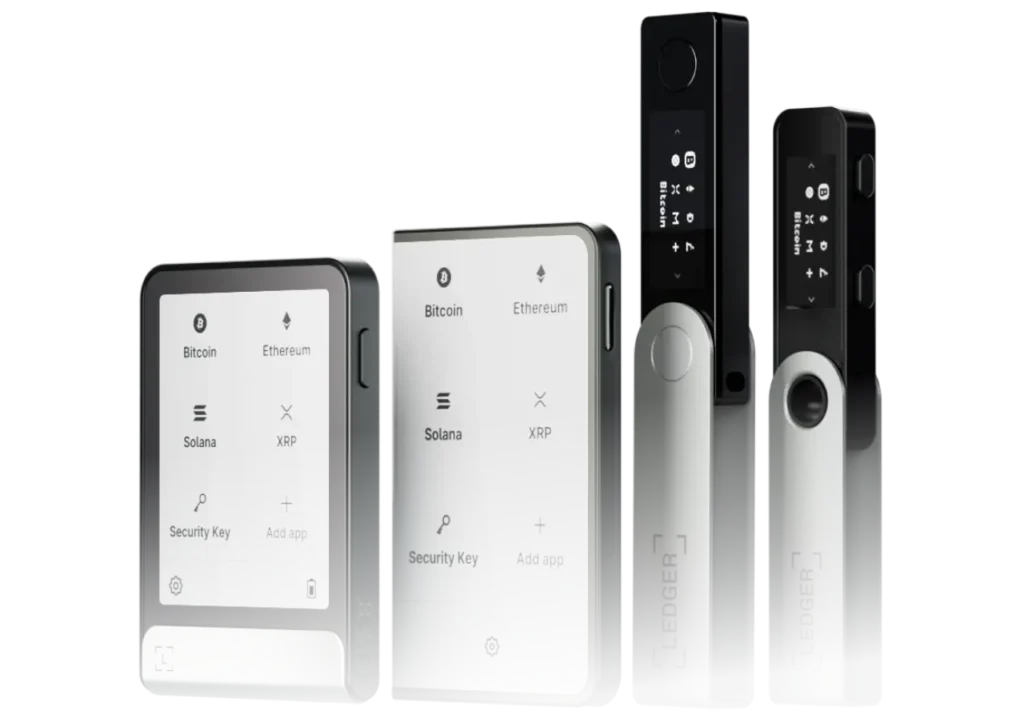
Cold Wallets (Hardware Wallets) : These are hardware devices that store your private keys offline, thus offering the highest level of security against online hacking. They often resemble secure USB keys. Recognized brands like Ledger (for example, Ledger Nano S Plus or Ledger Nano X) are the safest solutions for storing large amounts or for long-term storage.
Hot Wallets (Software Wallets) : These are software (mobile or desktop applications, browser extensions) that store your private keys on a device connected to the Internet. They are more convenient for frequent use and for interacting with decentralized applications (dApps), but are inherently more vulnerable to malware and phishing than cold wallets. Popular wallets like MetaMask or Trust Wallet can be configured to manage NEAR tokens.
The choice between a cold wallet and a hot wallet depends on your specific needs: favor a cold wallet (like Ledger) for maximum security of your main investments, and possibly use a hot wallet (like MetaMask or Trust Wallet) for smaller amounts intended for regular interactions with Near Protocol’s DeFi ecosystem. The essential thing is to always carefully secure your recovery phrase (seed phrase) and never share it or store it digitally.
Several legitimate methods allow you to obtain NEAR without direct investment, although these opportunities typically require time, skills, or active participation in the Near Protocol ecosystem.
Airdrops represent the most popular method for getting free NEAR. The Near Protocol ecosystem regularly organizes token distributions to reward active users, developers, or participants in specific events.
Validation staking offers an opportunity for technical users to earn NEAR by participating in securing the network. Validators receive rewards proportional to their stake and performance.
Development programs from Near Protocol reward creators of decentralized applications with grants in NEAR. NEAR University and NEAR Academy also offer paid learning opportunities.
Hackathons and contests organized by the Near Protocol ecosystem offer prizes in NEAR for the best innovations and applications developed on the blockchain.
Is Near Protocol (NEAR) Legal ?
The legality of Near Protocol varies by jurisdiction, but the token is generally considered legal in the majority of countries that allow cryptocurrencies.
In the European Union, NEAR benefits from the MiCA (Markets in Crypto-Assets) regulatory framework that clarifies the status of cryptocurrencies. France, Germany, Spain, Portugal, and most European countries explicitly authorize the holding and exchange of NEAR.
In the United States, the situation remains complex with evolving regulations. However, NEAR has not been classified as a security by the SEC, which facilitates its trading on regulated American platforms. The launch of the Bitwise NEAR Staking ETP confirms the institutional acceptance of the token.
Restrictive countries like China, certain regions of India, and some Middle Eastern countries maintain prohibitions or restrictions on cryptocurrencies that also apply to NEAR.
Who Holds the Most NEAR ?
The distribution of NEAR tokens follows a typical model of modern blockchain projects, with a distribution among the founding team, institutional investors, the community, and the foundation.
Near Foundation and the founding team hold approximately 20% of the total supply of NEAR, or approximately 200 million tokens. These tokens are generally subject to vesting periods to prevent massive sales.
Institutional investors collectively own about 17.2% of the supply, or 172 million NEAR. This category includes prestigious funds and strategic investors who participated in private funding rounds.
The community and rewards represent 35% of the total supply, or 350 million NEAR, including staking rewards, airdrops, and incentives for active developers and users.
Finally, ecosystem reserves constitute 27.8% of the supply, or 278 million NEAR, intended for ecosystem development, strategic partnerships, and growth initiatives.
Our Review on Near Protocol (NEAR) in 2026
Near Protocol positions itself as one of the most promising blockchains in the crypto ecosystem in current_date format=’Y’], combining remarkable technical innovations with massive adoption and a unique positioning in the blockchain AI market.
Near Protocol’s strengths lie in its exceptional adoption with 46 million monthly active users, positioning the blockchain as one of the most used in the world. This massive adoption testifies to the ease of use and attractiveness of the ecosystem for developers and end users. Not to mention the technical innovation with Nightshade sharding and the Doomslug algorithm that offer remarkable performance.
Positioning as an AI-native blockchain opens unique perspectives in a rapidly expanding market, which is why our opinion is generally positive on Near Protocol and its NEAR token.
Caméléon de la rédaction et experte SEO, Maholy Ny Voary a découvert le monde des cryptomonnaies et du Web3 en 2021. Constamment à l’affût des nouveautés, elle continue de se former pour créer des contenus engageants qui aident véritablement les internautes.
Frequently Asked Questions About Near Protocol (NEAR)
What makes Near Protocol different from other blockchains ?
Near Protocol stands out thanks to its Nightshade sharding, which enables up to 100,000 transactions per second (TPS), and its unique positioning as the first AI-native Layer 1 blockchain. With 46 million active users, it’s currently the second most-used Layer 1 in the world.
Is Near Protocol a good investment in 2025 ?
Analysts forecast NEAR could reach $4.66 by the end of 2025. The platform’s massive adoption—with 46 million users—and its AI-native strategy support this bullish outlook, despite recent market volatility.
How can you earn passive income with NEAR ?
Staking NEAR allows users to earn passive income by delegating their tokens to network validators. Rewards vary depending on validator performance, typically ranging between 8% and 15% annually.
Where can you safely buy Near Protocol ?
NEAR is available on all major platforms, including Binance, Coinbase, Kraken, and OKX. For European investors, regulated exchanges accepting SEPA bank transfers offer one of the safest and most convenient options.
Can Near Protocol compete with Ethereum ?
Near Protocol offers significant technical advantages, including 100,000 TPS and lower transaction fees than Ethereum. Combined with its AI-native positioning and 46 million active users, Near is emerging as a serious long-term competitor to Ethereum.
DISCLAIMER
This article is for informational purposes only and should not be considered as investment advice. Trading cryptocurrencies involves risks, and it is important not to invest more than you can afford to lose.
InvestX is not responsible for the quality of the products or services presented on this page and cannot be held liable, directly or indirectly, for any damage or loss caused by the use of any product or service featured in this article. Investments in crypto assets are inherently risky; readers should conduct their own research before taking any action and invest only within their financial means. This article does not constitute investment advice.
Risk Warning : Trading financial instruments and/or cryptocurrencies carries a high level of risk, including the possibility of losing all or part of your investment. It may not be suitable for all investors. Cryptocurrency prices are highly volatile and can be influenced by external factors such as financial, regulatory, or political events. Margin trading increases financial risks.
CFDs (Contracts for Difference) are complex instruments with a high risk of rapid capital loss due to leverage. Between 74% and 89% of retail investor accounts lose money when trading CFDs. You should assess whether you understand how CFDs work and whether you can afford to take the high risk of losing your money.
Before engaging in financial or cryptocurrency trading, you must be fully informed about the associated risks and fees, carefully evaluate your investment objectives, level of experience, and risk tolerance, and seek professional advice if needed. InvestX.fr and the InvestX application may provide general market commentary, which does not constitute investment advice and should not be interpreted as such. Please consult an independent financial advisor for any investment-related questions. InvestX.fr disclaims any liability for errors, misinvestments, inaccuracies, or omissions and does not guarantee the accuracy or completeness of the information, texts, graphics, links, or other materials provided.
Some of the partners featured on this site may not be regulated in your country. It is your responsibility to verify the compliance of these services with local regulations before using them.
Get 6200 USDT with Bitget ! 🔥
Don't miss out on this offer !
Create your account now to unlock this exclusive reward