

What is Kalshi?
Kalshi is a prediction market platform that allows users to bet on the outcomes of real-world events. What fundamentally distinguishes Kalshi from many other platforms in this sector is its unique regulatory status. Indeed, Kalshi is the first and only platform of its kind to be fully regulated in the United States by the Commodity Futures Trading Commission (CFTC), as a Designated Contract Market (DCM).
This status gives the platform a legitimacy and security that competitors like Polymarket, which operates in a regulatory grey area, cannot currently offer. Kalshi’s approach to compliance is a guarantee of seriousness.
This strict regulation, at the heart of Kalshi’s model, ensures a high level of transparency, integrity, and security for all users of the Kalshi platform. Funds deposited on Kalshi are protected, and the markets available on Kalshi are closely monitored to prevent any form of manipulation.

In short, Kalshi offers an experience of trading on future events that is more akin to a secure financial market than a decentralized betting platform like Polymarket.
How does the Kalshi platform work?
The functioning of Kalshi is based on simple and ingenious financial instruments called “Event Contracts.” Each contract available on the Kalshi platform is linked to a binary (Yes/No) question about a future event. Kalshi users can buy shares for “Yes” or for “No”.
The price of a share on Kalshi, which fluctuates between $0.01 and $0.99, represents the market-perceived probability of the event occurring. If the event happens, each “Yes” share is settled at $1, while “No” shares lose all value. In the opposite case, “No” shares are settled at $1. Kalshi’s system is simple and highly intuitive.
Traders on Kalshi can buy and sell these shares at any time before the event’s resolution date, allowing them to make profits (or losses) based on probability fluctuations, similar to a classic stock market. The Kalshi platform charges transparent transaction fees, calculated based on the number of contracts traded and their price.
Moreover, a notable advantage of the platform is that it offers a yield of 3.75% APY on liquidity and positions held by users, a rare feature that adds value to “dormant” capital.
What can you bet on with Kalshi?
The diversity of markets is undoubtedly one of Kalshi’s greatest assets. The platform offers an extremely wide range of categories, allowing each user to bet on topics that interest them or for which they believe they have particular expertise. The market offering is constantly expanding.
Here’s an overview of the main market categories available:
- Politics: A favorite area for the platform, with markets on presidential elections, referendum results, political appointments, or the passage of laws.
- Economy: Traders can speculate on Federal Reserve decisions, unemployment figures, inflation rates, and many other macroeconomic indicators.
- Finance: This category covers quarterly financial results of listed companies (like Tesla), commodity prices, or stock market indices.
- Crypto: Although regulated, Kalshi doesn’t ignore the cryptocurrency world and offers markets on reaching certain price thresholds for Bitcoin and other major digital assets.
- Culture & Entertainment: Users can bet on award winners like the Oscars, box office success of films, or the outcome of media events.
- Sports: Kalshi offers markets on winners of major championships (Football, Baseball, etc.), as well as results of important matches.
- Science and Technology: Markets on rocket launches, technological advances, or scientific discoveries are also available.
- Climate and Weather: A unique category where you can bet on objective data such as maximum temperatures, precipitation levels, or hurricane trajectories.
Advantages and disadvantages of Kalshi
Before diving into Kalshi, it’s essential to objectively weigh its strengths and weaknesses. The platform has undeniable assets but also some constraints to consider.
Advantages
- Unique regulatory status: Only prediction market platform fully regulated by the CFTC in the United States
- Exceptional market diversity: Wide range of categories covering politics, economy, crypto, sports, culture, climate, and technology
- Attractive yield: 3.75% APY on uninvested funds, adding value to dormant capital on the platform
- Professional interface: Institutional-quality user experience with fast, secure transactions and intuitive interface
Disadvantages
- High fees: Transaction and settlement costs higher than on decentralized platforms, impacting the profitability of small trades
- Mandatory KYC: Complete identity verification process eliminating all anonymity and potentially deterring some users
- Centralized nature: Structure controlled by a company, opposite to the decentralized philosophy of Polymarket favored by crypto purists
- Limited geographic access: Restriction mainly to US residents, excluding a large portion of international and European traders
Kalshi vs Polymarket
The confrontation between Kalshi and Polymarket is fascinating because it symbolizes the meeting of two opposing visions: traditional, regulated, and centralized finance versus the agile and decentralized ecosystem of blockchain. To help you better understand the differences, here is a detailed comparison table of Kalshi and Polymarket features.

| Feature | Kalshi | Polymarket |
|---|---|---|
| Regulatory Status | Fully regulated by the CFTC in the United States | Unregulated, operates in a legal gray area |
| User Access | Legal and open to US residents | Prohibited in the US but accessible in several other jurisdictions |
| Main Currency | US Dollar (USD) | Stablecoin (USDC) |
| Fees | Transaction, deposit/withdrawal, and settlement fees on profits | Network fees (gas) and 2% on profits from winning trades |
| Anonymity | Registration with KYC (Know Your Customer) required | Pseudonymous, simple connection via a crypto wallet |
| Structure | Centralized, managed by KalshiEX LLC | Decentralized, based on autonomous smart contracts |
This table highlights the very different positioning of Kalshi. The choice between Kalshi and Polymarket will therefore depend entirely on your investor profile, geographic location, and risk tolerance.
User reviews of Kalshi
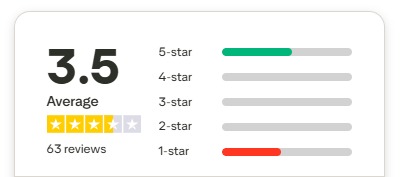
Before giving our own analysis, it’s essential to examine what users really think of Kalshi. On Trustpilot, the platform displays a rating of 3.5 stars out of 5 based on 63 reviews, reflecting a generally positive experience but with some friction points.
One user points out that the application is “easy to navigate with an excellent referral program! The app is very fast and I love that, no waiting for results, bets, or money!” Another positive testimony emphasizes customer service: “They addressed all of my concerns quickly and efficiently. The customer service team was helpful, attentive, and went above and beyond.”
However, some users report frustrating experiences. Jeremy testifies to a major technical issue: “Kalshi has been a frustrating experience. After placing bets on a market, I checked later to discover that a bug had moved my money to something completely different.” Another user complains about customer service: “I’ve emailed support several times each day and no response.”
These feedback experiences reveal that while Kalshi excels in certain areas like transaction speed and user interface, improvements are needed in terms of technical bug management and customer support responsiveness.
Our opinion on Kalshi: Even better than Polymarket?
So, is Kalshi the platform destined to dethrone the giant Polymarket? The answer is more complex than a simple yes or no. For the American user, the platform represents without a shadow of a doubt the best option available today. Its robust regulatory framework and professional corporate structure make Kalshi a reliable and trustworthy platform. This reliability is the key to its meteoric rise, which has seen the platform capture more than 60% of global market share in September 2025.

However, Polymarket should not be written off too quickly. The decentralized platform retains undeniable advantages for another category of users. Its blockchain-based model, absence of KYC procedures, and use of cryptocurrencies will continue to appeal to purists of decentralized finance (DeFi), who value anonymity, censorship resistance, and greater freedom.
Fees on Polymarket are also more competitive, a compelling argument for the most active traders. In conclusion, our final opinion on Kalshi is positive. It doesn’t yet replace Polymarket, but establishes itself as a leading alternative, mature and regulated, which could well become the industry standard if the trend toward regulation of prediction markets is confirmed globally. The Kalshi unicorn has brilliantly demonstrated that it’s possible to marry innovation and compliance; the future will tell if this model becomes the norm.

