Unveiling Paradex: Exploring the Perpetual DEX and DIME Token
What is Paradex in the booming DeFi ecosystem? In the competitive world of decentralized exchanges (DEX) for derivatives, Paradex has emerged as a leading contender, backed by top institutional players. Is Paradex merely an alternative or a true revolution in the making?
Paradex is a second-generation decentralized exchange (DEX) specializing in derivatives trading, particularly perpetual contracts. Launched in 2023, it operates as an AppChain (application-blockchain) on Starknet, an Layer 2 solution for Ethereum. This architecture enables it to deliver high performance, near-zero transaction fees, and a seamless user experience that rivals centralized platforms (CEX) like Binance or Bybit.
Paradex’s ambition is to solve the DEX trilemma by offering the security and transparency of decentralized finance (DeFi), the liquidity and performance of centralized exchanges, and enhanced privacy for its users. To achieve this, the protocol leverages cutting-edge technology, notably zero-knowledge proofs (zk-STARKs), and a unified product vision that brings together trading, asset management, and lending/borrowing within a single interface.
How does a DEX work?
To fully understand the innovation that Paradex represents, it’s essential to recall how a decentralized exchange functions. Unlike a CEX, which is a private entity acting as a trusted intermediary to manage orders and custody users’ funds, a DEX operates autonomously through smart contracts.
These computer programs, deployed on a blockchain, execute peer-to-peer transactions without any central authority being able to intervene. Users permanently maintain control of their private keys and, consequently, their cryptocurrencies.
This non-custodial approach is at the heart of DeFi philosophy, offering increased censorship resistance and transparency.
Behind every ambitious project lies a solid team, and Paradex is no exception. The project was incubated by Paradigm, which happens to be the largest institutional liquidity network for crypto derivatives, facilitating over one billion dollars in daily trading volume. This lineage is a major strategic asset, offering Paradex privileged access to deep liquidity and cutting-edge expertise from launch.
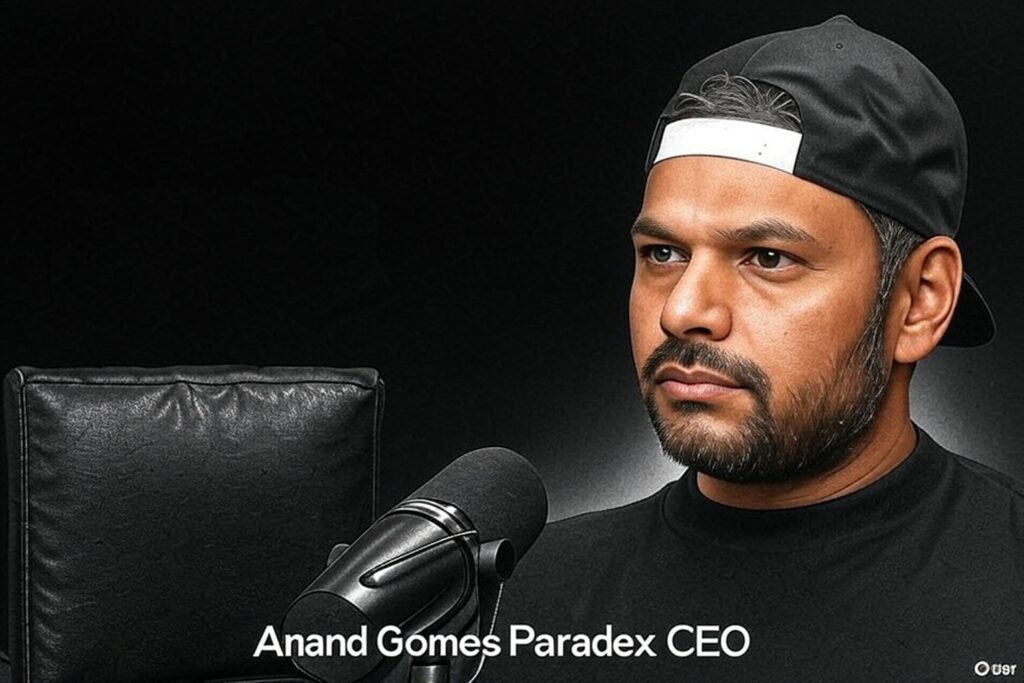
Portrait of Anand Gomes CEO of Paradex in black and white on white and black background
At the helm of the project, we find Anand Gomes, co-founder and CEO of both Paradigm and Paradex. His experience and vision are key drivers in the platform’s development. The team is primarily composed of former Paradigm members, experts who have shaped the institutional derivatives trading landscape.
This unique background, combining the rigor of traditional finance with DeFi’s agility, allows Paradex to position itself as a bridge between these two worlds.
Paradex features
Paradex distinguishes itself from competitors through a series of innovative features designed to attract both retail and institutional traders. The platform doesn’t simply replicate existing offerings but seeks to improve them by leveraging its unique architecture.
One of Paradex’s strongest value propositions is fee-free trading for retail traders across over one hundred perpetual contract markets. This aggressive policy, for both makers (those who add liquidity to the order book) and takers (those who remove it), eliminates a major barrier to entry and encourages high trading volume.
The platform also highlights institutional-grade privacy. zk-proofs encrypt accounts, thus masking traders’ positions, their entry and exit points, as well as their profits and losses. This opacity, rare in DeFi’s transparent universe, is a crucial feature for professional traders who wish to protect their strategies.
The Unified Margin concept is another pillar of the Paradex experience. It allows users to trade across over 250 markets, including futures, options, and soon spot, from a single account, using their entire portfolio as collateral. This approach significantly optimizes capital efficiency, a strong expectation of active traders.
Finally, Paradex is developing a complete financial ecosystem with yield-generating products. Paradex Vaults are investment vaults that allow users to access automated passive yield strategies. Eventually, the protocol will also introduce XUSD, a yield-bearing synthetic dollar, as well as integrated lending and borrowing markets, transforming Paradex into a true all-in-one financial station.
At the heart of the ecosystem lies DIME, Paradex’s native token. Announced in December 2024, DIME is designed to be much more than a simple governance token. It aims to become the fuel for the entire network, aligning incentives for all participants, from traders to liquidity providers to developers.
DIME will serve as the native gas token for the Paradex Chain upon its launch, allowing users to pay all network transactions with this token. In the future, DIME will also enable trading fee payments (with possible discounts), participation in staking and liquidity mining programs to reward users who secure the network and provide liquidity, and voting rights in the protocol’s decentralized governance.
DIME’s tokenomics have been designed to favor progressive decentralization and reward the community. Of the total supply, 57.6% of tokens are allocated to the community through various initiatives. This includes a community airdrop of 20%, continuous post-airdrop rewards (26.6%), and liquidity programs (5%).
The remainder is distributed among the foundation budget, core and future contributors, and Paradigm shareholders, the project’s incubator. This distribution demonstrates a desire to build a sustainable ecosystem controlled by its users.
How to be eligible for the DIME token airdrop?
Since the DIME token is not yet available on the market, the only way to obtain it is to participate in the airdrop campaign organized by Paradex. Eligibility is determined by an experience points (XP) system, designed to reward real activity on the platform.
Here are the key steps to accumulate XP and position yourself for the future airdrop:
Create and fund your account: Visit the Paradex website and connect a Web3 wallet compatible with the Starknet network, such as Argent or Braavos. Once connected, you’ll need to deposit funds (typically USDC) from the Ethereum network to your Paradex account on Starknet. Integrated bridges facilitate this process.
Generate trading volume: The main rewarded activity is trading on perpetual contract markets. The higher your trading volume, the more points you accumulate. XP calculation is directly proportional to the trading fees you would have theoretically paid, even though the platform offers fee-free trading for retail users.
Participate in referral programs: Paradex offers a referral system that allows you to earn a percentage of XP generated by traders you’ve invited. It’s an excellent way to increase your points passively.
Stay active across multiple seasons: The airdrop campaign is divided into several “seasons.” Rewarding long-term engagement is a key objective. Users who maintain regular activity across multiple seasons will likely harvest better rewards than those who concentrate high activity over a very short period.
Explore other features: While trading is the primary source of XP, using other upcoming features, such as Paradex Vaults or lending/borrowing markets, could also be an eligibility factor. Stay attentive to official team announcements.
Like any innovative platform, Paradex presents significant advantages but also some disadvantages that are important to consider before venturing into it.
Advantages
Zero trading fees for retail traders, a major competitive advantage that maximizes profitability.
Top-tier performance and liquidity thanks to its Starknet architecture and Paradigm incubation.
Enhanced privacy via zk-encrypted accounts, a rare and valuable feature for professional traders.
All-in-one financial ecosystem (unified margin, vaults, lending/borrowing) that greatly optimizes capital efficiency.
Strong institutional backing from Paradigm, guaranteeing top-tier expertise and liquidity.
Disadvantages
Complexity for beginners: the Starknet ecosystem and derivatives concepts can be intimidating.
Current relative centralization: as a “Stage 0 Rollup,” the platform still depends on centralized components.
DIME token not yet launched: the absence of the native token currently limits community involvement.
Layer 2 inherent risks: the protocol is exposed to technological risks of Starknet and bridges.
Very intense competition in the perpetuals DEX market.
Paradex vs other perpetuals DEX: Comparison
The perpetuals DEX market is extremely competitive, with several leading players innovating at a frenzied pace. To better position Paradex, here’s a comparative table based on several key criteria against its main competitors: Hyperliquid, dYdX, Aster, and Lighter.
Criterion
Paradex
Hyperliquid
dYdX
Aster
Lighter
Underlying Technology
AppChain on Starknet (Ethereum Layer 2)
Proprietary Layer 1 (HyperBFT)
AppChain on Cosmos SDK
Multi-chain deployment (BNB, ETH, SOL, ARB)
zk-Rollup on Arbitrum (Ethereum Layer 2)
Trading Fees (Retail)
Zero
Low, maker/taker model
Low, maker/taker model
Variable, with “Simple” and “Pro” modes
Zero
Unique Value Proposition
Privacy (zk-proofs), unified ecosystem, institutional support (Paradigm)
Extreme performance (200k TPS), on-chain order book, strong community
Market pioneer, mature decentralized governance, established brand
Proof of solvency, mathematically verifiable execution
How to use Paradex? Step-by-step guide
Paradex offers traders an experience as smooth as on a centralized exchange, while allowing them to benefit from the advantages of decentralization. Here’s a simple guide to start using the platform.
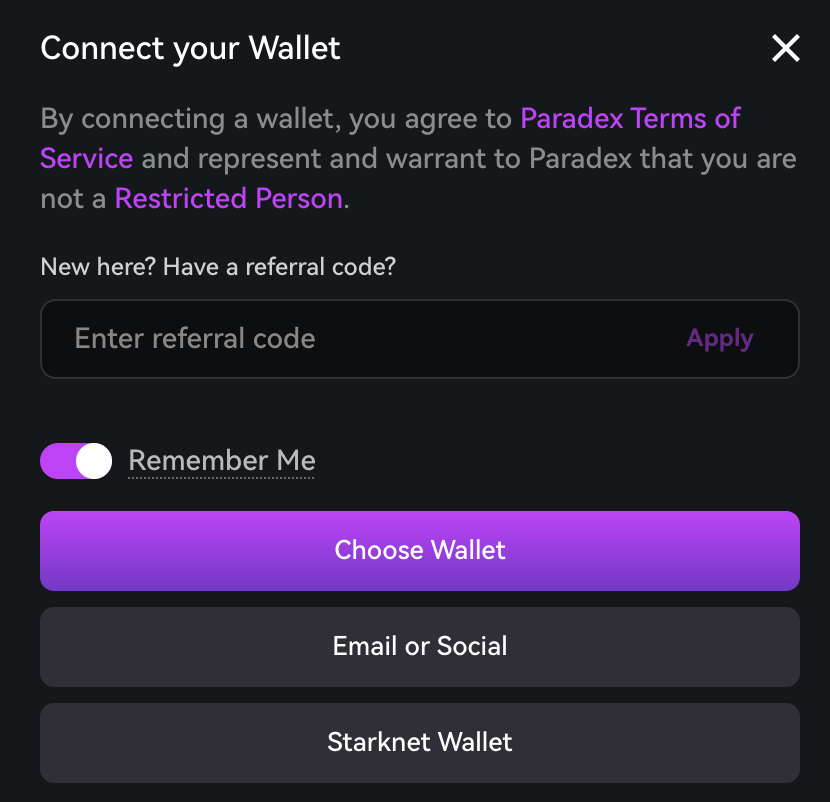
Access the platform and connect your wallet: The first step is to visit the official Paradex website. You’ll then need to connect a wallet compatible with the Starknet ecosystem. The most popular are Argent and Braavos. If you don’t have one, you’ll need to create one and transfer funds to it.
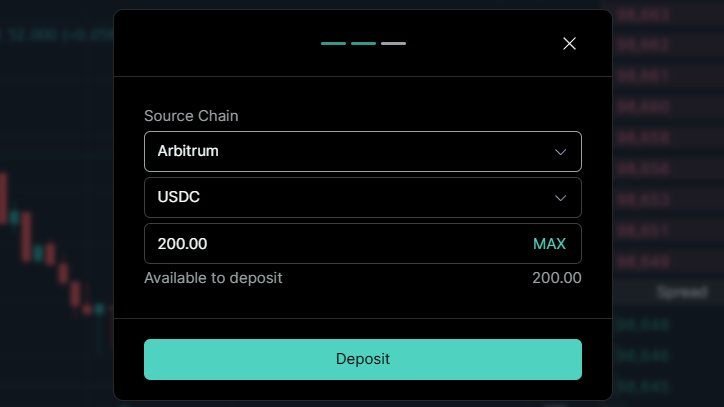
Deposit funds on Layer 2: To trade, you need to have funds on the Paradex Chain. The platform integrates bridge solutions that allow you to easily transfer assets, such as USDC, from the main Ethereum network (Layer 1) to your account on Layer 2. The operation can take a few minutes and involves gas fees on Ethereum.
Choose a market and analyze the order book: Once your account is funded, you can explore the over 250 available markets. The interface presents a real-time order book, a price chart, and various order types, similar to what’s found on CEX platforms. Choose the pair you want to trade (for example, BTC-USD).
Place a trading order: You can place several types of orders. The most common are Market orders (at market price), which execute instantly, and Limit orders, which only execute when the market reaches a price you’ve specified. Enter your position size, carefully choose your leverage, then confirm your order (Long to bet on upward movement, Short to bet on downward movement).
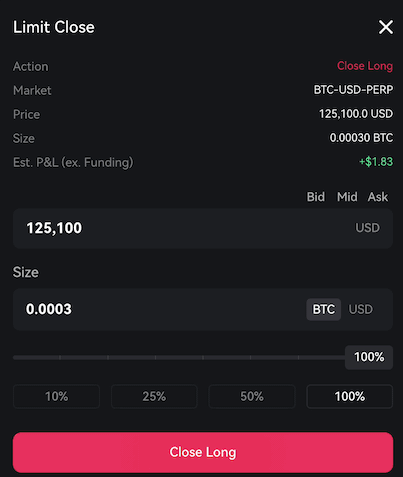
Manage and close your position: Your open position will appear in the corresponding section of the interface. You can track your real-time profits and losses (PnL), your liquidation price, and adjust your position if necessary. To close your trade, you can simply click the close button or place a reverse order of the same size.
The future of Paradex: Perspectives and expected developments
Paradex’s future revolves around an ambitious roadmap aimed at consolidating its position among leaders and pushing the boundaries of decentralized finance even further. The project is currently in a critical transition phase, moving from a partially centralized model to a fully autonomous infrastructure governed by its community.
The main objective is to achieve Stage 2 Rollup status, the highest level of decentralization and security for a Layer 2, according to L2BEAT’s classification. This evolution involves decentralizing key components like the sequencer (which orders transactions) and making the code entirely open-source. Simultaneously, Paradex will open its blockchain to external developers, thus transforming the platform into a permissionless environment where they can create new financial applications in synergy with the exchange.
In terms of products, the ecosystem will be significantly enriched. The launch of Spot trading, Dated Options, the XUSD synthetic dollar, and lending/borrowing markets is imminent. These additions will transform Paradex into a truly integrated financial solution. User experience improvements are also planned, such as social login integration and support for multiple collateral assets, further strengthening capital efficiency for traders.
Our opinion on Paradex: A revolution or just another DEX?
So, is Paradex the DEX that will change the game? Our analysis suggests it has several assets to be much more than just a competitor. Its solid technical architecture on Starknet, combined with a zero fee policy and innovative features like position privacy, immediately places it in the leading pack. Paradigm’s support isn’t just a detail; it’s a guarantee of seriousness, expertise, and above all, access to institutional liquidity that often lacks in DEX platforms.
However, the road to dominance is fraught with obstacles. Competition is fierce, with players like Hyperliquid constantly innovating. The inherent complexity of the Starknet ecosystem could slow adoption by the general public. Paradex’s success will depend on its ability to execute its ambitious roadmap, particularly its transition to complete decentralization, and to build a strong and engaged community around its DIME token.
In conclusion, Paradex is not just another DEX. It has the potential for revolution by bringing together the best of centralized and decentralized finance. Only the future will tell if it manages to transform this promise into reality.
Passionate about cryptocurrencies since 2019, I cover the latest news through clear and accessible articles. My goal is to make crypto understandable for everyone, with reliable and well-researched content.
FAQ on Paradex
What is Paradex in a few words?
Paradex is a high-performance decentralized exchange (DEX) for crypto derivatives trading, built on the Starknet network.
Is the Paradex token available for purchase?
No, the native token DIME is not yet available and will be distributed via a community airdrop.
Is Paradex secure?
Yes, Paradex uses zk-STARKs technology from Starknet and is incubated by Paradigm, a leading institutional player, providing robust security guarantees.
Do I need to verify my identity (KYC) to use Paradex?
No, as a DEX, Paradex does not require any KYC to start trading. You only need a personal wallet.
What are the fees on Paradex?
Paradex offers zero trading fees for retail traders on most of its perpetual contracts markets.
What is the difference between Paradex and dYdX?
Paradex stands out with its Starknet architecture, enhanced privacy, and unified margin model, while dYdX is an AppChain built on Cosmos.
How can I be eligible for the Paradex airdrop?
Eligibility for the DIME airdrop is based on accumulating experience points (XP) by actively trading on the platform.
DISCLAIMER
This article is for informational purposes only and should not be considered as investment advice. Trading cryptocurrencies involves risks, and it is important not to invest more than you can afford to lose.
InvestX is not responsible for the quality of the products or services presented on this page and cannot be held liable, directly or indirectly, for any damage or loss caused by the use of any product or service featured in this article. Investments in crypto assets are inherently risky; readers should conduct their own research before taking any action and invest only within their financial means. This article does not constitute investment advice.
Risk Warning : Trading financial instruments and/or cryptocurrencies carries a high level of risk, including the possibility of losing all or part of your investment. It may not be suitable for all investors. Cryptocurrency prices are highly volatile and can be influenced by external factors such as financial, regulatory, or political events. Margin trading increases financial risks.
CFDs (Contracts for Difference) are complex instruments with a high risk of rapid capital loss due to leverage. Between 74% and 89% of retail investor accounts lose money when trading CFDs. You should assess whether you understand how CFDs work and whether you can afford to take the high risk of losing your money.
Before engaging in financial or cryptocurrency trading, you must be fully informed about the associated risks and fees, carefully evaluate your investment objectives, level of experience, and risk tolerance, and seek professional advice if needed. InvestX.fr and the InvestX application may provide general market commentary, which does not constitute investment advice and should not be interpreted as such. Please consult an independent financial advisor for any investment-related questions. InvestX.fr disclaims any liability for errors, misinvestments, inaccuracies, or omissions and does not guarantee the accuracy or completeness of the information, texts, graphics, links, or other materials provided.
Some of the partners featured on this site may not be regulated in your country. It is your responsibility to verify the compliance of these services with local regulations before using them.
Get 6200 USDT with Bitget ! 🔥
Don't miss out on this offer !
Create your account now to unlock this exclusive reward