

US-Iran Ceasefire: Bitcoin Surges to $72,700
The night of April 7 to 8, 2026, will go down in crypto trading history. Trump announced a two-week bilateral ceasefire with Iran via Truth Social, triggering in just a few hours one of the most violent moves seen in cryptocurrencies since the conflict began. The market was waiting for either a resolution or an escalation; it got both successively within a 24-hour window.
The immediate context was explosive. Trump had set a deadline for 8:00 PM ET on Tuesday, April 7, threatening devastating strikes on Iranian infrastructure. That very morning, he posted that “an entire civilization would die tonight” if Iran did not agree to open the Strait of Hormuz, a message that sent markets plunging. It was in this extreme environment that the ceasefire announcement, negotiated via Pakistan, arrived.
The Short Squeeze Mechanics: $595 Million in 12 Hours
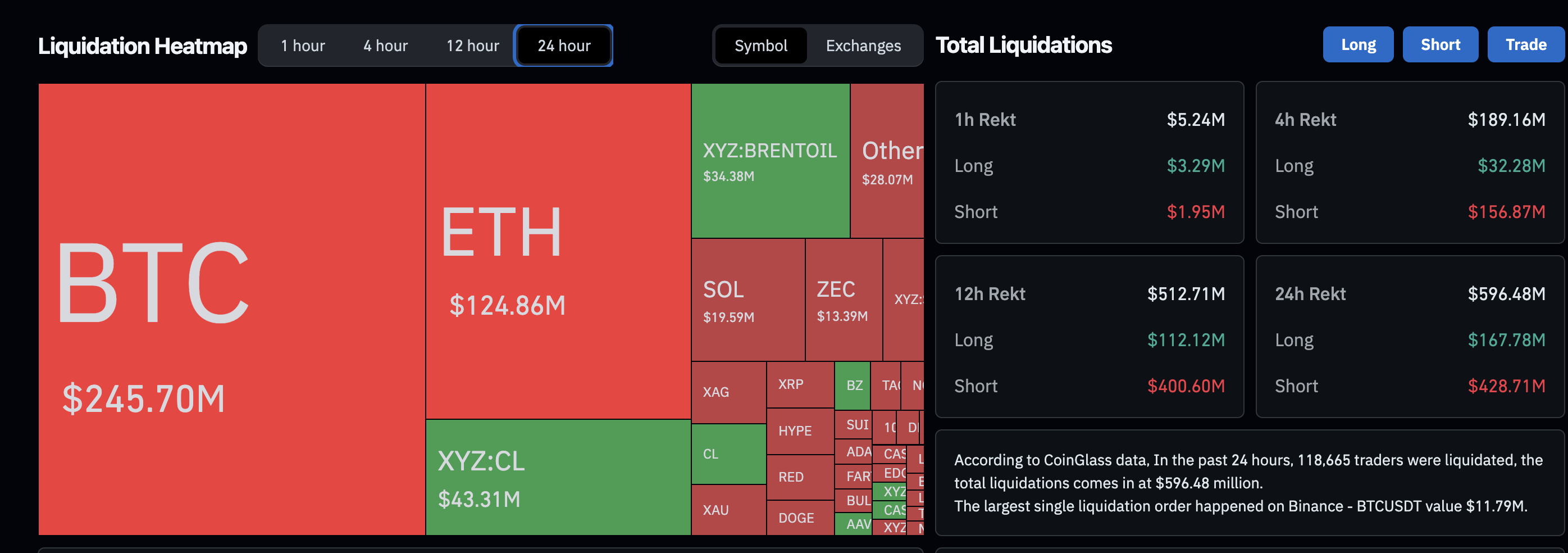
The price action was amplified by a predictable market dynamic for anyone tracking open interest. The spike triggered approximately $595 million in crypto liquidations, with short positions accounting for roughly $427 million, marking the most aggressive short squeeze since early March. Within a 12-hour span, $508 million had already been liquidated, including $398 million in shorts. The largest single liquidation order was an $11.79 million BTC-USDT short position on Binance.
Bitcoin accounted for $245 million in total liquidations, Ethereum followed with $126 million, Solana added $19.6 million, and Zcash recorded $13.4 million over the same timeframe. Tokenized Brent crude oil futures on Hyperliquid added another $33 million in liquidations, as crude collapsed by over 10% with WTI dropping to around $95 a barrel.
This type of setup perfectly illustrates why derivatives markets amplify price movements in both directions. Six weeks of ranging within a $65,000-$73,000 bracket had encouraged a buildup of short positions just waiting for a catalyst to capitulate massively.
The Pattern Repeating for Six Weeks
This is not the first episode of its kind since the conflict began. Ever since Operation “Epic Fury” launched on February 28, Bitcoin has been stuck in a frustrating range between $65,000 and $73,000. Every rally fails at the ceiling. Every selloff finds support at the bottom. Six weeks of this regime. The pattern is identical every time: a positive headline drops, BTC pumps 4 to 6%, short sellers get liquidated, and the bullish follow-through never arrives.
As Diana Pires from sFOX put it: the move looks “less like a change in fundamentals and more like off-sides positioning.” Sentiment was highly bearish, short positions had piled up, and when the ceasefire headlines hit, this positioning had to unwind rapidly.
This is exactly the takeaway for traders looking to capitalize on these moves: in a market driven by geopolitical headlines, being right on the fundamentals does not protect you from liquidation if your timing is off.
Bitcoin at $72,700: What’s Next Depends on the Two-Week Negotiations
Bitcoin peaked at $72,699, or +5% over 24 hours. Bitcoin futures open interest jumped by 5% to $49.53 billion in 24 hours, a clear signal of new institutional positioning.
Bitcoin now finds itself at the top of the $65,000-$73,000 range that has contained all trading activity during the war. Decisively breaking through this level depends on how the two-week ceasefire unfolds.
The situation is easy to read: if negotiations make concrete progress, Bitcoin has room to attempt a new ATH above the $125,904 mark set in the fall of 2025. If they stall or a new escalation arises, the $65,000 support once again becomes the primary pivot level to watch. For short term price predictions, everything now depends on a diplomatic negotiation room, not a chart. The crypto market knows this and is placing its bets accordingly.
Sources:
- X (TagadoBTC)
- Coinglass
- X (TedPillows)
Related Articles:

