

Whales capitulate, corporations sweep the board
On the surface, Bitcoin’s price action is showing signs of weakness. The market is undergoing a prolonged correction, and short term sentiment is darkening. However, data published on CryptoQuant Insights tells a completely different story. The market is not crashing: it is undergoing a massive structural shift.
According to Ki Young Ju, CEO of CryptoQuant, the Bitcoin correction is directly linked to massive selling by historical whales whose entry costs are close to $16,000. This selling pressure outweighs the combined institutional buying from ETFs and MicroStrategy. For these early investors, the arrival of institutional capital provides an unexpected exit window, similar to an initial public offering.
Against them, corporate buyers are not backing down. MicroStrategy recently added another 5,000 BTC to its reserves, and the March 29 statement by Michael Saylor has bolstered institutional confidence. Furthermore, Bitcoin reserves on exchanges plummeted by roughly 20,000 BTC in a single week, coins that are likely heading into the cold storage of long term holders.
ETF rotation: A misleading signal for the crypto market?
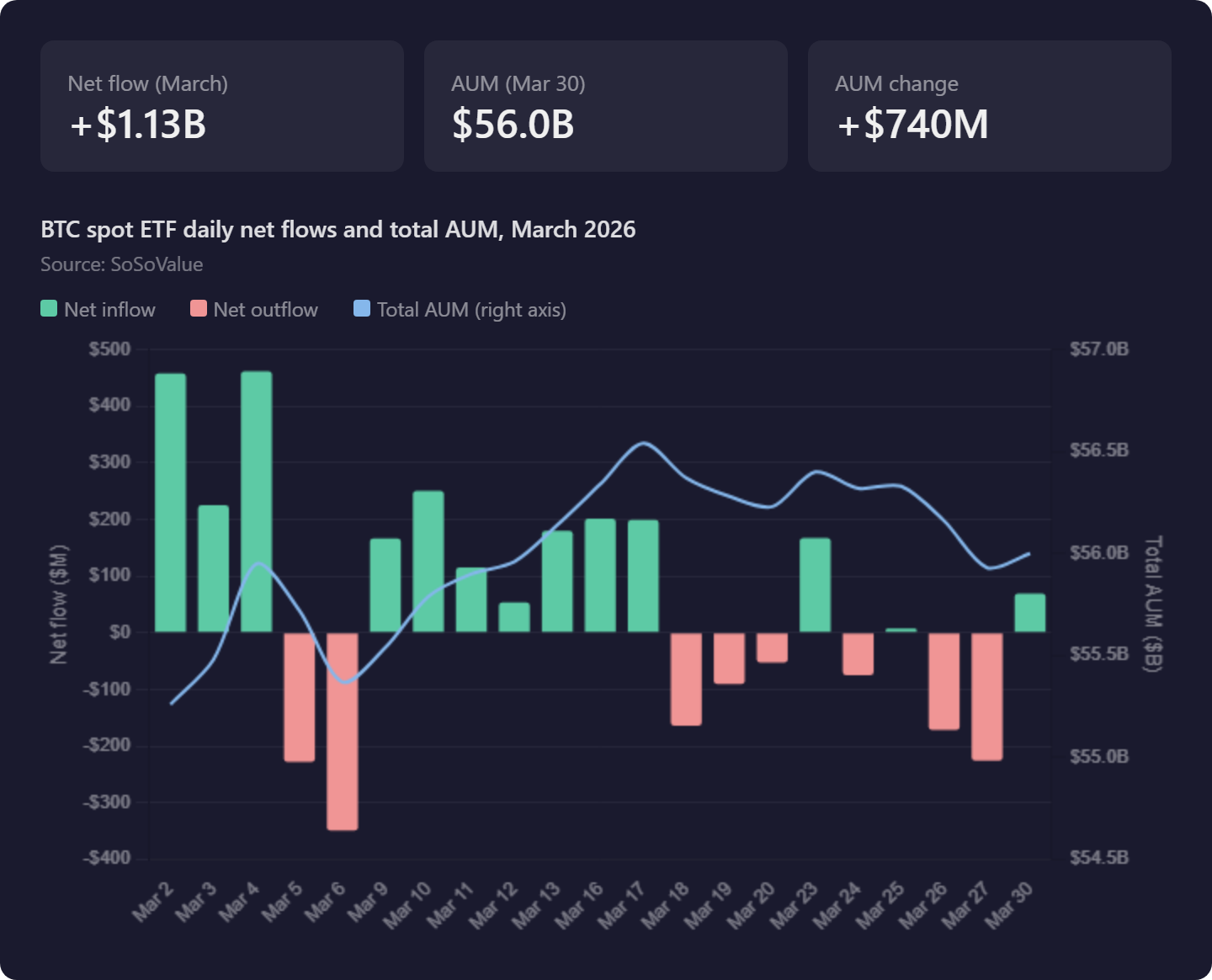
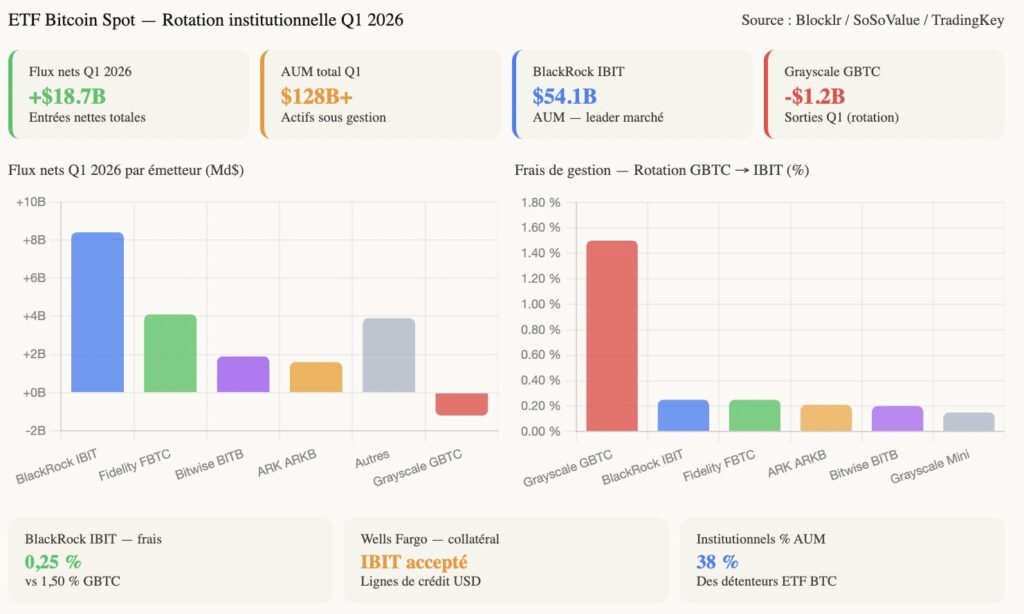
The other dynamic blurring the lines involves Spot Bitcoin ETFs. US Spot Bitcoin ETFs recorded $18.7 billion in net inflows in Q1 2026, pushing total assets under management beyond $128 billion. BlackRock IBIT dominated with $8.4 billion in net inflows, followed by Fidelity FBTC with $4.1 billion. Grayscale GBTC outflows slowed to $1.2 billion for the quarter.
GBTC outflows do not signal a flight from Bitcoin: the money is migrating toward cheaper products. GBTC charges a 1.5% management fee compared to 0.25% for BlackRock IBIT and Fidelity FBTC. This internal rotation gives the illusion of a stagnant market, when in reality it is a restructuring of institutional portfolios. The Bitcoin supply is not disappearing: it is simply changing hands.
BlackRock IBIT now boasts $54.12 billion in assets under management and has established itself as the primary vehicle for institutional liquidity. Wells Fargo now allows the use of Bitcoin ETF shares as collateral for dollar credit lines. This treats Bitcoin with the same financial utility as government bonds.
Is this the right time to accumulate Bitcoin before the next surge?
The current situation requires looking beyond daily charts. CryptoQuant data shows that Binance received 12,000 BTC from large wallets in a single day on February 6, ten times the monthly average. The whale signal is divided: some are accumulating, while others are positioning coins for sale. This confusion is reflected in contradictory on chain behaviors.
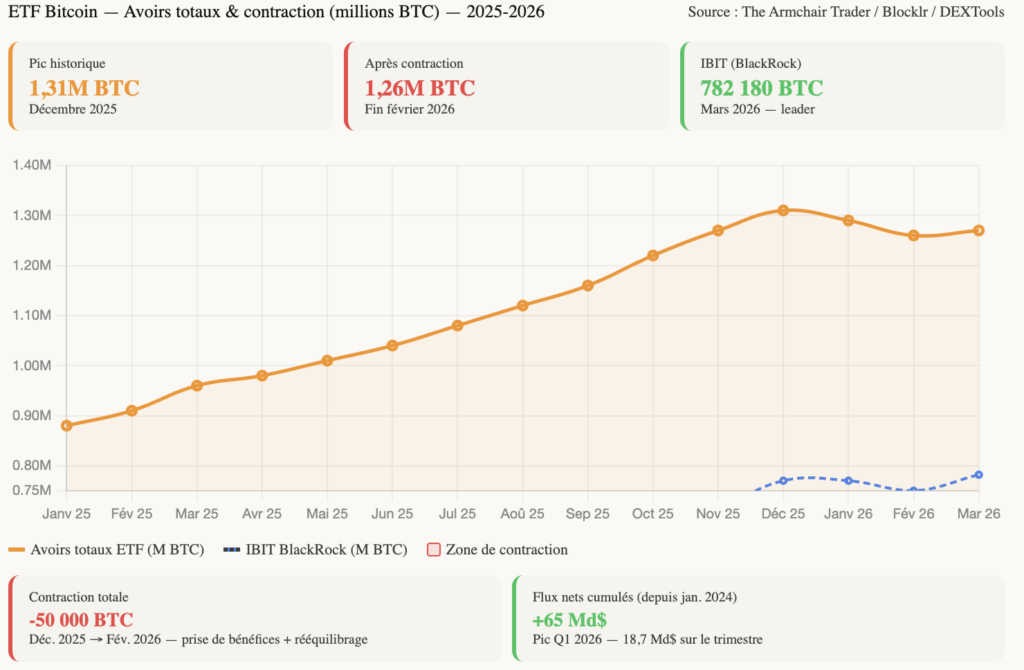
After reaching a peak of nearly 1.31 million BTC in December 2025, ETF holdings pulled back to around 1.26 million by the end of February 2026, marking the first sustained contraction since their launch. This development reflects a combination of profit taking, portfolio rebalancing, and increased volatility.
Traders who let themselves be blinded by the current bearish sentiment risk missing out on one of the biggest opportunities of this cycle. Once the selling pressure from whales is exhausted, the market could witness a spectacular breakout catching all short positioned traders off guard. How high can the price of Bitcoin soar once institutions have permanently locked up the available supply?
Sources:
Related Articles:

