

Dogecoin on the verge of exploding
Dogecoin is going through a pivotal phase. After suffering a 31% correction over 30 days, the asset has managed to defend the psychological support of $0.09 and is now trading between $0.091 and $0.092, showing a slight increase of 1.86% over 24 hours. This technical bounce occurs in a fragile market environment, where Bitcoin and altcoins remain under macroeconomic pressure. The 7% increase in trading volumes is a signal to watch. However, it is not yet enough to confirm a structural reversal.
As of March 30, 2026, 26 technical indicators signal a bearish bias compared to only 6 bullish ones, with an RSI at 43.79 in neutral territory. This picture does not rule out a potential bounce, but it indicates that the market remains in a wait and see mode.
Can the spot market trigger a new DOGE bull run?
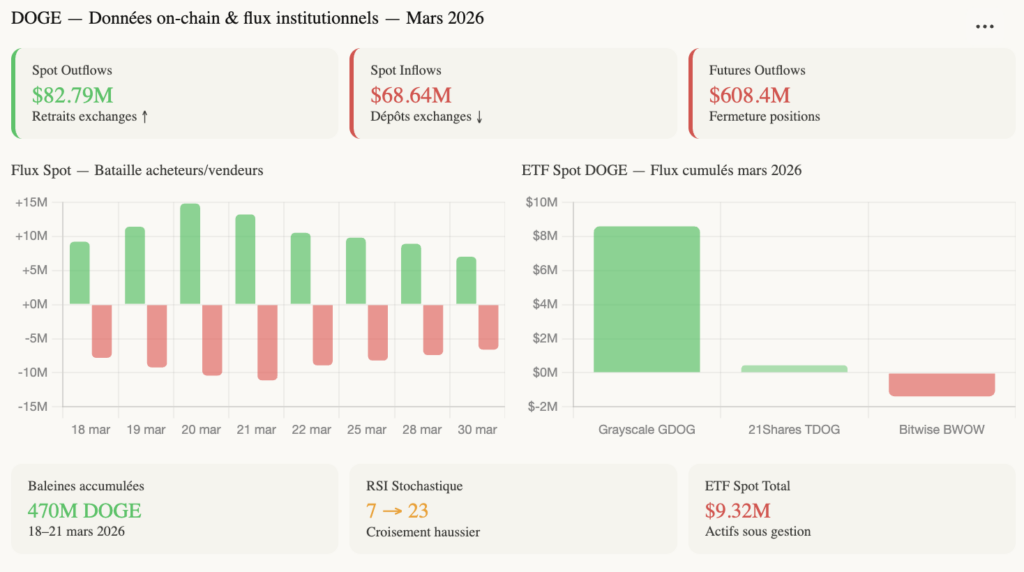
This is where the fundamental interest of the current setup lies. On chain data reveals a battle between two opposing forces: the spot market is recording $82.79 million in outflows against $68.64 million in inflows, a sign that holders are withdrawing their DOGE from exchanges and reducing selling pressure. At the same time, over $608.4 million has left the futures market. This signals a massive closure of positions and a reduction in risk appetite.
Whales accumulated 470 million DOGE between March 18 and 21, 2026, during the price weakness. Meanwhile, negative funding rates on futures indicate a predominance of short positions. This type of setup, with whales buying on the spot market and dominant shorts in futures, creates the conditions for a potentially violent short squeeze if buying pressure were to take over. The stochastic RSI has validated a bullish crossover by moving from 7 to 23, reflecting a renewed buying pressure. However, the indicator remains anchored in the oversold zone, signaling the persistence of sellers.
On the institutional side, the situation is more disappointing. US spot DOGE ETFs recorded less than $1 million in net inflows throughout the entire month of March 2026, with total assets sitting at just $9.32 million. Grayscale GDOG and 21Shares TDOG dominate with $8.58 million and $439,000 in cumulative inflows respectively. Institutional interest therefore remains marginal for now.
How high can the Dogecoin (DOGE) price go?
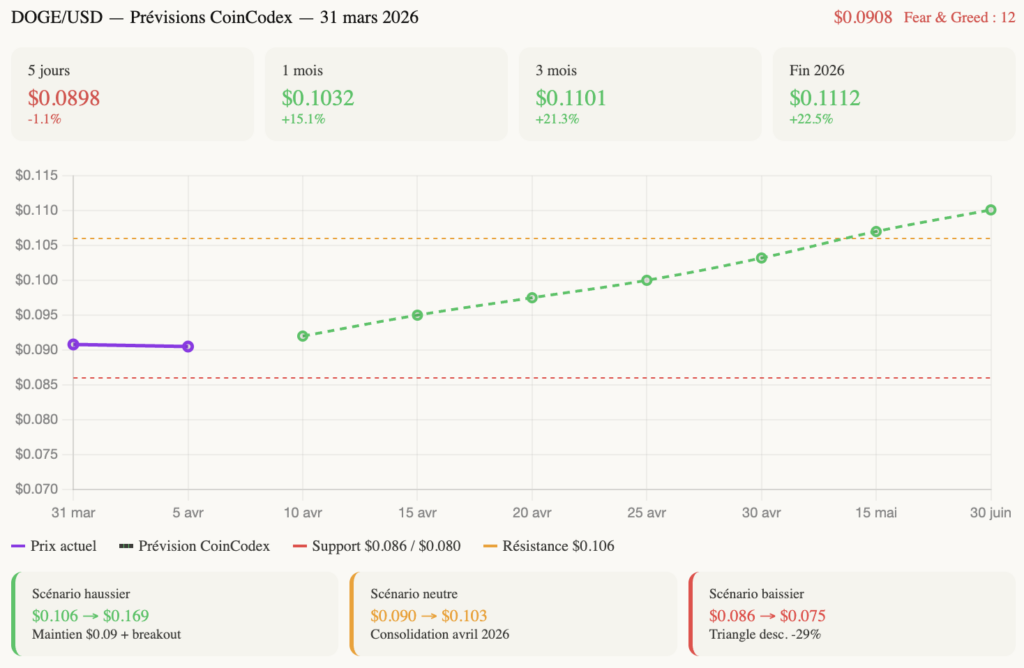
In a bullish scenario, if spot demand manages to absorb futures selling, DOGE could maintain the $0.09 level and target the $0.106 resistance. In a bearish scenario, a break below $0.09 would expose the asset to a slide towards $0.086, and then $0.080 as critical support.
Analysts are pointing out a descending triangle forming on the DOGE charts, with bearish pressure that could trigger a measured move of 29% down to $0.075. A daily close above $0.0985 is necessary to invalidate this scenario.
In the longer term, CoinCodex projects a 14.62% increase over one month to reach $0.1061 by the end of April 2026, while Cryptopolitan expects $0.16865 by the end of 2026, representing an 87% upside potential from current levels. These projections remain conditional on an improvement in overall market sentiment.
An external catalyst also deserves attention: rumors of a SpaceX IPO, which could raise up to $80 billion, have directly fueled interest in DOGE, with Elon Musk remaining the primary sentiment driver for the asset.
What the data really indicates
DOGE is currently in a rare setup: quiet accumulation by whales, volatility compression, negative funding rates, and recovering volumes. These combined elements create a favorable environment for a strong directional move, one way or the other.
The correlation of DOGE with Bitcoin exceeds 0.65. A return of BTC towards $70,000 would provide a significant tailwind to attempt breaking through resistances. Without this macro catalyst, the risk of prolonged consolidation between $0.085 and $0.10 remains the central scenario.
What distinguishes this setup from previous ones is the classification of DOGE as a digital commodity by the SEC and CFTC on March 26, 2026, which reduces a major regulatory uncertainty. This is not an immediate trigger, but it is a fundamental factor that improves the environment for upcoming institutional products. The market is watching closely. The next weekly closes will decide the outcome.
Sources:
Related Articles: