
Bitcoin and Crypto: Is the Fed ready to cut rates?
Is the Fed hinting at rate cuts? Discover how this could impact Bitcoin (BTC) and its potential to reach a new all-time high. Read now!


Is the Fed hinting at rate cuts? Discover how this could impact Bitcoin (BTC) and its potential to reach a new all-time high. Read now!
The FOMC minutes from March 17 and 18, 2026, published on April 9, confirm what the markets have feared for several weeks: the Fed is flying blind. Policymakers weighed opposing scenarios regarding how the war could impact inflation and employment. Most participants stated that a prolonged war could weaken the labor market and increase the need for rate cuts. Meanwhile, others estimated that rate hikes might be necessary if surging energy prices intensify inflationary pressure. For a crypto market looking for a clear signal, this is maximum ambiguity.
The internal picture at the FOMC is more fragmented than it appears. Seven policymakers favor zero rate cuts in 2026, while seven support a single cut. Only one governor dissented: Stephen Miran, who favored a 25 basis point cut. Jerome Powell acknowledged that the possibility of a rate hike was discussed at the meeting, but the vast majority of participants did not view it as their baseline scenario.
The economy is caught in a vice. The CPI rose by 2.4% year over year in February, and the core CPI is holding at 2.5%, still above the 2% target. Oil prices crossed the $100 per barrel mark in March, and the Fed’s internal inflation model estimates that a $10 per barrel increase pushes inflation up by approximately 0.35%. A three to six month period above $100 could therefore add more than one percentage point to inflation. For traders positioning rate futures, this context is particularly challenging to integrate into a coherent model.
The Fed maintained its projection of a single rate cut in 2026. Nevertheless, markets remain skeptical about the chances of monetary easing this year. The next FOMC meeting is scheduled for April 28 and 29, 2026.
In this blurry macroeconomic context, Bitcoin produced its most violent move in weeks. Bitcoin surged to around $72,700 after Trump announced a two week ceasefire with Iran, abruptly reversing days of bearish positioning. The spike triggered approximately $595 million in crypto liquidations. Short positions accounted for roughly $427 million, marking the most aggressive short squeeze since early March.
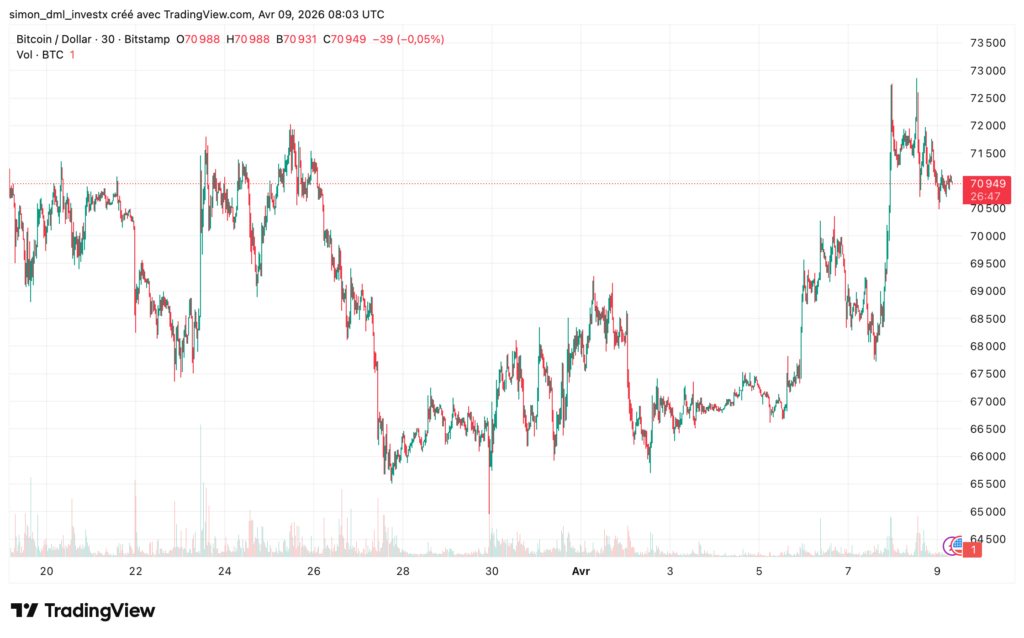
The mechanics of these liquidations are well known to active operators in the derivatives markets. The rally was partly fueled by short covering after traders betting on an escalation between the US and Iran were caught off guard. In this type of setup, the market often stalls while waiting for fresh demand. Without it, gains can quickly reverse.
The following day proved this caution right. Bitcoin held above $70,000 but markets retraced the ceasefire euphoria. Cracks appeared in the truce between the US and Iran less than 48 hours after its announcement. The Iranian Parliament signaled that three clauses of the ceasefire had been violated, while Brent crude climbed back toward $97.
For cryptocurrency investors, the right question is not whether the Fed will cut rates in April, but rather what geopolitical scenario will unfold by April 29. James Butterfill, Head of Research at CoinShares, explains it clearly:
“If the conflict were to deescalate, the immediate effect would be felt through lower oil prices and reduced inflationary pressure, increasing the probability of a looser monetary policy, which tends to support Bitcoin.”
Bitcoin’s correlation with the Nasdaq at 0.74 means that any hawkish signal from the Fed suggesting that rates will remain higher for longer could prolong the current weakness well beyond May. The key levels remain clear. The support sits between $62,000 and $65,000, while resistance is concentrated between $72,000 and $75,000. For those closely following technical analysis, the $68,000 level remains the crucial pivot that must hold on a daily close.
For traders looking to position themselves, the equation is straightforward. A lasting ceasefire reduces oil driven inflation and frees the Fed’s hands to cut rates. This gives Bitcoin the room to test $75,000 and then explore uncharted territory since its all time high of $125,904 in October 2025. If the truce collapses and oil surges again, the opposite scenario applies with the exact same mechanics. Monitoring Bitcoin ETFs also remains a useful barometer. Sustained inflows exceeding one billion per month would validate institutional resilience. The crypto market is waiting for the same event as the rest of the financial markets: a resolution to the crisis in the Middle East. Until this is resolved, following Bitcoin price predictions without factoring in the geopolitical variable is like flying blind.
Sources:
Related Articles:

Crypto analyst with over 7 years of trading experience and a strong background in the iGaming and cryptocurrency industries, I cover crypto news with a rigorous yet accessible approach. Passionate about blockchain since 2019, I have published more than 1,200 articles and guides on cryptocurrencies, DeFi, and blockchain, recognized for their reliability and clarity.
Specializing in on-chain trading and whale activity analysis, I decode blockchain flows to anticipate market trends before they become obvious.
One of my articles was cited by Éric Larchevêque, co-founder of Ledger, highlighting the quality and credibility of my analysis.
My goal remains unchanged: to make crypto accessible and understandable for everyone, from beginners to experienced investors.
Follow me on LinkedIn and X to stay updated with my latest insights.
DISCLAIMER
This article is for informational purposes only and should not be considered as investment advice. Trading cryptocurrencies involves risks, and it is important not to invest more than you can afford to lose.
InvestX is not responsible for the quality of the products or services presented on this page and cannot be held liable, directly or indirectly, for any damage or loss caused by the use of any product or service featured in this article. Investments in crypto assets are inherently risky; readers should conduct their own research before taking any action and invest only within their financial means. This article does not constitute investment advice.





Risk Warning : Trading financial instruments and/or cryptocurrencies carries a high level of risk, including the possibility of losing all or part of your investment. It may not be suitable for all investors. Cryptocurrency prices are highly volatile and can be influenced by external factors such as financial, regulatory, or political events. Margin trading increases financial risks.
CFDs (Contracts for Difference) are complex instruments with a high risk of rapid capital loss due to leverage. Between 74% and 89% of retail investor accounts lose money when trading CFDs. You should assess whether you understand how CFDs work and whether you can afford to take the high risk of losing your money.
Before engaging in financial or cryptocurrency trading, you must be fully informed about the associated risks and fees, carefully evaluate your investment objectives, level of experience, and risk tolerance, and seek professional advice if needed. InvestX.fr and the InvestX application may provide general market commentary, which does not constitute investment advice and should not be interpreted as such. Please consult an independent financial advisor for any investment-related questions. InvestX.fr disclaims any liability for errors, misinvestments, inaccuracies, or omissions and does not guarantee the accuracy or completeness of the information, texts, graphics, links, or other materials provided.
Some of the partners featured on this site may not be regulated in your country. It is your responsibility to verify the compliance of these services with local regulations before using them.

