

A Massive Technical Rebound After the Winter Storm
The Bitcoin network has just experienced a significant difficulty adjustment, marking a clear break from the trend of previous weeks. This movement follows a period of lows caused by extreme weather conditions, often referred to as “frost-driven dips”. Indeed, cold waves in the United States, particularly in Texas, regularly force industrial miners to reduce their energy consumption to support the electrical grid, causing a temporary drop in Hashrate.
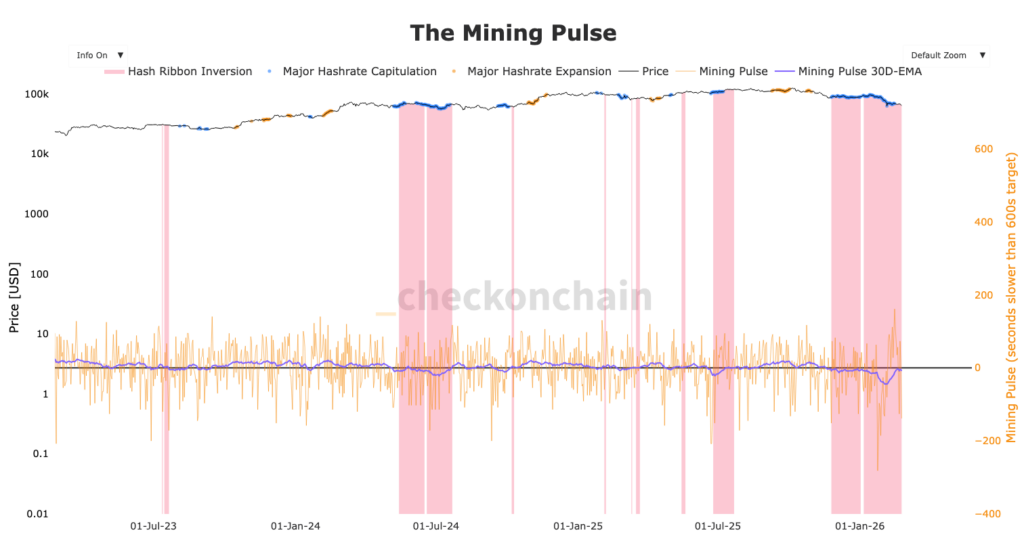
Today, the situation is reversing dramatically. With the return to normal mining operations, the computing power deployed on the blockchain has surged, mechanically driving up the difficulty. This self-regulation mechanism ensures network security, but it comes at a cost: it becomes more difficult and expensive to validate a block. For on-chain observers, this V-shape recovery of the hashrate is a sign of infrastructure resilience, but it imposes a new economic reality on market participants.
This recovery erases previous losses and places the difficulty close to its all-time highs (ATH). This means that competition for BTC rewards is fiercer than ever, which could influence the supply available on markets in the coming weeks.
BTC Trapped in a Range: Consolidation Analysis
From a purely technical perspective, Bitcoin is going through a complex consolidation phase. Since losing the key level of $70,000, the digital asset has been moving in a sideways channel, seeking solid support above the $63,000 zone. This inability to resume an immediate upward trend reflects a weakening of buying momentum, typical of post-rally retracement phases.
Volatility is compressing, which often precedes an explosive move. However, the current structure remains fragile. According to Killa, a drop below $60,000 is only a matter of time. But he also adds that Bitcoin will return to $180,000 in the next 2 to 3 years.
Miners Under Pressure: Buy Signal or Capitulation?
The interaction between Bitcoin price and mining difficulty is a leading indicator that traders watch closely. When difficulty increases while price stagnates or falls (as is currently the case with BTC below $70k), miners’ margins shrink drastically. This is called margin compression.
Historically, this situation can lead to two scenarios. The first is miner capitulation: the least profitable players are forced to sell their BTC holdings to cover their operational costs, adding selling pressure to the market. The second scenario, more optimistic, is that this difficulty increase signals a market floor. Strong miners accumulate, and the high production cost acts as a “soft floor” for Bitcoin’s price.
Currently, the market is closely watching outflows from miners’ wallets. If they start to massively liquidate their positions, the $63,000 zone could give way. However, if the hashrate continues to climb despite falling prices, this demonstrates long-term confidence from industrials in the asset’s future value.
The convergence between record mining difficulty and a consolidating price creates a critical tension point. The crypto market hates uncertainty, and the current volatility compression won’t last forever. Technical indicators suggest that the next move will be violent.
Related Articles: