

Bond Yields Hit New Highs: A Heavy Blow for Crypto?
Financial markets are navigating a turbulent zone. Yields on two and ten year US Treasury bonds have surged to reach 4.05% and 4.5% respectively, marking a record high over the past 12 months. This spectacular spike is driven by hotter than expected inflation data for April, forcing investors to reassess their expectations regarding interest rate cuts.
In this tense macroeconomic environment, risk assets like cryptocurrencies are facing a true stress test. Rising yields are acting as a major headwind for the crypto market.
Capital tends to flee toward assets deemed safer, making the overall market sentiment particularly bearish. As a result, institutional investors are now prioritizing guaranteed returns.
Paradoxically, this dynamic is benefiting a rapidly expanding niche sector: tokenized Treasuries. While gold and BTC are losing momentum, government bonds on the blockchain are attracting increasing amounts of liquidity, offering a hybrid alternative between traditional finance and DeFi.
Bitcoin Faces the $82,000 Wall: Is a Breakout Impossible?
From a technical standpoint, the Bitcoin chart is showing signs of exhaustion. Currently trading around $81,000, BTC remains stubbornly stuck below its 200 day moving average (sitting near $82,400). This indicator is crucial: a rejection at this level often confirms a prolonged correction, whereas a clean break is required to validate a genuine bullish breakout.
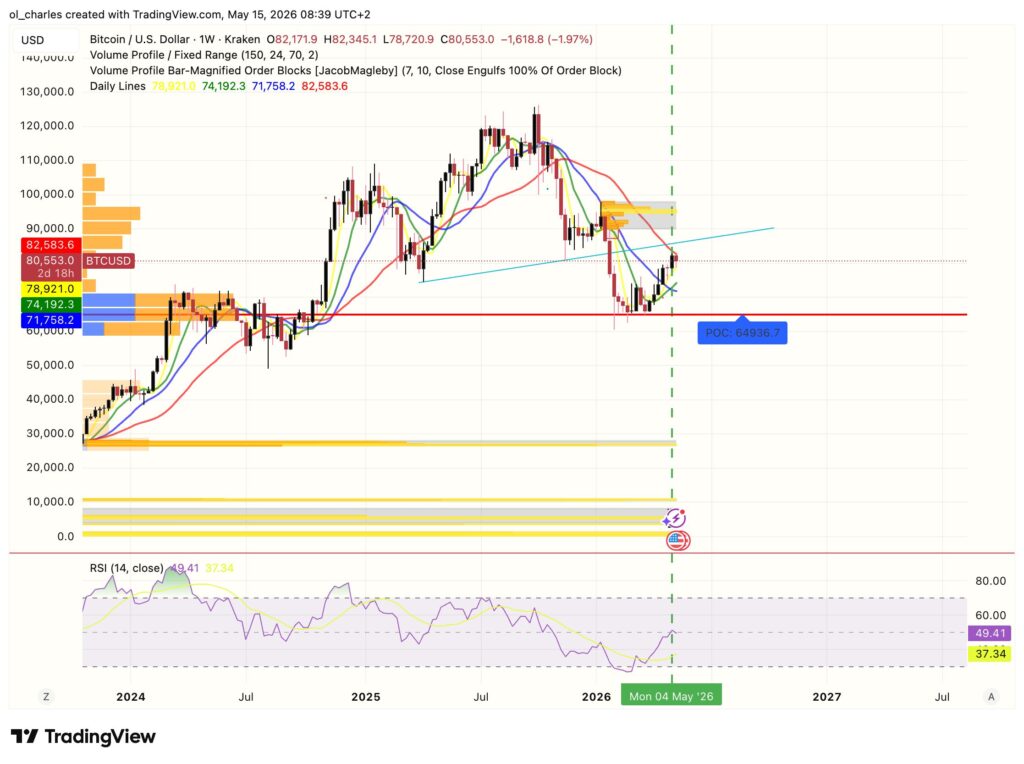
Onchain data and institutional flows confirm this fragility. Spot Bitcoin ETFs recently recorded massive outflows exceeding $635 million in a single day. Without an influx of fresh capital into the spot market, the recent rally appears to be primarily driven by leverage and short liquidations, creating a historically unstable market structure.
If buyers fail to regain control quickly, the risk of a deeper retracement will intensify. Traders are closely monitoring the $80,000 psychological support level. Breaking below this threshold could invalidate hopes for a new rally and drag BTC back down to $75,000, as discussed yesterday.
Can Bitcoin Rebound Against Macroeconomic Pressure?
Despite this bleak outlook, a few glimmers of hope remain for market bulls. The advancement of the CLARITY Act in the US Senate could provide a favorable regulatory framework, restoring confidence among institutional investors. Furthermore, the potential appointment of Kevin Warsh to lead the Fed introduces a new variable into American monetary policy.
However, these types of news events are often announced at local tops or bottoms. Given the current price action of BTC, a retracement is now the more probable scenario.
The question now is whether the market has already priced in these negative macroeconomic updates. Will whales take advantage of this dip to accumulate more tokens, or are we about to witness a broader capitulation from retail investors? The next move for Bitcoin promises to be decisive for the entire crypto ecosystem.
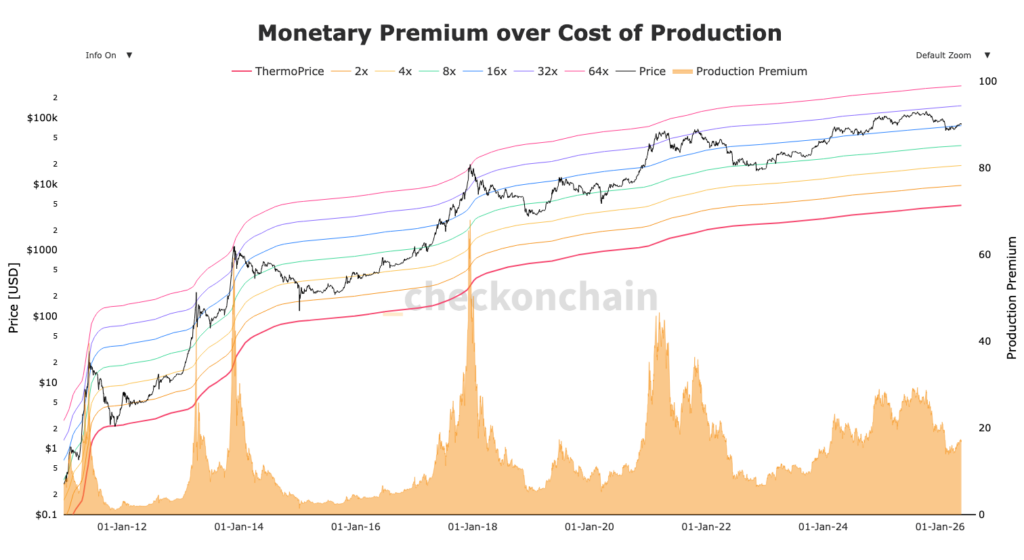
From a longer term perspective, an onchain chart is raising questions about the trajectory of Bitcoin over the coming years. Indeed, the monetary premium indicates that BTC remains too expensive for miners. The massive sell off by miners in recent weeks further confirms the struggles faced by this essential sector.
This chart illustrates the monetary premium of Bitcoin, meaning the extent to which its market price exceeds its production cost. The black line represents the price of BTC on a logarithmic scale. The colored lines represent multiples of the production cost. Simply put, the higher the line, the more expensive BTC is compared to the actual cost of mining it.
If Bitcoin follows previous cycles regarding miner behavior, the ultimate bottom for Bitcoin could sit anywhere between $37,000 and $9,000. Currently, Bitcoin is trading well above its production cost multiples (between 16x and 32x), highlighting a very high monetary premium. This reflects strong speculative and institutional demand. Historically, when this premium reaches such elevated levels, the market is considered mature but highly vulnerable to corrections. The coming months will undoubtedly provide more clarity.
Sources:
Related Articles:

