

Bitcoin: Iran Dictates the Market Tempo
Donald Trump’s speech from the White House on Wednesday evening dashed hopes of a swift easing of tensions in the Middle East. Rather than offering the path to deescalation that markets had anticipated, the US president promised to strike Iran “extremely hard” over the next two to three weeks, specifying that American forces are nearing the completion of Operation Epic Fury. Bitcoin immediately dropped by 2.2% to fall back below $66,600, wiping out the previous day’s gains in a matter of hours.
Oil prices reversed their trend and climbed back above $100 a barrel, reigniting concerns over supply disruptions through the Strait of Hormuz. This move dragged all risk assets down in its wake: equities, US futures, and cryptocurrencies retreated simultaneously, confirming that Bitcoin is once again behaving as a high beta asset rather than an uncorrelated store of value.
Macro and Options: Particularly Unfavorable Timing
The drop cannot be explained solely by geopolitics. On March 27, Bitcoin fell by nearly 5% to around $66,484, its lowest level since the beginning of the month, during an expiration of $14.1 billion in Bitcoin options, an event that mechanically amplifies short term volatility. Meanwhile, the 10 year US Treasury yield climbed to 4.456%, its highest level since July, and the dollar posted its best monthly performance since July 2025.
This combination is structurally hostile for cryptocurrency trading. When oil rises, investors do not just anticipate the risk of war: they price in more persistent inflation, central banks forced to keep rates higher for longer, and reduced liquidity for risk assets. Financial markets have begun to price in a 70% probability that the Fed will raise rates in 2026. For Bitcoin, this is the worst case scenario: high energy costs, rising real rates, and sentiment geared toward inflation rather than fresh liquidity injections.
The $65,000 Mark Remains the True Structural Test
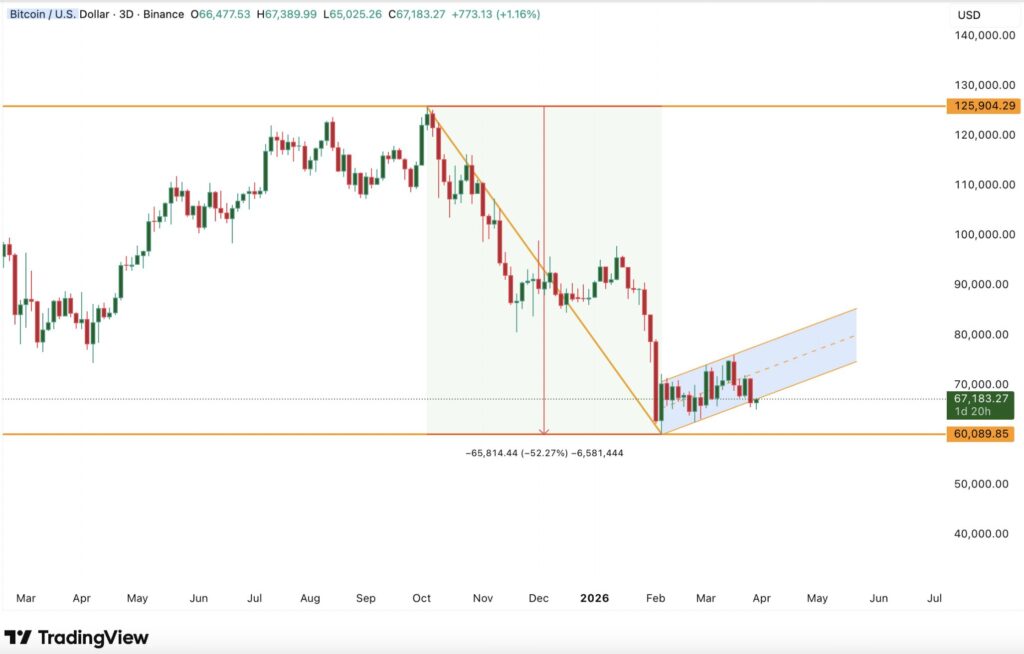
In terms of technical analysis, the $65,000 zone is capturing all the attention. Buyers are actively defending this psychological threshold, which serves as the last line of defense for the ongoing bullish trend. A clean break below this level would likely trigger stops and pave the way toward $60,000, a level that has historically attracted buyers during previous corrections.
Onchain data confirms persistent distribution pressure: the whale ratio has increased throughout 2026, signaling that large holders are regularly transferring coins to exchanges. Combined with a slowdown in inflows to Bitcoin ETFs, this dynamic weakens the short term demand structure. The RSI on the daily chart remains in neutral to slightly bearish territory, neither oversold enough to trigger a mechanical bounce, nor strong enough to confirm a recovery.
ETF flows are nevertheless sending a less negative signal than it seems. Since March 2026, Bitcoin ETFs have recorded $1.3 billion in inflows, a positive first in four months. If this trend is confirmed, James Butterfill of CoinShares believes that Bitcoin could climb back toward $80,000.
Should You Buy the Dip or Wait?
This is the real question every investor is asking right now. The honest answer is binary depending on your profile. For long term positions on Bitcoin, the current zone between $65,000 and $67,000 objectively represents a 45 to 50% correction from the all time high of $126,000. Historically, similar mid cycle corrections have preceded significant rallies.
On the other hand, for short term positions, the macro context does not lend itself to immediate optimism. Two conditions would be necessary for a sustainable bounce: an easing of macro pressure, specifically a drop in interest rates and oil prices, and a resumption of inflows into Bitcoin ETFs. Without these two catalysts, the market will remain at the mercy of the next geopolitical headlines coming out of Washington.
Our take: as long as the conflict between Iran and the United States remains open and oil stays above $100 a barrel, Bitcoin will continue to behave as a risk asset correlated to equity markets. A potential ceasefire, even a partial one, would be the most powerful short term catalyst to reignite bullish price predictions for Bitcoin.
Sources:
- KobeissiLetter on X
- TradingView
- WHALES_CRYPTOt on X
Related Articles:

