

The Pi Network Launchpad: A Revolution?
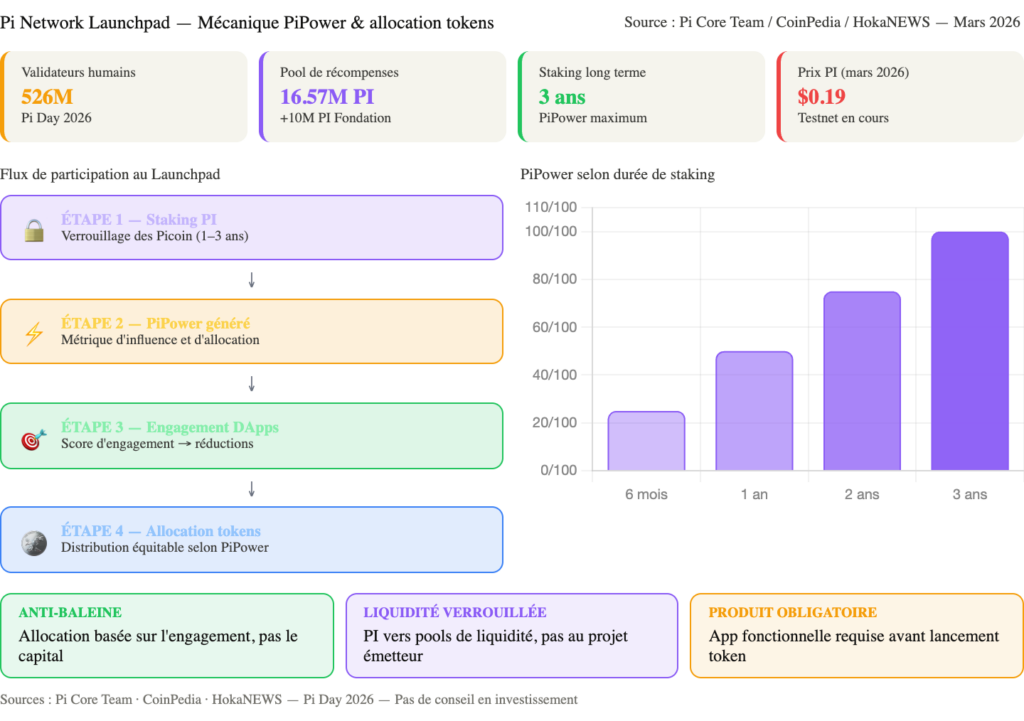
As the crypto market hopes for a new bull run, the Pi Network ecosystem is setting the stage with its most ambitious update in seven years. During Pi Day 2026, the Core Team officially unveiled the Pi Launchpad on Testnet, a token launch platform designed for utility-driven projects within the Pi ecosystem. The fundamental rule that sets this Launchpad apart from all its competitors: no project can issue a token without first having a functional application. The Pi collected during each launch is directed into liquidity pools, rather than to the issuing project. This structure-first logic represents a clean break from the speculative ICOs that dominated previous cycles.
The release of the Launchpad with a test token immediately sparked discussions across the Pi community. Several ecosystem players described this Testnet deployment as a deliberate strategy to allow users to understand the mechanics before the Mainnet deployment, particularly the engagement scoring, PiPower allocation, and automated liquidity features.
PiPower: The Mechanic That Changes Everything
At the core of the system are two distinct yet complementary actions: staking and engagement. Participants stake their Pi, which generates PiPower, a metric representing the maximum number of tokens each participant can receive during a launch. This mechanism creates a direct link between community involvement and token allocation. Unlike traditional ICOs that favor large capital or insiders, Pi Network connects distribution to verifiable on-chain activity.
Pioneers who lock their Picoin for a period of 3 years benefit from a higher level of PiPower, thereby rewarding long-term loyalty. The longer the staking duration, the larger the share of tokens during launches. This massive lock-up mechanism reduces the circulating supply, a structurally bullish signal for the medium-term Pi price prediction.
The tokens accessible via the Launchpad are backed by locked liquidity pools, reducing the risk of sudden crashes or market manipulation. Establishing a price floor protects participants against extreme losses, a chronic issue on traditional launch platforms.
Engagement as a Competitive Advantage for Pioneers
This is where the true differentiating mechanic comes into play. Users are encouraged to interact with decentralized applications operating on the Pi Network Testnet. Platforms like Archimedes, BNPI, and ShrimpSwap allow them to observe token flows, understand trading mechanics, and gain hands-on experience with Web3 features. Every interaction boosts the engagement score, which unlocks direct discounts on the purchase price of new tokens during launches.
The most dedicated pioneers can thus accumulate a much larger quantity of tokens for the exact same initial investment, without the size of their capital being the deciding factor. This model transforms passive miners into active participants in the DeFi ecosystem, while ensuring an organic distribution that limits the effects of post-launch massive dumping.
Can the Pi Token Smash a New ATH During Mainnet?
According to information shared by Woody Lightyear, Pi Network has announced a precise schedule for its node protocol updates, culminating in the v23.0 upgrade. This progression is mandatory for all node operators, highlighting the coordination and consensus across the entire ecosystem.
Protocol 20 introduces the technical infrastructure required for smart contracts on the Pi blockchain, enabling developers to build decentralized applications, automate transactions, and manage NFTs, subscriptions, and escrow systems. Subscription and escrow contracts are currently undergoing external security audits prior to deployment. Furthermore, over 526 million human validations have been completed by more than 1.09 million validators, with a reward pool of 16.57 million PI supplemented by an additional 10 million PI from the Pi Foundation.
If the momentum continues and the Mainnet launch is confirmed in the coming months, the massive token lock-up via staking will mechanically reduce the supply available for sale. Combined with a community of over 1 million active validators and an ecosystem of functional applications, this structure could act as the catalyst for a significant technical breakout on crypto exchanges as soon as secondary markets open.
Sources:
- WaeliaMe on X
- PiNewsMedia on X
- Pi Core Team
Related Articles: