

The DePIN Sector Shunned by the Crypto Market
The crypto market has witnessed a spectacular resurgence of legacy tokens driven by utility narratives in 2025, but the DePIN sector remains severely lagging behind. This sector, despite being considered one of the most useful in the blockchain ecosystem, shows a staggering 74% decline this year according to Artemis data, placing it among the ten worst-performing sectors.
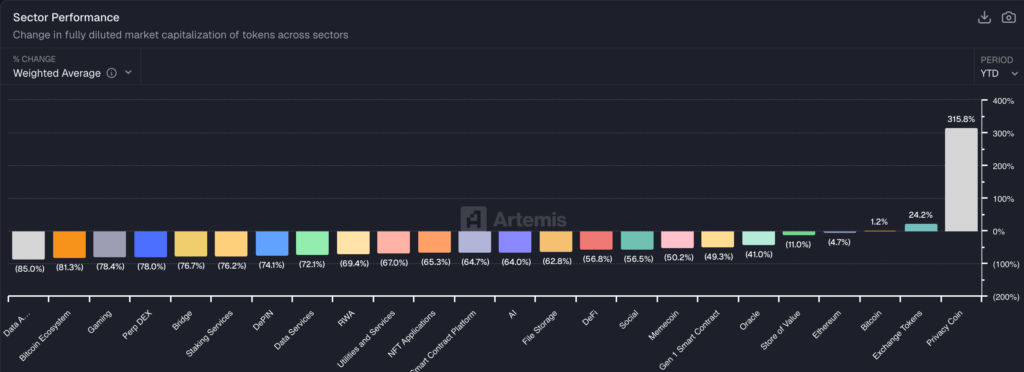
First, DePIN, an acronym for Decentralized Physical Infrastructure Networks, refers to blockchain systems that coordinate, finance, and operate physical infrastructure through decentralized incentive mechanisms. Unlike traditional centralized models, these networks distribute the deployment of infrastructure like wireless coverage, storage, IoT sensors, or energy networks among multiple individual contributors compensated in tokens. This approach drastically reduces initial costs while expanding the geographic reach of services.
A Fundamental Paradox: Usage Rising, Valuation in Free Fall
The DePIN sector is currently experiencing a fascinating paradox. While valuations collapse, real usage metrics are reaching historic highs. In October 2025, fees generated by DePIN networks reached a record $2.5 million, with Helium leading at $1.7 million. Hivemapper and Livepeer recorded monthly growth of 111% and 74% respectively, while total fees progressed 273% year-over-year.
This divergence between price action and fundamentals reveals a major gap between speculative perception and real adoption. Sami Kassab, managing partner at Unsupervised Capital, explains that the general weakness of altcoins has naturally impacted DePIN, but the problem goes deeper.
“There hasn’t been a revolutionary DePIN yet capable of capturing market attention. DePINs are building real infrastructure and real businesses, which takes time in a market accustomed to quick narratives and overnight gains,” he emphasizes.
Leo Fan, co-founder of Cysic, identifies a structural mismatch between infrastructure building cycles and the crypto market’s short attention span:
“NFTs, memecoins, and major altcoins thrive through culture and enthusiasm. DePIN functions as an invisible infrastructure layer that investors struggle to connect with emotionally. Value grows quietly through hardware deployments and real compute capacity, progress that is neither immediately visible nor profitable short-term.”
Maria Carola, CEO of StealthEx, confirms this behavioral bias. Investors massively prefer quickly tradeable assets rather than sectors requiring deep understanding of complex tokenomic mechanisms:
“DePIN’s approach is too complex. Most investors never understand how token incentives stimulate data collection, storage, or connectivity, and how this generates revenue. DePIN is the crypto version of traditional infrastructure: unglamorous but absolutely essential,” she analyzes.
Invest in the best DePINs like Render on Pionex with automated bots that increase your annual returns by 50-150% and protect you against market downturns. Try to win up to $1,000 USDT here:
The Catalysts for an Expected Turnaround in 2026
Several experts anticipate a major bullish momentum for DePIN in 2026, driven by convergent factors. Enterprise adoption constitutes the most powerful catalyst according to Leo Fan.
“Once enterprises begin integrating decentralized infrastructure into their existing systems, confidence in the model increases. DePIN’s credibility relies on measurable performance, and corporate engagement provides exactly that validation,” he explains.
The rise in fees during a bear environment demonstrates that real users continue to find concrete value in these services, whether decentralized storage or distributed compute. Maria Carola notes that this dynamic is typical of emerging infrastructure sectors where fundamentals strengthen well before price recognition. “When revenue follows growing usage, like in internet’s early days, these metrics will matter more than short-term token performance,” she predicts.
Vinayak Kurup, partner at Escape Velocity Crypto, observes concrete signs of change:
“Helium is now advertising its free phone plan in New York subway. Compared to Web2 players, DePINs have only recently reached sufficient capitalization to penetrate mainstream markets. 2026 will be DePIN’s comeback year,” he affirms.
The gradual shift in investor preferences toward projects with recurring cash flows and solid fundamentals creates a favorable environment. Leo Fan emphasizes that the rise of RWAs and growing institutional adoption in 2025 demonstrate that the real economy already values decentralized systems.
“DePIN is positioned to become the infrastructure layer connecting DeFi to enterprise use cases. When institutions seek verifiable and profitable infrastructure for secure settlements, DePIN will shift from niche experiment to foundational layer of digital finance.”
Related articles:

