

$18 Million Lost to Crypto Exploits
PeckShield data reveals that just $18.18 million was stolen across 15 separate incidents in October 2025 in the crypto market. This dramatic drop stands in stark contrast to the $127.06 million recorded the previous month. From a purely statistical perspective, this represents the lowest level of losses observed since the beginning of the year.
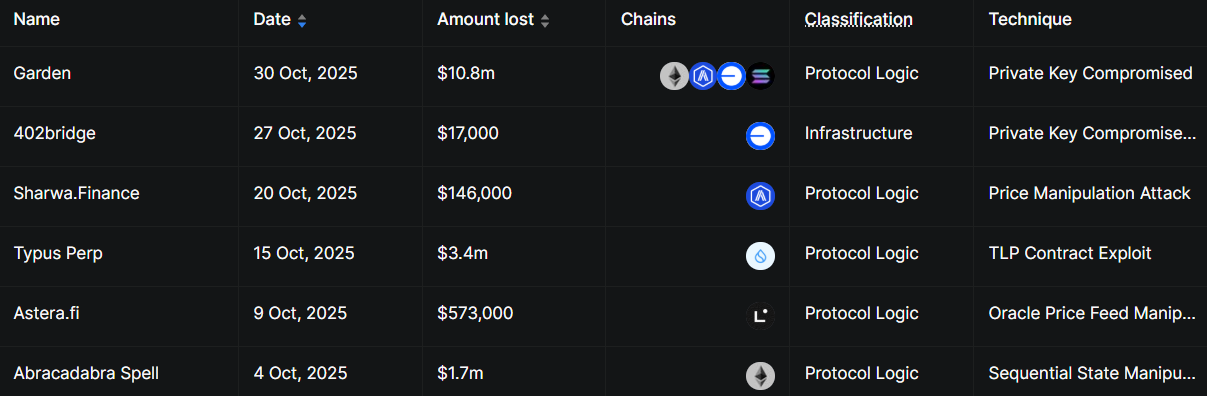
The Garden Finance incident alone accounts for more than $10 million of this total. This peer-to-peer Bitcoin protocol was exploited on October 30 after one of its resolvers was compromised. Without this last-minute attack, the monthly losses would have been limited to approximately $7.18 million – a historically low level not seen since early 2023.
Typus Finance and Abracadabra complete the trio of major exploits for the month. The former, a yield platform on Sui, suffered an oracle manipulation on October 15 that drained $3.4 million from its liquidity pools. The attack exploited a vulnerability in a TLP contract, causing a 35% drop in the native token. Abracadabra, for its part, weathered its third exploitation since launch with estimated losses of $1.8 million in MIM stablecoin.
Garden Finance and Typus: Technical Vulnerabilities Still Exploitable
The attack against Garden Finance illustrates the persistence of vulnerabilities in intermediary components. Security audits often overlook resolvers, which facilitate transactions between users and constitute points of centralization. The Typus Finance case demonstrates another threat: oracle manipulation, allowing hackers to falsify asset prices and drain liquidity pools. Abracadabra confirms that a history of exploits doesn’t immunize a protocol, revealing structural gaps and flaws in post-incident audits.
October’s figures mask a concerning evolution in the threat landscape, with North Korean-linked hacking groups now directly integrating malicious code into blockchain networks, bypassing traditional security layers. State actors’ involvement is intensifying, targeting blockchain infrastructure to establish persistent backdoors. DeFi protocols are strengthening their security audits and monitoring systems, but these efforts remain focused on application layers.
This phase of blockchain cyber-warfare is pushing protocols to rethink their security models, as traditional defenses based on smart contract audits and transaction monitoring are insufficient against attacks targeting the foundations of decentralized systems. The decline in hacks might reflect a transition period, but the crypto industry remains at a crossroads – either moving toward sustainable security improvements or facing a new wave of sophisticated attacks in the coming months.
How to Secure and Buy Crypto on Bitget?
Bitget is a convenient platform for easily buying and managing your cryptocurrencies, securing rewards, benefiting from 10% cashback, and positioning yourself strategically in the market.
Guide for purchasing on Bitget:
- Create an account and verify your identity (KYC + 2FA).
- Deposit funds: bank transfer or crypto.
- Buy crypto: Spot or Limit orders.
- Enjoy 10% cashback on certain transactions.
- Store and manage your assets on Bitget or a secure external wallet.

On the same topic:

