Hyperliquid DEX Defies Market Crash: Is It More Reliable Than Binance?
As Binance faces critical outages and a major fee listing controversy, Hyperliquid showcases that decentralisation is not just an alternative but a real threat to the dominance of centralised exchanges. Handling uninterrupted $10 billion liquidations during the October 10 chaos, could on-chain transparency be emerging as the new trust standard in the crypto ecosystem?
Hyperliquid Absorbs the Shock While Binance Falters
October 10 marked the most significant stress test for the crypto sector since the FTX collapse. Of the $19 billion in liquidations recorded during this cryptocurrency Black Friday, Hyperliquid processed over $10 billion without a single second of downtime. This 100% uptime stands in stark contrast to Binance’s repeated outages, which forced the centralized exchange to compensate affected users.
Matt Hougan, CIO of Bitwise, emphasized that DeFi protocols like Hyperliquid, Uniswap, and Aave remained operational throughout the crash. This technical resilience is significant: it proves that decentralized infrastructure can handle extreme volatility without single points of failure. While leveraged traders liquidated billions in positions, market integrity remained intact on the DeFi side.
Platform
September 2025 Volume
Market Capitalization
Hyperliquid
≈ $200 billion
≈ $13.2 billion
Aster
≈ $20 billion
≈ $2.5 billion
dYdX
≈ $7 billion monthly
$1.5T cumulative
Data from DeFiLlama reveals an underlying trend: the market share of perp DEXs has grown from less than 10% in 2023 to 26% in early 2025. Hyperliquid now represents approximately $200 billion in monthly volume as of September 2025, with a market cap of $13.2 billion. The platform captured 35% of blockchain fee revenue in July according to VanEck, an impressive efficiency ratio compared to centralized giants.
Invest in the future of DeFi and trading by purchasing Hyperliquid’s HYPE token easily on Bitget. Receive $10 free after registering here:
Listing Fee Scandal Reveals Trust Gap
Controversy erupted when the CEO of Limitless Labs publicly accused Binance of demanding 9% of the total token supply plus multi-million dollar deposits to list new projects. Binance denied these allegations, mentioning refundable deposits and its Alpha program, but the damage was done. CZ himself intervened with a viral statement: “If you don’t like the fees, build your own platform without fees.”
Hyperliquid seized the opportunity to highlight its difference. On its L1 network, there are no listing fees, no business department to convince, no gatekeepers to satisfy. Spot deployment is entirely permissionless: any project can launch a token by simply paying in HYPE and receive up to 50% of the transaction fees generated on their trading pairs. This permissionless approach disrupts the extractive model of centralized exchanges.
HIP-3 extended this philosophy to perpetual markets, allowing developers to create futures contracts on any asset without central validation. Circle has even added native USDC to the Hyperliquid chain, while Eyenovia launched a validator and HYPE treasury. These institutional integrations demonstrate the ecosystem’s growing maturity.
Operational Efficiency That Defies Centralized Logic
Hyperliquid’s competitive advantage isn’t based on team size or marketing budget. Ten engineers manage an infrastructure that rivals Binance’s 7,000 employees and its $500 million annual marketing expenditure. VanEck describes this model as “profit without marketing budget,” a position of strength that no centralized player can replicate without cannibalizing its own revenue.
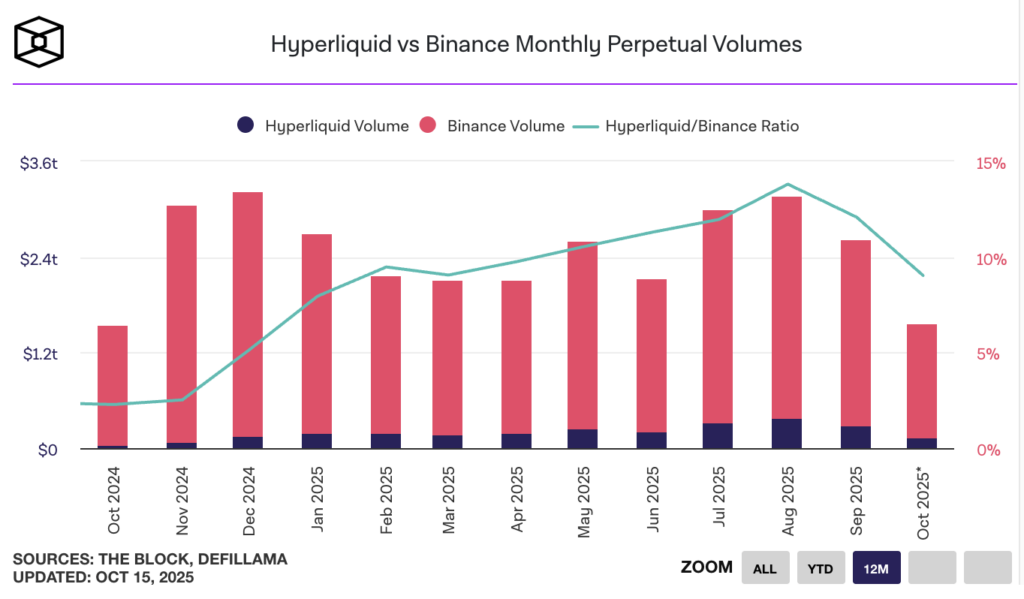
Source: TheBlock
This efficiency transforms every dollar saved into direct value for HYPE token holders and liquidity rewards for market makers. Data shows that Hyperliquid’s share of Binance’s volume reached approximately 15% in August 2025 before stabilizing. This ratio demonstrates growing trader interest in on-chain derivatives, particularly since the crisis of confidence in CEXs.
Grayscale predicts that DEXs will dominate the long tail of assets where transparency and community governance take precedence over raw liquidity depth. Max Shannon from Bitwise projects that decentralized perps could process between 20 and 30 trillion dollars in annual volume within five years if regulatory frameworks align. However, he warns that DEXs handling $67 billion daily will require standardized risk controls and audited insurance funds.
Charles Ledoux is a Bitcoin and blockchain technology specialist. A graduate of the Crypto Academy, he has been a Bitcoin miner for over a year. He has written numerous masterclasses to educate newcomers to the industry and has authored over 2,000 articles on cryptocurrency. Now, he aims to share his passion for crypto through his articles for InvestX.
DISCLAIMER
This article is for informational purposes only and should not be considered as investment advice. Some of the partners featured on this site may not be regulated in your country. It is your responsibility to verify the compliance of these services with local regulations before using them.
DISCLAIMER
This article is for informational purposes only and should not be considered as investment advice. Trading cryptocurrencies involves risks, and it is important not to invest more than you can afford to lose.
InvestX is not responsible for the quality of the products or services presented on this page and cannot be held liable, directly or indirectly, for any damage or loss caused by the use of any product or service featured in this article. Investments in crypto assets are inherently risky; readers should conduct their own research before taking any action and invest only within their financial means. This article does not constitute investment advice.
Risk Warning : Trading financial instruments and/or cryptocurrencies carries a high level of risk, including the possibility of losing all or part of your investment. It may not be suitable for all investors. Cryptocurrency prices are highly volatile and can be influenced by external factors such as financial, regulatory, or political events. Margin trading increases financial risks.
CFDs (Contracts for Difference) are complex instruments with a high risk of rapid capital loss due to leverage. Between 74% and 89% of retail investor accounts lose money when trading CFDs. You should assess whether you understand how CFDs work and whether you can afford to take the high risk of losing your money.
Before engaging in financial or cryptocurrency trading, you must be fully informed about the associated risks and fees, carefully evaluate your investment objectives, level of experience, and risk tolerance, and seek professional advice if needed. InvestX.fr and the InvestX application may provide general market commentary, which does not constitute investment advice and should not be interpreted as such. Please consult an independent financial advisor for any investment-related questions. InvestX.fr disclaims any liability for errors, misinvestments, inaccuracies, or omissions and does not guarantee the accuracy or completeness of the information, texts, graphics, links, or other materials provided.
Some of the partners featured on this site may not be regulated in your country. It is your responsibility to verify the compliance of these services with local regulations before using them.
Get 6200 USDT with Bitget ! 🔥
Don't miss out on this offer !
Create your account now to unlock this exclusive reward