

The “MicroStrategy killer” mirage turns into a nightmare
To understand the scale of this disaster, we need to look back at the initial promise. Nakamoto Inc., born from a merger with a medical company (KindlyMD), aggressively pivoted to a Digital Asset Treasury (DAT) strategy. The model is simple and appealing on paper: raise funds on the stock market to massively accumulate Bitcoin (BTC), following the resounding success of Michael Saylor with MicroStrategy.
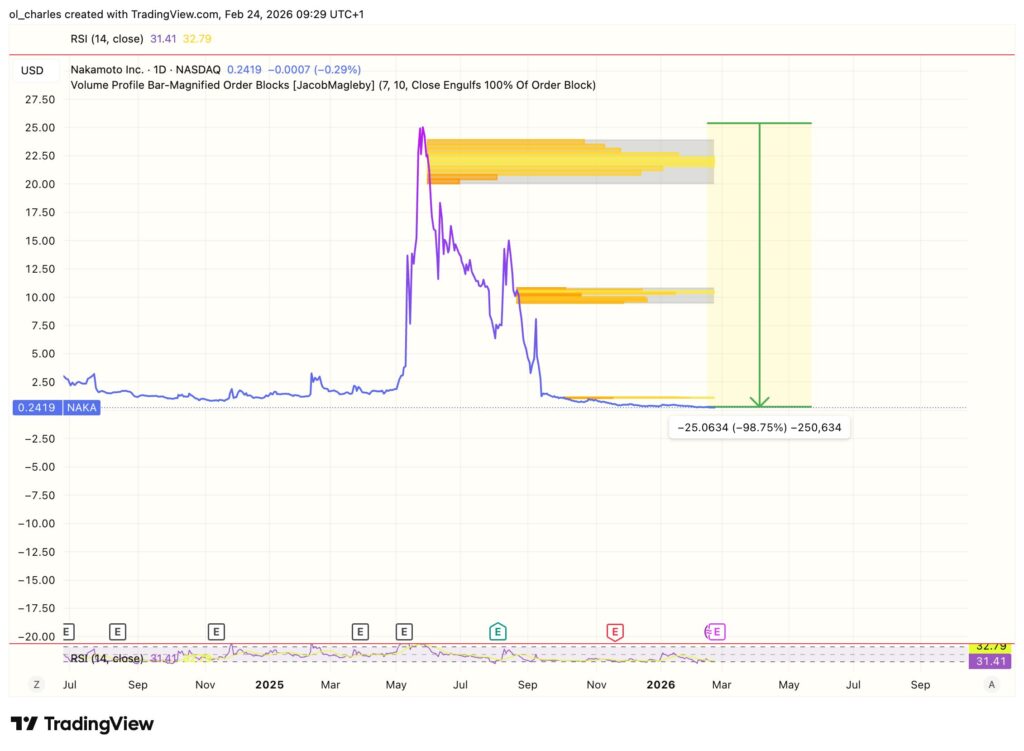
Driven by market euphoria and institutional FOMO, NAKA stock experienced a meteoric rise, climbing to irrational peaks around $30. The company thus amassed nearly 5,400 BTC. But reality brutally caught up with retail investors. Unlike organic growth, this surge was fueled by risky financial engineering, creating a bubble ready to burst at the slightest sign of weakness.
An orchestrated institutional “dump”?
The 99% crash is no coincidence. It highlights the opaque mechanisms of certain fundraising operations via PIPE (Private Investment in Public Equity). In simple terms, institutional investors and insiders were able to acquire NAKA shares at ridiculously low prices (sometimes between $1 and $5) long before the general public paid top dollar at the bubble’s peak.
As soon as the lock-up period ended, these insiders massively liquidated their positions, flooding the market with sell orders. The result is unequivocal: devastating downward pressure that pulverized the stock price, leaving retail investors with colossal losses. This movement resembles what many observers consider a legal “rug pull”, where retail liquidity served as an exit door for early entrants.
David Bailey, CEO of Nakamoto Inc., attempted to downplay the situation by dismissing criticism as “Twitter noise,” but the numbers don’t lie. Market capitalization has collapsed, and the stock value is now disconnected from the company’s Bitcoin treasury holdings, creating a situation of massive discount relative to NAV (Net Asset Value).
Are DATs the new trap of this cycle?
This event casts a shadow over the entire DAT sector. While MicroStrategy remains the gold standard with near-perfect execution, the proliferation of “copycats” is concerning. NAKA’s crash serves as a reminder that holding Bitcoin isn’t enough to make a company a safe investment. Capital structure, financing conditions, and shareholder dilution are metrics that traders must monitor as closely as BTC price itself.
The risk now is seeing contagion of distrust. If institutional investors begin to doubt the viability of these investment vehicles, the entire corporate adoption narrative could take a hit. The market could become much more selective, severely punishing structures with questionable fundamentals while favoring transparent players.
Nakamoto Inc.’s fall is a brutal warning, but it also offers a valuable lesson: in a bullish market, everything rises, but only quality survives corrections. Investors must now distinguish between genuine long-term treasury strategies and opportunistic operations designed to enrich a handful of insiders.
Related Articles: