

Pi Network: 526 million KYC validations completed
In the realm of highly community-driven crypto projects, Pi Network has just reached a significant operational milestone. The Core Team has officially confirmed the distribution of the first cycle of KYC rewards, revealing the true scale of the work accomplished by its decentralized network. The figures published on the official blog are precise and verifiable. Exactly 526,970,631 validations were completed by 1,094,680 human validators, successfully verifying the identity of 18 million users worldwide.
Each Pioneer’s KYC application required an average of 20 validations before reaching a final decision. This process breaks down an application into several distinct tasks assigned to different validators. Each task requires at least two independent validations for the liveness video, identity document, and photo. This design preserves privacy while ensuring accuracy.
The compensation for this collective effort is also accurately documented. The price per validation was calculated at 0.0504179 PI per successful validation, which is 21 times the base mining rate. This includes the 16,568,774 PI from the reward pool, supplemented by 10 million PI sponsored by the Pi Foundation to cover the network’s bootstrapping phase.
Protocol v21.2: What operators are really risking
The date of April 6, 2026, is a strict deadline with no room for maneuver. “This is not an optional update. It is a security and compatibility hard fork,” confirmed the Pi OpenMainnet 2025 account, describing the upgrade as a step toward network unification. As stated in the official announcement:
“Every Mainnet node operator must complete the upgrade to remain synchronized,” and “any node missing this deadline risks immediate disconnection from the Mainnet.”
This deadline primarily concerns desktop node operators. Those who mine exclusively via the mobile app generally do not need to take any direct action regarding this update. The latest desktop node version listed on the official page is version 0.5.4.
This clarification is worth highlighting for community members who may be unduly worried. The vast majority of mobile users are not directly affected by this technical migration. It is the infrastructure operators who bear the responsibility for compliance by April 6.
The strategic dimension of this update goes beyond simple technical maintenance. The Pi Day 2026 blog indicates that Protocol 20 lays the foundation for smart contract capabilities and that other protocol changes are being gradually integrated to align the blockchain with newer versions. This suggests that the latest node requirement is part of a broader rollout linked to future ecosystem features.
What this data reveals about the project’s true structure
Unlike centralized KYC platforms that rely on a single third-party provider, Pi Network has distributed the work and rewards across its community. This approach diffuses value among users rather than concentrating it in the hands of a centralized provider. The Core Team plans to introduce new KYC tasks, creating additional opportunities for participation.
This model is structurally interesting beyond Pi Network: it demonstrates that a blockchain can build a functional, large-scale decentralized workforce, compensated in a native token, for tasks requiring human judgment. This is precisely the argument the Core Team puts forward to position Pi as a “human-in-the-loop” infrastructure for the AI economy.
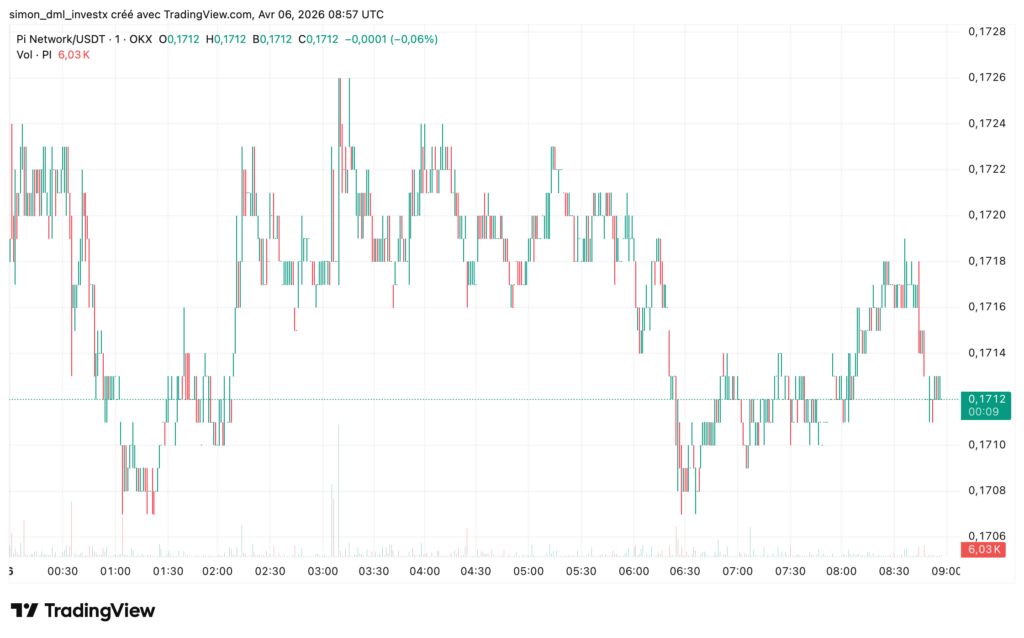
In terms of price, the PI token is trading around $0.17 on over-the-counter (OTC) markets after testing the $0.30 zone during its stint on Kraken. After the Kraken listing propelled the token near $0.29, the price slipped to approximately $0.176 on March 28 as market sentiment weakened. The compression of the Bollinger Bands visible on the daily chart suggests that a directional move is brewing, the outcome of which will largely depend on the rollout of the April 6 update and the activation of smart contracts planned with Protocol v23.0.
Our take on this matter: Pi Network remains a project with operational fundamentals that are stronger than its sometimes skeptical image in crypto media might suggest. 526 million validations on a decentralized infrastructure is a concrete technical achievement that few projects can showcase at this stage. The real question for traders remains the actual launch of the public Mainnet and the activation of smart contracts. Without these elements, institutional liquidity will remain limited, and price predictions will stay speculative.
Sources:
- PiCoreGroup on X
- Pi_OM_2025 on X
- TradingView
Related Articles: