
Monero’s Ring Signatures
S. Virza’s critique directly targets the fundamental architecture of Monero. Each XMR transaction includes the real spend alongside 16 randomly generated decoys to mask the origin of funds. On paper, this approach seems robust. IIn practice, Virza identifies two major weaknesses that seriously compromise the promised confidentiality, at the opposite of Zcash.
First, 16 decoys constitute an objectively limited anonymity set against modern analysis techniques. Researchers have developed heuristics capable of progressively isolating the real transaction from this limited group.
Second, the OSPEAD attack exploits random distribution biases: In reality, the 16 decoys statistically behave like just 4.2 real options. This degradation transforms theoretical protection into an exploitable vulnerability.
Virza references academic studies documenting these traceability flaws. The problem isn’t hypothetical: Some Monero transactions have already been retroactively deanonymized. For an ecosystem that places confidentiality at the core of its value, this structural limitation represents an existential challenge that simple updates cannot solve without a complete protocol redesign.
Zcash Shielded Pool Protects Anonymity
Zcash (ZEC) uses a radically different model. Fully protected (z-to-z) transactions benefit from the entire shielded pool as their anonymity set, amounting to millions of potential notes. Using zero-knowledge proofs, the network mathematically verifies transaction validity without ever revealing which previous note is being spent.
While Monero obscures metadata that still remains on-chain, Zcash structurally removes it from the public ledger. As Sean Bowe, Zcash’s principal engineer, explains:
“Even a quantum computer analyzing the blockchain a thousand years from now wouldn’t be able to determine who made each shielded transaction, because that data simply never touched the ledger.”
Zcash also has a DeFi composability advantage: Unlike Monero, it can integrate with decentralized protocols via atomic swaps and cross-chain bridges. This interconnection allows Bitcoin holders to “encrypt” part of their exposure through the ZEC shielded pool.
Quantum Resistance: Zcash’s Structural Advantage
The quantum threat forms the third pillar of the argument. Monero’s ring signatures rely on discrete logarithms, a form of cryptography that powerful quantum computers could algorithmically break. Such a scenario would allow complete retroactive reconstruction of all transaction history on Monero.
In contrast, Zcash uses unique shielded addresses: Sensitive metadata is never recorded on-chain, eliminating any exploitable structure, even against quantum computing power.
Bitcoin shares the same vulnerability as Monero: Its ECDSA addresses could become breakable, exposing UTXOs.
This difference reveals two philosophies:
- Monero and Bitcoin rely on cryptographic obfuscation, vulnerable to future advancements.
- Zcash focuses on data minimization, a sustainable approach resistant to technological advances.
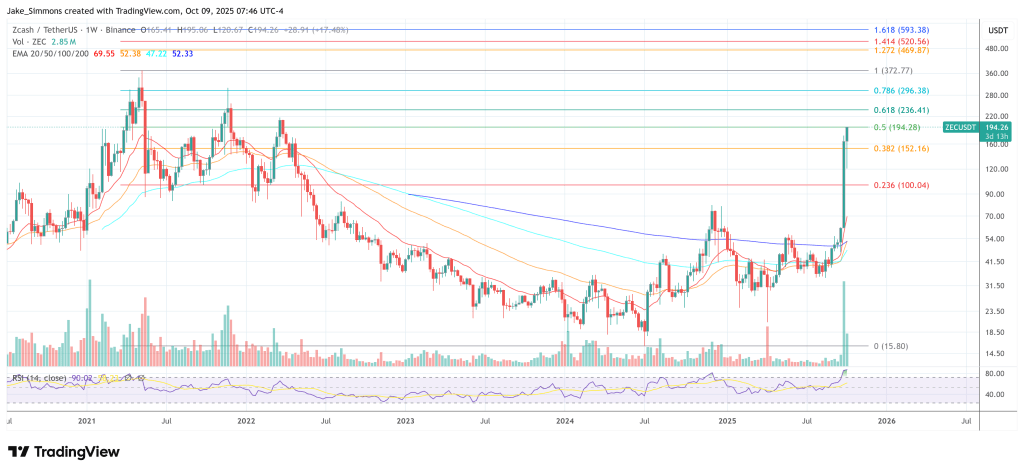
How to Invest in Zcash on Bitget?
For long-term holders, this distinction could become decisive in the decades ahead.
Zcash is trading around $246.47 USD. With growing interest in privacy cryptocurrencies and the network upgrade planned for November, ZEC could soar by the end of 2025.
Buying guide on Bitget:
- Create your account on Bitget and complete the KYC.
- Deposit funds (USDT, card, bank transfer).
- Search for ZEC/USDT in the Spot section.
- Place your order (Market for immediate execution, Limit for target price).
- Activate your special limited-time ZEC bonus on Bitget.
- Secure your ZEC in a personal wallet or cold wallet

On the same topic:

