

A massive $1.2 billion volume: Polygon stands strong against the giants
Institutional adoption of cryptocurrencies has just reached a decisive new milestone. Fintech giant Revolut has officially surpassed the staggering mark of $1.2 billion in cumulative stablecoin transfer volume on the Polygon (POL) network. This massive figure demonstrates genuine adoption and usage for cross-border payments, propelling blockchain technology to the core of traditional finance.
Why Polygon? The answer lies in its formidable efficiency. According to recent data, fees on Polygon are on average 426 times cheaper than on Ethereum and 4 times lower than on Solana. In a context where users are looking to maximize their yields and avoid excessive gas fees, choosing this Layer 2 infrastructure was an obvious decision for Revolut.
This integration allows the neobank’s millions of users to send and receive USDC and USDT almost instantly. Far from the uncertainty of the altcoin market and the volatility surrounding Bitcoin, the on-chain payment ecosystem is experiencing explosive growth. In 2025, Revolut’s stablecoin payment volumes surged by 200% to reach $14.3 billion across all chains.
SWIFT crushed by the speed of blockchain?
The real shockwave of this announcement concerns the SWIFT network, the global standard for interbank transfers. Historically slow and expensive, an international SWIFT transfer typically takes between 1 and 5 business days to settle. In contrast, stablecoin transactions on the Revolut app via Polygon are validated in under 5 minutes.
The blockchain infrastructure thus becomes completely invisible to the end user, who simply enjoys faster transfers and better exchange rates. This seamless experience is the main driver of massive adoption. While traditional banks suffer from the sluggishness of their aging systems, Revolut demonstrates that decentralized finance (DeFi) offers an infinitely more efficient alternative.
With over 40 million customers worldwide and a recent application for a national bank charter in the United States, Revolut is positioning itself as a pioneer. If other financial institutions follow suit, the SWIFT monopoly could suffer a severe blow, or even face planned obsolescence against the technical superiority of crypto networks.
Furthermore, Revolut is among the top 10 highest-valued companies in the world. However, they are not alone. Other fintechs are generating even more volume in the shadows. Indeed, as Alex points out on X, BVNK Finance has generated more volume than Revolut in stablecoins, with a total volume exceeding $15 billion. All this with a much smaller media presence. This proves the market’s potential, driven by almost organic adoption.
According to Cyprx Research, the next generation of payment networks is currently being built, at the expense of giants like SWIFT:
“A new category of cryptocurrencies is emerging: stablecoin payment chains. This is not about replacing Ethereum or competing with Solana. The goal is more targeted: dedicated networks optimized for payments, liquidity, and settlement. The real transition underway is from general-purpose blockchains to specialized financial infrastructures. Crypto is no longer just building ecosystems. It is building the next generation of payment networks,” they write.
Can the POL token explode after this key announcement?
This massive institutional validation inevitably raises the question of its impact on the network’s native token, POL (formerly MATIC). Historically, such an increase in utility and transactional volume acts as a powerful catalyst for price action.
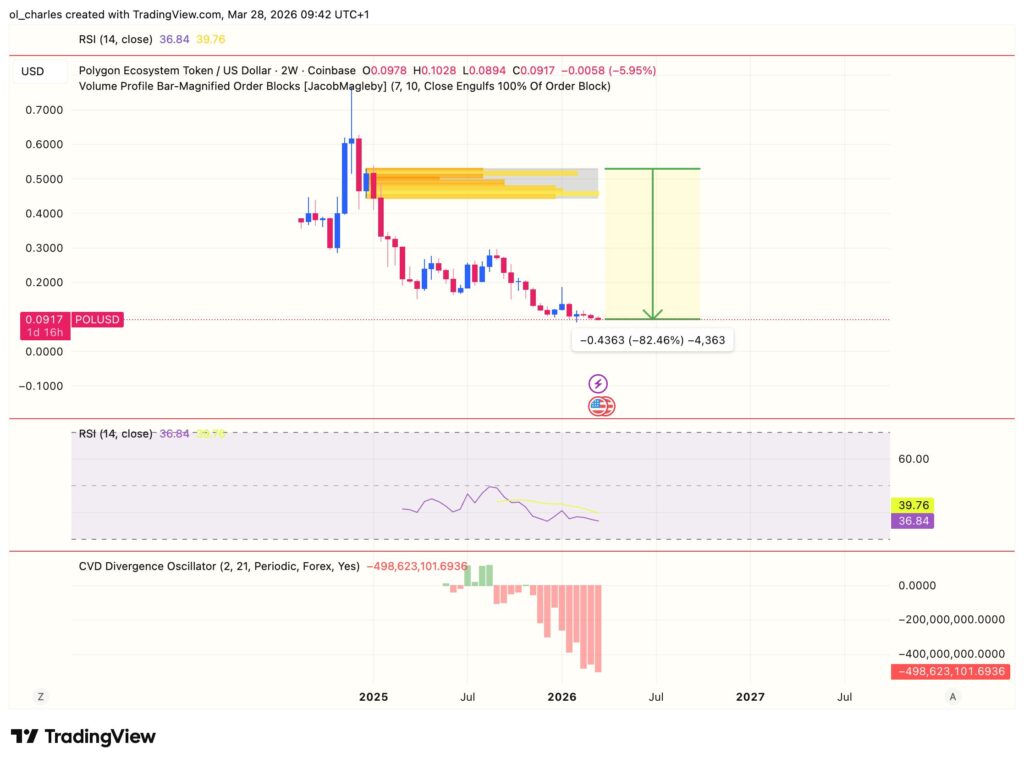
However, despite these extremely solid fundamentals, the crypto market remains volatile. The POL token has lost 82% of its value since December. A staggering drop that serves as a reminder that investors are prioritizing utility over speculation. The POL token offers no real utility for the holder, whereas the Polygon blockchain is actively driving this transition toward the new payment system of tomorrow.
As Revolut proves that blockchain is ready for global scale use: is this the perfect time to accumulate POL before the rest of the banking sector joins the revolution?
While volumes are exploding, the POL token is collapsing. It is crucial to remain highly cautious with the altcoin market and be selective. Behind Polygon, projects like BVNK Finance demonstrate that competition is fierce. It must also be emphasized that investors need to differentiate the token from the blockchain itself. Without real utility, the POL token remains a risky asset.
Sources:
Related Articles:

