

XRP and Altcoins: Institutions Are Quietly Accumulating
The paradox of bear markets is that they create the exact conditions major players wait for to position themselves. While overall sentiment remains depressed and retail investors sell out of fear, institutions are doing the opposite. A joint report by Coinbase and EY-Parthenon published in early 2026, surveying 351 decision-makers each managing over $1 billion in assets, confirms what on-chain data already suggested: 73% of major institutions plan to increase their digital asset allocations this year.
This figure is worth pausing over. We are not talking about opportunistic hedge funds or adventurous family offices here. We are talking about traditional asset managers, pension funds, and corporate treasuries—slow moving entities with lengthy validation processes that do not enter a market without deep conviction.
Beyond Bitcoin: The Institutional Paradigm Shift
What clearly emerges from the study is the end of single asset institutional crypto allocations. For years, Bitcoin served as the only acceptable gateway, acting as a reserve asset, digital gold, and safe haven. That era is over. The share of institutions holding cryptocurrencies other than BTC and ETH is expected to grow from 51% to 56% in 2026, a seemingly modest shift that actually represents tens of billions of dollars in potential movement.
Institutions are no longer simply seeking exposure to the asset class. They are looking for asymmetric returns on projects with real utility and measurable fundamentals. This marks a profound qualitative shift in how these players approach the sector.
XRP: The Institutional Asset No One Expected
In this context of aggressive diversification, XRP stands out as one of the major beneficiaries. According to the Coinbase/EY-Parthenon study, 18% of surveyed institutions already held XRP in January 2026, and a quarter of them plan to strengthen their positions. This level of adoption is remarkable for an asset that was still facing SEC litigation just two years ago.
The regulatory clarity Ripple achieved against the SEC was the decisive turning point. It transformed a legally risky asset into an institutionally acceptable payment infrastructure. Following this, several Spot XRP ETFs were launched in the United States, quickly absorbing over $1.4 billion—a strong signal of the latent demand that was simply waiting for a regulated vehicle to express itself.
On a fundamental level, the XRP Ledger ecosystem continues to develop with concrete use cases: real world asset tokenization (RWAs), the deployment of the RLUSD stablecoin, and international payment corridors. These advancements position Ripple as a serious infrastructure alternative to the SWIFT system, a narrative that corporate treasurers and banks instinctively understand.
The Mechanics of a Supply Shock
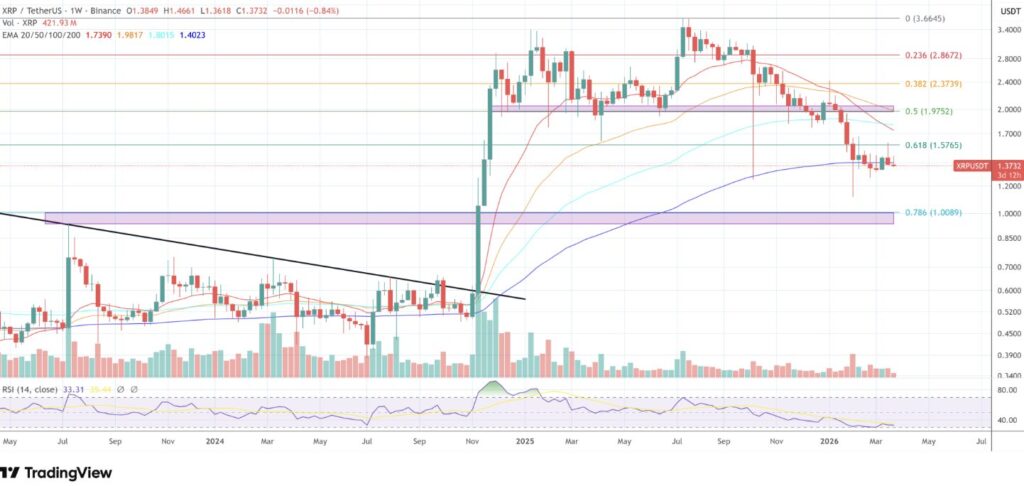
Technically, XRP is currently trading around $1.36, in a post-correction consolidation zone. What is particularly interesting here is the significant drop in XRP reserves on centralized exchanges. Less available supply on CEXs combined with growing institutional demand creates the classic setup for a brewing supply shock. Historically, these compressions precede the most violent upward price movements.
Technical analysts are closely monitoring the $1.20 to $1.40 zone as an accumulation support. Holding above these levels, coupled with a return of positive ETF flows, could trigger a rapid climb back toward $2. The $5 zone remains a credible mid term target if the US legislative framework continues to soften, particularly with initiatives like the CLARITY Act currently under discussion in Congress.
Our Take on the Situation
Let’s be honest about what this setup implies and its limitations. The institutional narrative surrounding XRP is real and well documented. However, XRP remains highly correlated to Bitcoin price movements, and until BTC confirms a trend reversal, XRP’s upside potential will remain partially capped.
What is happening right now looks like a quiet accumulation phase. Whales are building positions while overall sentiment remains depressed and retail volumes are low. This is exactly the type of setup that precedes the most powerful rallies, but it is also the one that tests investors’ patience the most.
Personally, the current zone seems interesting for a progressive DCA strategy rather than a single entry position. The potential is there, and the fundamentals have strengthened considerably. But the timing remains uncertain in a market that is still dependent on macroeconomic catalysts. Above all, what this report confirms is that smart money is no longer asking whether altcoins deserve a place in their portfolios. They are only asking how much and when.
Sources:
- Adam_Xrp_ on X
- Cointelegraph on X
- TradingView.com
Related Articles:

