

Massive Liquidations Rock Crypto Market
The last 48 hours have been particularly brutal for crypto traders. The market has wiped out nearly $600 million in leveraged positions, primarily affecting longs who were betting on continued upward momentum. Bitcoin failed to maintain its position above the $126,000 ATH, creating the first signal of technical weakness.
The total cryptocurrency market capitalization has slipped approximately 1%, falling below the symbolic $4.2 trillion threshold to settle at $4.14 trillion. This movement has spared no sector: Bitcoin and Ethereum have recorded significant declines, but altcoins are bearing the brunt of the correction, with double-digit drops for several DeFi and Layer 2 projects.
This correction phase comes after several days of a bullish rally that propelled Bitcoin toward new all-time highs. The sentiment reversal has been abrupt, and on-chain indicators show a marked decrease in investor confidence and selling pressure from long-term holders.
Gold and Silver Drain Capital from the Crypto Market
One of the primary causes of this correction lies in the exceptional performance of precious metals. Gold has just established new ATHs, with a total capitalization now exceeding $27 trillion. In just a few months, gold has gained nearly $6 trillion in additional valuation, a historically rare movement.
Silver is following the same explosive trajectory, with a market cap approaching $2.7 trillion. This double surge in traditional safe-haven assets typically signals rising risk aversion among institutional investors. When gold soars at this pace, it often reflects deep economic concerns or anticipations of geopolitical instability.
This phenomenon mechanically creates a capital rotation effect. Investors, particularly institutional ones, are reallocating their positions in favor of safe-haven assets at the expense of riskier asset classes like cryptocurrencies.

Profit-Taking and Massive Outflows from Bitcoin ETFs
The second major factor behind this correction comes from widespread profit-taking. After reaching historical peaks around $126,000, many Bitcoin holders have chosen to secure their gains. This strategy, perfectly rational after such a violent rally, has created significant selling pressure on the spot market.
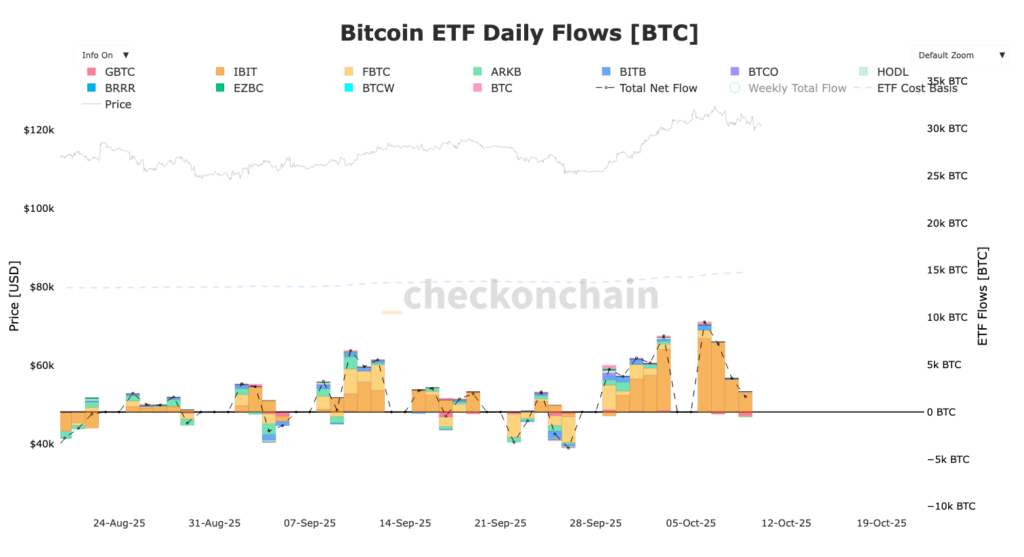
The flows of American Bitcoin ETFs confirm this movement of distrust. Yesterday, Grayscale recorded net outflows of $45.5 million, a strong signal of institutional disengagement. Fidelity and ARK Invest also experienced withdrawals of $13.2 million and $5.6 million respectively. These figures contrast sharply with previous weeks, when Bitcoin ETFs were attracting hundreds of millions of dollars daily.
This reversal of institutional flows constitutes a significant regime change for the market. Bitcoin ETFs have become a reliable barometer of traditional investors’ appetite for crypto. When these vehicles record net outflows over several consecutive sessions, it typically foreshadows a phase of consolidation or more prolonged correction.
Macroeconomic Uncertainty Weighs on Trader Sentiment
The macroeconomic context adds an additional layer of uncertainty. Traders are eagerly awaiting the next statements from Jerome Powell and key economic data to anticipate the trajectory of interest rates. The Fed maintains an ambiguous discourse on the timing of future rate cuts, creating volatility across financial markets.
The partial shutdown of the U.S. government amplifies this climate of uncertainty. Markets hate political unpredictability, and this situation creates a bearish bias on risky assets. At the same time, inflation expectations are starting to climb again, which could further delay the monetary easing so anticipated by markets.
This cocktail of unfavorable macroeconomic factors explains why the crypto market is struggling to find solid support. The $600 million in liquidations primarily affected long positions, showing that traders were overly positioned for upside before this brutal reversal.
On the same topic:

