

The Strategy: Binary Market Arbitrage
The strategy focuses on short-term binary markets, such as those on Bitcoin price every 15 minutes. On these markets like Polymarket, you can buy “YES” shares (the price will be above a certain threshold) or “NO” shares (it will be below). At the end, one of the two shares is worth $1, the other $0. In theory, the price of a YES share plus that of a NO share should always equal $1.
But in practice, this isn’t always the case. The market, driven by human emotions, creates temporary imbalances. This is where bots come into play. Their goal isn’t to predict the outcome, but to buy YES and NO shares when their combined cost is less than $1.
It’s a pure arbitrage strategy: if you can buy a pair of shares (one YES and one NO) for, say, $0.97, you’re guaranteed to make a profit of $0.03, because one of the two shares will inevitably be worth $1 at the end.
The “Gabagool” Method in Action
The strategy, as analyzed by @thejayden, is disarmingly simple:
- Buy low: The bot constantly scans markets and buys YES and NO shares only when they are “cheap,” meaning when their price is below their expected value.
- Balance positions: The goal is to hold roughly equal numbers of YES and NO shares. This neutralizes the risk tied to the event’s outcome.
- Lock in profit: Once the average cost of a pair (one YES share + one NO share) is less than $1, the profit is mathematically guaranteed. All that’s left is to wait for the 15 minutes to end and collect.
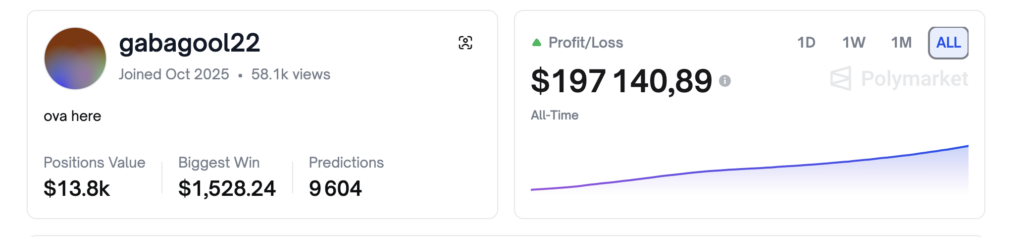
In a concrete example, the trader “gabagool” invested approximately $1,237 to acquire a balanced basket of YES and NO shares, with a cost per pair of $0.966. At the end of the 15 minutes, his net gain was $58.52, representing a return of nearly 5% in half an hour.
Repeated on a large scale across dozens of markets simultaneously, this strategy allows for accumulating considerable gains, transforming small arbitrage opportunities into millions of dollars in profits.
Why Humans Can’t Compete
This approach is nearly impossible to replicate manually. It requires constant monitoring, real-time calculations, and near-instantaneous execution, tasks for which bots are infinitely superior. They have no emotions, aren’t subject to FOMO (fear of missing out), and can operate 24/7.
These bots aren’t oracles, they’re simply ultra-fast calculators exploiting the inefficiency of human-driven markets. They remind us of a fundamental lesson in decentralized finance: in an open and programmable ecosystem, the advantage doesn’t go to the one who best predicts the future, but to the one who most efficiently exploits the present.
While human traders bet on what might happen, bots capitalize on what’s already there: the small pricing errors that, put together, build empires.
The Pionex exchange offers a free bot that delivers the same returns: The Hedging Bot. Test it now by visiting the Pionex website and searching for Hedging bot in the “Bot” tab:

