

Who really controls institutional Bitcoin?
Since the launch of spot Bitcoin ETFs in the United States in January 2024, the question is no longer whether Wall Street will adopt Bitcoin. It already has. The real question now is understanding how quickly this institutionalization is transforming the deep market structure, and what risks it creates along the way.
In 2026, around 25 US asset managers offer products linked to digital assets. However, the top five collectively manage over $100 billion in digital asset products. Their dominance reflects just how deeply institutional capital has anchored itself in crypto through regulated ETFs.
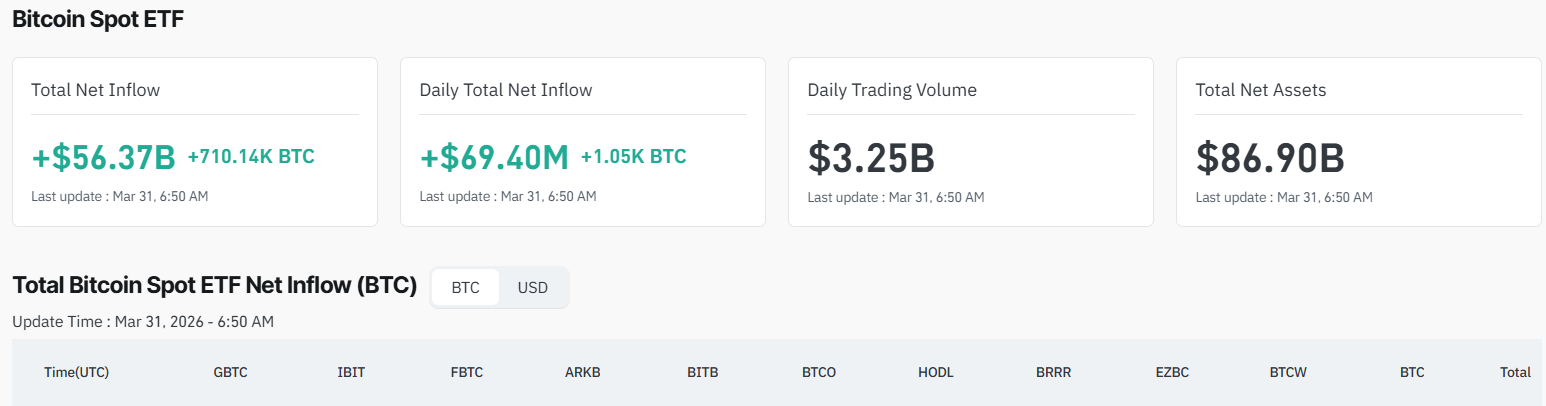
BlackRock crushes the competition, Fidelity holds its ground
The hierarchy at the top is clear cut. BlackRock’s iShares Bitcoin Trust (IBIT) boasts $51.9 billion in assets under management, representing roughly 45% of all spot Bitcoin ETF assets. In Q1 2026, IBIT recorded $8.4 billion in net inflows, more than double any competitor. The fund held approximately 782,180 BTC as of March 27, 2026.

BlackRock’s strength in this market does not rely solely on its brand. With $12.5 trillion in total assets under management, its distribution capacity to financial advisors, pension funds, and family offices is structurally unmatched by any crypto native player.
Fidelity maintains a solid second place with its Wise Origin Bitcoin Fund (FBTC) at $12.8 billion in AUM, holding around 187,813 BTC. The firm attracted $4.1 billion in net inflows in Q1 2026. Its proprietary custody model through Fidelity Digital Assets and its 0.25% fee make it the benchmark for institutional allocators focused on compliance.
As for Grayscale, the transition remains challenging but the bleeding is slowing down. The Bitcoin Trust (GBTC) held roughly 154,710 BTC valued at around $10 billion, while the Bitcoin Mini Trust added another $3.4 billion. Outflows from GBTC dropped to $1.2 billion in Q1 2026, a sharp decline compared to the monthly billions seen in 2024.
Coinbase holds the keys: An underestimated systemic risk
While the landscape of asset managers appears healthy due to its relative diversity, the reality of custody tells a very different story. Coinbase provides custody for over 80% of the assets in US Bitcoin and Ethereum ETFs. This concentration creates operational efficiencies but also introduces a concentration risk. A cyber incident, a service outage, or a governance failure at a single custodian could simultaneously affect multiple funds, with cascading repercussions on creations, redemptions, and trading liquidity.
Brian Armstrong, CEO of Coinbase, acknowledged this situation directly: “We have a fairly dominant market share in terms of custody for ETFs. I see that as a strength. We are the trusted counterparty on the institutional side.
” He added that large funds often diversify their custodians as assets grow, which he described as “healthy and good.”
This is exactly where the tension lies. Bitcoin was designed to operate without a single point of failure. Coinbase has become one on an institutional scale. Fidelity stands out as an exception by handling its own custody, but it is the only player among the top five to have made this choice.
Wall Street creates the market it wanted, with its own rules
Coinbase reached $300 billion in assets under custody in the third quarter of 2025. US Bancorp has revived institutional Bitcoin custody projects, while Citi and State Street are exploring custody relationships for crypto ETFs. Their sales pitch: do you want 85% of ETF flows to depend on a single counterparty?
This diversification movement is worth watching closely for cryptocurrency investors tracking the Bitcoin price prediction. In the short term, the concentration of assets with BlackRock and Coinbase creates structural buying pressure that reduces the available supply on exchanges. In the medium term, the real risk is that this centralized architecture creates exactly the systemic fragility that financial regulators fear. If Coinbase encounters a serious problem, it is not just an exchange that falters. It is simultaneously the largest Bitcoin ETFs in the world experiencing operational disruptions. Wall Street has built a solid crypto infrastructure for itself. However, it remains more fragile than it appears.
Sources:
- Coinglass
- X (@EricBalchunas)
- BlackRock
- [EXT_LINK_4:]MilkRoad on X
Related Articles:

