

Whales on Polymarket for the 2026 World Cup: When big players wager hundreds of thousands of dollars
On Polymarket, the 2026 World Cup is already a playground for “whales”, those investors who move impressive amounts of money. Unlike traditional bookmakers, the platform allows users not only to bet but also to trade contracts in real time, which attracts a genuine investment strategy.
Based on the current volumes visible on the platform, France dominates with an 18% share and over $29 million wagered, closely followed by Spain (17%). These movements reflect the classic whale strategy: concentrating the bulk of their capital on the strongest teams while diversifying slightly. In total, as of May 17, the prediction platform competing with Kalshi reached $1 billion in volume on this World Cup market.
The two most impressive profiles right now
1. The “Rrrrrffff” whale – The mysterious trader
A recently registered user has concentrated almost their entire position on France. With a portfolio value of $54,700, they currently hold $54,716 in “Yes France champion 2026” contracts, bought around 17.4 to 17.8 cents.
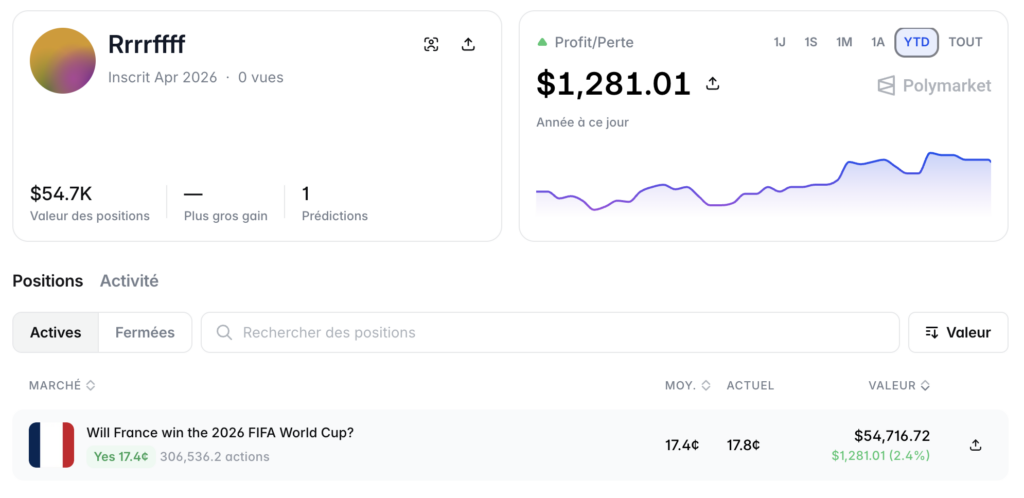
In a very short time, they have already made a +$1,281 profit (2.4%). This massive concentration on France shows the extreme confidence some big players have in Mbappé’s team.
2. The super whale “FootballFan98” – Smart diversification
Here is the largest publicly visible position: a $518,100 portfolio. This whale holds:
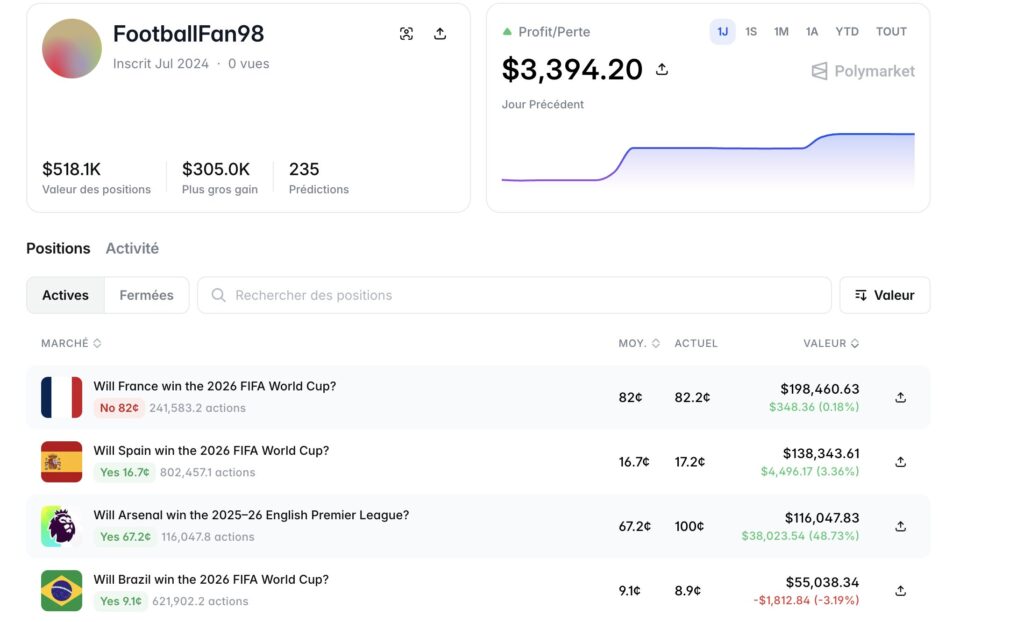
→ France No at 82 cents ($198,460 position)
→ Spain Yes at 17.2 cents ($138,343)
→ Brazil Yes at 8.9 cents ($55,038)
With a total gain of +$3,394 over the previous day, this strategy is particularly interesting. By betting on both “France does not win” (hedging) and Spain + Brazil, the player protects themselves while maintaining strong exposure to the favorites.
Classic whale strategy: Betting on multiple teams
Many whales and savvy traders use a more accessible strategy: betting on each of the four main teams (France, Spain, Brazil, Argentina). At the current price (around 17.8¢ France / 17.2¢ Spain / 8.9¢ Brazil / ~8.3¢ Argentina).
For example, if you wager $300 on each of the top 4 potential winning teams on Polymarket, you would get:
→ France wins → Total net profit ≈ +$476
→ Spain wins → Total net profit ≈ +$534
→ Brazil wins → Total net profit ≈ +$2,171
→ Argentina wins → Total net profit ≈ +$2,414
If none of these 4 teams win, it results in a total loss of the $1,200 invested.
This is the assumed risk: betting that the winner will be among the market’s ultra favorites. But if one of them wins, it is a minimum profit of $476 and can go up to $2,400.
The power of Polymarket: No need to be right
One of the biggest advantages on Polymarket is the ability to sell your contracts before the end. Whales exploit this feature massively.
A concrete example with England (currently around 11 cents):
If you buy at 11¢ and England reaches the final, the contract can easily climb to 33 to 40 cents. Selling at that moment allows you to triple your investment without the team even lifting the trophy. It is exactly like trading stocks: you bet on market inefficiency. Basically, when the general public underestimates a team after a good match or a favorable draw, the price rises quickly. Whales analyze volumes, performances, and news, and exit with profits well before the final result.
Why does this strategy appeal to millionaires?
→ France and Spain account for the bulk of whale volumes (together they represent over 35% of the shares in the outright winner market).
→ Brazil and Argentina offer better leverage (low price = more shares for the same dollar).
→ The ability to hedge (like FootballFan98 with France No + Spain Yes) helps reduce risk.
→ Total transparency: everyone sees the big moves in real time.
Risks not to be overlooked:
→ Possible total loss (-$1,200 in the 4 team strategy)
→ High volatility (a bad result in the group stage can cause a contract to drop by 20 to 30%).
→ Competition among whales that can influence prices
In conclusion, whether it is the $54k whale entirely on France, or the over $500k whale diversified across France, Spain, and Brazil, these examples show that big players treat the 2026 World Cup as a true financial market.
The combined strategy (betting on the 4 favorites + active trading) offers both stability and high yield potential. Even with a smaller budget, you can copy this logic: follow whale volumes, buy on inefficiencies, and know how to take profits at the right time.
Reminder: Trading and betting remain risky. Only invest what you can afford to lose. Prices change very quickly — always check live on Polymarket. Furthermore, Polymarket has been banned in most European countries since 2024. Some traders use a VPN to bet on the 2026 World Cup.
Sources:
Related Articles:

