

Unlock Postponement Relieves Selling Pressure
Markets often react in a counterintuitive manner to events that alter supply dynamics. In the case of Aster, this unlock postponement could reshape the token’s trajectory in the short and medium term.
The mechanism is simple yet powerful: fewer tokens available in the market means less immediate selling pressure. The initially scheduled unlock was set to inject a substantial quantity of tokens into circulation, creating a risk of massive sell-offs. Its postponement instantly changed market sentiment.
Current holders have seen their positions mechanically strengthened. Without the influx of new tokens, anticipated dilution is delayed, stabilizing the supply-demand balance. Buyers who were waiting for a post-unlock drop have had to revise their strategy, triggering short squeezes and bullish acceleration.
This dynamic echoes that observed in other projects where vesting delays have created significant profit opportunities. The market quickly integrates this new data, and reactive traders have been able to capture this 10% movement in just a few sessions.
On-chain analysis confirms this thesis: trading volumes have increased significantly, while transfers to exchanges have decreased. A classic sign that holders prefer to keep their positions rather than sell in this reconfigured context.
Technical Analysis: Is $1.25 a Realistic Target for Aster ?
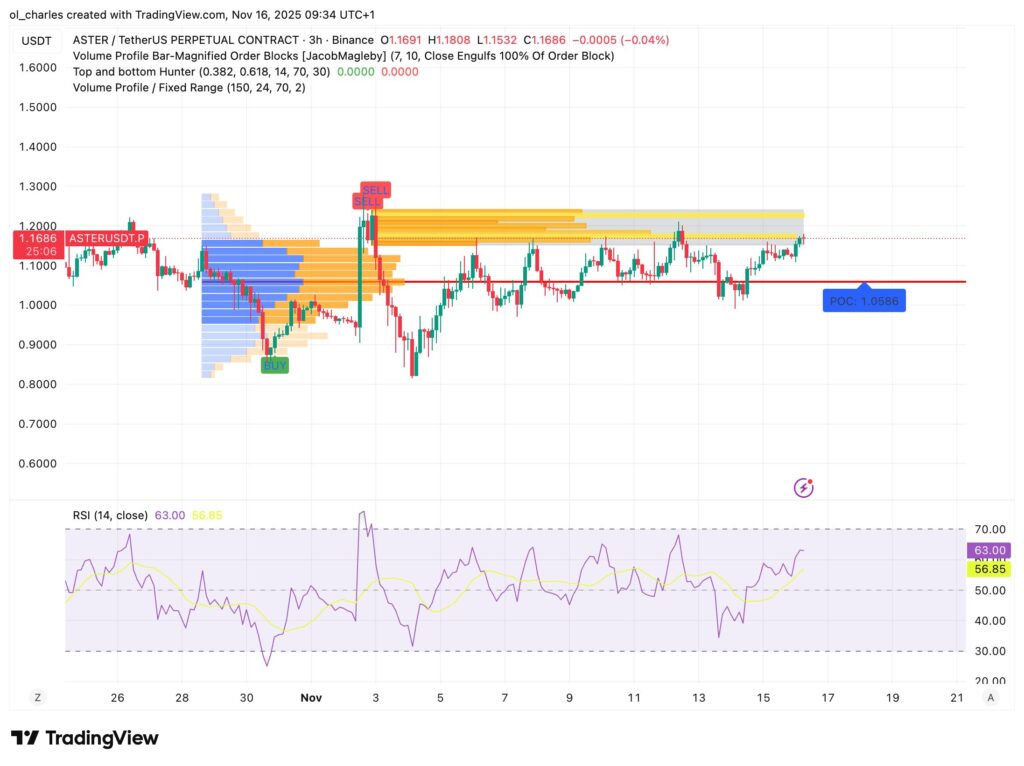
From a chartist perspective, breaking certain key levels could indeed pave the way toward $1.25. The support around $0.90 held firmly during recent corrections, establishing a solid foundation for building new bullish momentum. The 3-hour Order Block shows significant selling pressure up to $1.23. This is therefore the resistance to break to restart the dynamic.
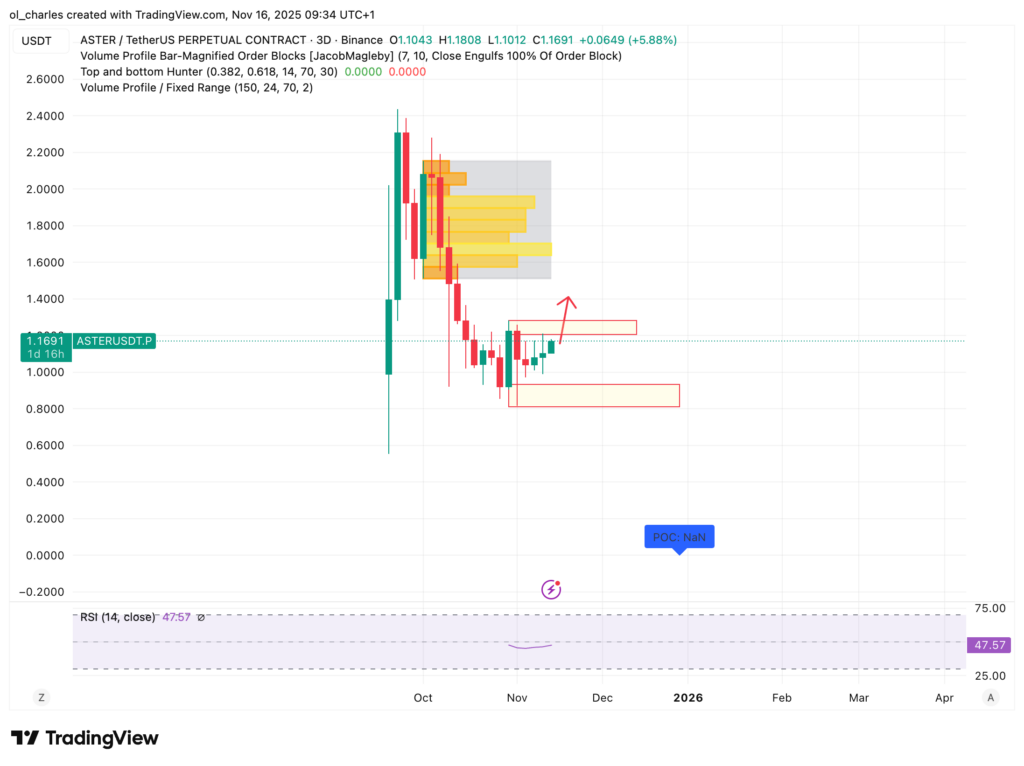
On the 3-day chart, the Order Block shows a massive selling zone, offering strong resistance that will require much more than an unlock postponement to be broken. It needs a strong catalyst and substantial volumes to overcome it. In this context, Aster could continue its range between $0.8 and $1.3 for several weeks.
The macroeconomic context of the crypto market plays in Aster’s favor. Capital rotation toward layer 1 altcoins and blockchain infrastructure projects particularly benefits tokens like ASTER, positioned within the Polkadot ecosystem. Correlations with Bitcoin and Ethereum remain moderate, offering beneficial decoupling.
Trading volumes have surged 45% in 24 hours, a promising bullish signal. Whale wallets are gradually accumulating without causing brutal pumps, suggesting medium-term conviction rather than short-term speculation.
How to Position on Aster?
Accumulate Aster and generate up to 100% annual returns even when its price does nothing thanks to Futures Grid Bots in neutral mode from Pionex.
The Futures Grid Bot in Neutral mode from Pionex allows accumulating Aster (AST) without predicting rises, by exploiting its lateral volatility. It simultaneously opens long and short positions with 3x leverage in a grid, buying low and selling high at each oscillation. Even if the price stagnates, you earn grid profits plus funding fees (up to 100% annualized in range).
Impact on Tokenomics and Investor Strategy
This unlock postponement profoundly modifies Aster’s tokenomics in the short term. The circulating supply remains constrained, mechanically increasing the token’s relative scarcity. For existing holders, this is a windfall that extends the period of low selling pressure.
Institutional investors are reevaluating their valuation models by integrating this new unlock schedule. Some funds that had adopted a cautious position in anticipation of dilution are now reconsidering their exposure. This dynamic could fuel additional demand in the coming weeks.
On the staking side, yields remain attractive around 8-12% APY, incentivizing holders to lock up their tokens rather than trade them. This reduction in token velocity amplifies the scarcity effect and supports prices. The staked token rate has actually increased by 3% since the postponement announcement.
The Aster community displays generally positive sentiment, although some developers express reservations about the technical reasons for the postponement. The team’s transparency about the causes of the delay – related to additional security audits – has nonetheless reassured the majority of observers. A postponement for security reasons is generally better received than a postponement without clear justification.
Related topics:

