

The Growing Institutional Demand for Bitcoin
Despite a slight slowdown in recent days, Bitcoin (BTC) maintains an impressive upward trajectory. With the virtual currency hovering around the $110,000 mark, institutional investors continue to flock to the market, hinting at further surges to come.
The numbers speak volumes. Between May 19 and 25, Michael Saylor‘s company, MicroStrategy, bought $427 million worth of Bitcoin at an average price of $106,237. Simultaneously, $2.75 billion flowed into BTC ETFs during the same week, signaling widespread confidence in the market.
To top it off, JPMorgan recently announced that it would provide its clients access to physical Bitcoin ETFs. Although the bank does not offer direct recommendations or custody services, this announcement marks a significant step. With $6 trillion in client deposits, JPMorgan suddenly paves the way for massive exposure to Bitcoin.
Beyond capital flows, technical indicators also paint a positive picture. The premium on Bitcoin futures contracts surged to 8% on May 26, reflecting increased demand for long positions. This level, within a healthy range of 5 to 10%, indicates a market far from being overvalued.
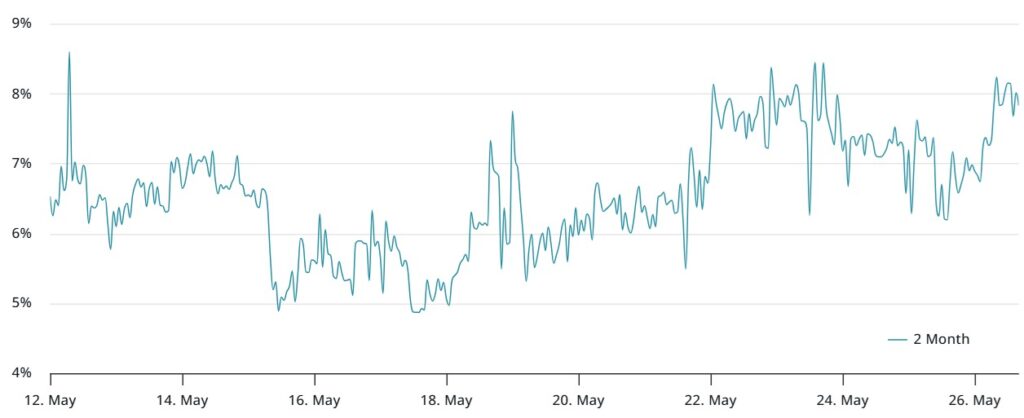
Similarly, the “delta-skew,” which measures the price difference between call and put options, shifted to -6%. This signal indicates that professional investors are generally optimistic about the future price movement.
A Consolidation Phase Before New Records ?
Despite these encouraging signals, the market remains cautious awaiting key economic data. Investors are particularly watching the US inflation report scheduled for May 30 and the Richmond Fed report on May 28. Economic uncertainty, coupled with concerns about US debt and a slowdown in mortgage applications, calls for caution.
However, the fundamentals remain strong, and liquidity continues to grow. Most importantly, the increasing interest from institutional investors shows that Bitcoin is increasingly seen as a sustainable investment rather than just speculative. In this context, a consolidation phase could precede new historical price surges.

