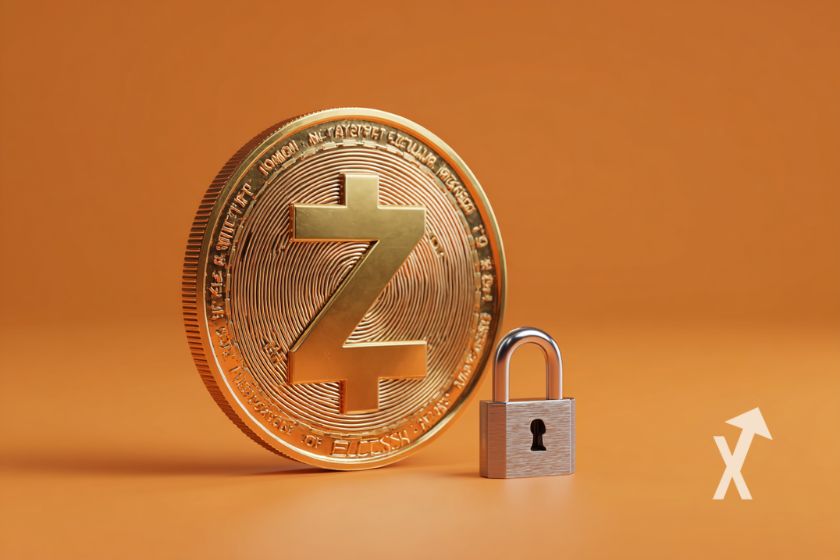
Zcash (ZEC) Crashes 60%: Critical Flaw Uncovered by Claude AI Threatens the Project’s Survival
A critical inflation vulnerability in Zcash, uncovered by Anthropic's Claude AI, sent ZEC crashing 60%. Here's what happened and what it means for privacy coins.
A catastrophic vulnerability at the heart of the Zcash protocol has just been brought to light — and it was an artificial intelligence that found it. The price of ZEC immediately plunged 60%, leaving investors in shock.
Behind this revelation lies a far deeper question: can you still trust a privacy coin whose very confidentiality mechanism was, in reality, concealing a ticking time bomb? The market’s response is unambiguous.
Here is what we know, and what this affair reveals about the structural limits of privacy-focused cryptocurrencies.
A Silent Inflation Exploit: The Nightmare Scenario for Any Cryptocurrency
The vulnerability discovered in the Zcash protocol belongs to the most feared category in the crypto ecosystem: an undetected inflation exploit. In practical terms, it would have allowed an attacker to mint an unlimited quantity of counterfeit ZEC without anyone being able to detect it — at least not without an in-depth audit.
This type of vulnerability is particularly devastating for privacy coins. Unlike Bitcoin, where every transaction is publicly verifiable on the blockchain, Zcash relies on zero-knowledge proofs (zk-SNARKs) to conceal transaction amounts and addresses. That opacity — its core commercial proposition — is precisely what made the flaw undetectable to the naked eye.
The paradox is brutal: the very technology designed to protect user privacy simultaneously protected the existence of this flaw. For an indeterminate period, the integrity of ZEC‘s total supply was simply not guaranteed.
Anthropic’s Claude at the Center of the Discovery: AI as Security Auditor
The most striking element of this story remains the vector through which the flaw was found: Claude, the large language model developed by Anthropic. While the precise technical details of the discovery are still to be confirmed, the involvement of an LLM in identifying such a critical cryptographic security vulnerability marks a turning point for the industry.
Large language models are increasingly being used for smart contract auditing and code analysis. Their ability to scan thousands of lines of code in seconds, identify anomalous patterns, and cross-reference vast technical knowledge bases makes them formidably effective auditing tools — and ones potentially accessible to any actor, including malicious ones.
This duality raises a structural question for the entire sector: if an AI can find this type of flaw, how many other protocols are exposed to similar vulnerabilities that have yet to be discovered? Blockchain security teams will need to integrate AI into their auditing processes — or risk being beaten to the punch.
The Market Delivers a Ruthless Verdict: What Now for Zcash?
The market’s reaction was immediate and violent. A 60% collapse in the ZEC price reflects a near-total loss of investor confidence in the project, at least in the short term. For a privacy coin whose entire value proposition rests on the cryptographic robustness of its protocol, a flaw of this nature is existential.
Technically, ZEC has entered capitulation territory. Historical support levels have been broken, sell-side volume has exploded, and market sentiment is deep in extreme fear. Any sustained recovery would require, at a minimum, transparent communication from the Zcash team on remediation measures, a full independent audit, and a patch deployed and verified on-chain.
Over the longer term, this episode could accelerate consolidation within the privacy coin segment around projects perceived as more robust — with Monero (XMR) leading the pack, as its different architecture could attract capital rotating out of ZEC. For Zcash, rebuilding trust will be a long road, and there is no guarantee the market will give it the time to do so.
Thomas holds a BTS in computer science with a specialization in SEO and is certified in web writing and e-commerce. Passionate about blockchain technology and cryptocurrencies since 2018, he specializes in analyzing crypto market cycles. His journey into GPU mining began in 2019 with ETH before transitioning to KASPA and Alephium (ALPH).
DISCLAIMER
This article is for informational purposes only and should not be considered as investment advice. Some of the partners featured on this site may not be regulated in your country. It is your responsibility to verify the compliance of these services with local regulations before using them.
DISCLAIMER
This article is for informational purposes only and should not be considered as investment advice. Trading cryptocurrencies involves risks, and it is important not to invest more than you can afford to lose.
InvestX is not responsible for the quality of the products or services presented on this page and cannot be held liable, directly or indirectly, for any damage or loss caused by the use of any product or service featured in this article. Investments in crypto assets are inherently risky; readers should conduct their own research before taking any action and invest only within their financial means. This article does not constitute investment advice.
Risk Warning : Trading financial instruments and/or cryptocurrencies carries a high level of risk, including the possibility of losing all or part of your investment. It may not be suitable for all investors. Cryptocurrency prices are highly volatile and can be influenced by external factors such as financial, regulatory, or political events. Margin trading increases financial risks.
CFDs (Contracts for Difference) are complex instruments with a high risk of rapid capital loss due to leverage. Between 74% and 89% of retail investor accounts lose money when trading CFDs. You should assess whether you understand how CFDs work and whether you can afford to take the high risk of losing your money.
Before engaging in financial or cryptocurrency trading, you must be fully informed about the associated risks and fees, carefully evaluate your investment objectives, level of experience, and risk tolerance, and seek professional advice if needed. InvestX.fr and the InvestX application may provide general market commentary, which does not constitute investment advice and should not be interpreted as such. Please consult an independent financial advisor for any investment-related questions. InvestX.fr disclaims any liability for errors, misinvestments, inaccuracies, or omissions and does not guarantee the accuracy or completeness of the information, texts, graphics, links, or other materials provided.
Some of the partners featured on this site may not be regulated in your country. It is your responsibility to verify the compliance of these services with local regulations before using them.
Get 6200 USDT with Bitget ! 🔥
Don't miss out on this offer !
Create your account now to unlock this exclusive reward